Results by title
2 books match the query 'Folk songs, Zulu'
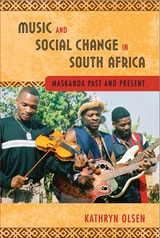
Music and Social Change in South Africa
Maskanda Past and PresentKathryn Olsen
Temple University Press, 2014
Music and Social Change in South Africa looks at contemporary maskanda-a folk musical genre distinguished by fast guitar picking and blues-style vocal intonation-against the backdrop of South Africa's history. A performance practice that emerged in the early decades of the twentieth century among Zulu migrant workers, maskanda is strongly associated with young Zulu men's experiences of repression and dislocation during imperial and, more particularly, apartheid rule.
Working closely with translated song lyrics and musical notation-and applying musical and socio-political analysis to this music and its cultural context-Olsen argues that maskanda offers insight into how the post-apartheid ideal of social transformation is experienced by those who were marginalized for most of the twentieth century.
Drawing on a decade of research, Olsen strives to demystify the Zulu part of contemporary experience in South Africa and to reveal some of the complexities of the social, economic, and political landscape of contemporary South Africa.
[more]
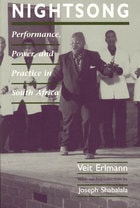
Nightsong
Performance, Power, and Practice in South AfricaVeit Erlmann
University of Chicago Press, 1996
First popularized by Ladysmith Black Mambazo and Paul Simon, the a cappella music known as isicathamiya has become internationally celebrated as one of South Africa's most vibrant and distinct performance traditions. But Ladysmith Black Mambazo is only one of hundreds of choirs that perform "nightsongs" during weekly all-night competitions in South Africa's cities.
Veit Erlmann provides the first comprehensive interpretation of isicathamiya performance practice and its relation to the culture and consciousness of the Zulu migrant laborers who largely compose its choirs. In songs and dances, the performers oppose the class and racial oppression that reduces them to "labor units." At the same time, Erlmann argues, the performers rework dominant images to symbolically reconstruct their "home," an imagined world of Zulu rural tradition and identity.
By contrasting the live performance of isicathamiya to its reproduction in mass media, recordings, and international concerts, Erlmann addresses important issues in performance studies and anthropology, and looks to the future of isicathamiya live performance in the new South Africa. Featuring an Introduction by Joseph Shabalala, the lead singer and founder of Ladysmith Black Mambazo, this book will be essential reading for anyone interested in the study of music, performance, popular culture, or South Africa.
[more]