Results by title
11 books match the query 'Food preferences'
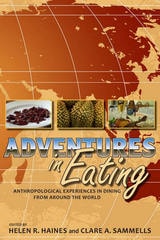
Adventures in Eating
Anthropological Experiences in Dining from Around the WorldHelen R. Haines
University Press of Colorado, 2010
Whether sago grubs, jungle rats, termites, or the pungent durian fruit are on the table, participating in the act of sharing food can establish relationships vital to anthropologists' research practices and knowledge of their host cultures. Using their own experiences with unfamiliar-and sometimes unappealing-food practices and customs, the contributors explore such eating moments and how these moments can produce new understandings of culture and the meaning of food beyond the immediate experience of eating it. They also address how personal eating experiences and culinary dilemmas can shape the data and methodologies of the discipline.
The main readership of Adventures in Eating will be students in anthropology and other scholars, but the explosion of food media gives the book additional appeal for fans of No Reservations and Bizarre Foods on the Travel Channel.

Dethroning the Deceitful Pork Chop
Rethinking African American Foodways from Slavery to ObamaJennifer Jensen Wallach
University of Arkansas Press, 2015
2017 Association for the Study of Food and Society Award, best edited collection.
The fifteen essays collected in Dethroning the Deceitful Pork Chop utilize a wide variety of methodological perspectives to explore African American food expressions from slavery up through the present. The volume offers fresh insights into a growing field beginning to reach maturity. The contributors demonstrate that throughout time black people have used food practices as a means of overtly resisting white oppression—through techniques like poison, theft, deception, and magic—or more subtly as a way of asserting humanity and ingenuity, revealing both cultural continuity and improvisational finesse. Collectively, the authors complicate generalizations that conflate African American food culture with southern-derived soul food and challenge the tenacious hold that stereotypical black cooks like Aunt Jemima and the depersonalized Mammy have on the American imagination. They survey the abundant but still understudied archives of black food history and establish an ongoing research agenda that should animate American food culture scholarship for years to come.
Eating Her Curries and Kway
A Cultural History of Food in SingaporeNicole Tarulevicz
University of Illinois Press, 2013
Discovering Singaporean identity through cooking and cuisine
While eating is a universal experience, for Singaporeans it carries strong national connotations. The popular Singaporean-English phrase "Die die must try" is not so much hyperbole as it is a reflection of the lengths that Singaporeans will go to find great dishes.
In Eating Her Curries and Kway: A Cultural History of Food in Singapore, Nicole Tarulevicz argues that in a society that has undergone substantial change in a relatively short amount of time, food serves Singaporeans as a poignant connection to the past. Eating has provided a unifying practice for a diverse society, a metaphor for multiracialism and recognizable national symbols for a fledgling state. Covering the period from British settlement in 1819 to the present and focusing on the post–1965 postcolonial era, Tarulevicz tells the story of Singapore through the production and consumption of food.
Analyzing a variety of sources that range from cookbooks to architectural and city plans, Tarulevicz offer a thematic history of this unusual country, which was colonized by the British and operated as a port within Malaya. Connecting food culture to the larger history of Singapore, she discusses various topics including domesticity and home economics, housing and architecture, advertising, and the regulation of food-related manners and public behavior such as hawking, littering, and chewing gum. Moving away from the predominantly political and economic focus of other histories of Singapore, Eating Her Curries and Kway provides an important alternative reading of Singaporean society.
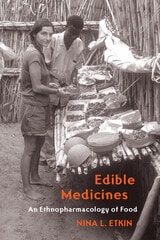
Edible Medicines
An Ethnopharmacology of FoodNina L. Etkin
University of Arizona Press, 2006
This book investigates the health implications of foods from the cuisines of peoples around the world to describe the place of food in health maintenance. In this wide-ranging book, Nina Etkin reveals the pharmacologic potential of foods in the specific cultural contexts in which they are used. Incorporating co-evolution with a biocultural perspective, she addresses some of the physiological effects of foods across cultures and through history while taking into account both the complex dynamics of food choice and the blurred distinctions between food and medicine. Showing that food choice is more closely linked to health than is commonly thought, she helps us to understand the health implications of people’s food-centered actions in the context of real-life circumstances.
Drawing on an extensive literature that transects food and culture, the history of medicine, ethnopharmacology, food history, nutrition, and human evolution, Edible Medicines demonstrates the intricate relationship between culture and nature. It will appeal to a wide range of scholars and professionals, from anthropologists to nutritionists, as well as general readers seeking a greater understanding of the medicinal aspects of food.
Fear of Food
A History of Why We Worry about What We EatHarvey Levenstein
University of Chicago Press, 2012
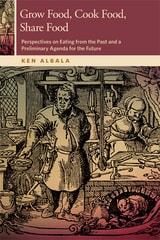
Grow Food, Cook Food, Share Food
Perspectives on Eating from the Past and a Preliminary Agenda for the FutureKen Albala
Oregon State University Press, 2013
Albala considers what the traditions we have needlessly lost have to offer us today: a serious appreciation for the generative power of the earth, the great pleasures of cooking food, and the joy of sharing food with family, friends, and even strangers. In Albala’s compelling book, obscure seventeenth-century Italian farmer-nobles, Roman statesmen, and quirky cheesemakers from the fifteenth and sixteenth centuries all offer lessons about our relationship with the food we eat.
A rare form of historical activism, Grow Food, Cook Food, Share Food is written for anyone who likes to eat, loves to cook, and knows how to throw a great dinner party.
An OSU Press Horning Visiting Scholars Publication.

Inside Ancient Kitchens
New Directions in the Study of Daily Meals and FeastsElizabeth A. Klarich
University Press of Colorado, 2010
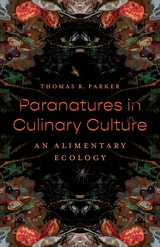
Paranatures in Culinary Culture
An Alimentary EcologyThomas R. Parker
University of Minnesota Press, 2025
Uncovering the intricate cultural threads that inform our dietary practices
Paranatures in Culinary Culture embarks on a gastronomic odyssey, redefining foods we thought we knew and revealing the extraordinary stories of ordinary ingredients and the cultural forces shaping our diets. The book begins with a simple premise: to eat is to assimilate the outer world into the inner body, both physically and mentally. But what happens when this assimilation process goes awry? Thomas R. Parker reveals how culinary staples are not only elements of identity formation but also instruments of cultural disruption when their true nature emerges and challenges our preconceptions.
Parker explores how certain foods—bread, oysters, pigs, cheese, and wine—can both create and destabilize narratives, unsettle assimilation, and decenter Western culinary traditions. Taking inspiration from architectural historian David Gissen’s concept of “subnature” and Michel Serres’s idea of the “parasite,” Parker develops the concept of paranatures: flavors, foods, and practices considered unpalatable by different societies at different times. He reveals how certain ordinary foods live parallel paranatural lives, addressing larger issues of colonial and postcolonial food theory and challenging long-held notions that cuisine was meant to uphold.
Serving up a rich blend of history, culture, and gastronomy, Parker leads readers to perceive food as an adventure, inviting them to taste the untamed side of nature. He offers a thought-provoking invitation to reconceptualize the roles and narratives we assign to the natural world and its produce, allowing us to see food, nature, and ourselves in new ways.
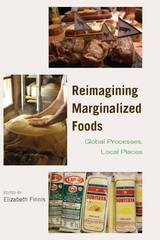
Reimagining Marginalized Foods
Global Processes, Local PlacesEdited by Elizabeth Finnis
University of Arizona Press, 2012
With globalization has come an increased focus on food—where it comes from, how it is transported, who eats it, and what cultural significance it has. This volume brings together ethnographically based anthropological analyses of shifting meanings and representations associated with the foods, ingredients, and cooking practices of marginalized and/or indigenous cultures. Contributors are particularly interested in how these foods intersect with politics, nationhood and governance, identity, authenticity, and conservation.
The chapters cover diverse locales, issues, and foods: the cultural meanings of sinonggi, a thick sago porridge from Sulawesi, Indonesia; the significance of pom, a Surinam dish popular in the Netherlands; the transformation of alpaca meat in Peru; the impact of culinary tourism on indigenous cuisine in Mexico; the re-presenting of minor millets in South India; and the development of cheeses in the Italian Alps. A conceptual essay on food and social boundaries rounds out the collection.
Throughout, the contributors address important questions, including: How are traditional foods “repackaged” in the process of mainstreaming access? What does this repackaging mean for the ways local or indigenous peoples view their traditional food practices? How are local cuisines mobilized in movements to create national images and identities? What tensions emerge between new representations of foods and local cultural meanings?
Together the contributors provide a thoughtful inquiry into what happens when food and culinary practices are moved from the cultural or physical margins, and how such movements can be shaped by—and employed in the pursuit of—political, social, and cultural goals.

Stirring the Pot
A History of African CuisineJames C. McCann
Ohio University Press, 2009
Africa’s art of cooking is a key part of its history. All too often Africa is associated with famine, but in Stirring the Pot, James C. McCann describes how the ingredients, the practices, and the varied tastes of African cuisine comprise a body of historically gendered knowledge practiced and perfected in households across diverse human and ecological landscape. McCann reveals how tastes and culinary practices are integral to the understanding of history and more generally to the new literature on food as social history.
Stirring the Pot offers a chronology of African cuisine beginning in the sixteenth century and continuing from Africa’s original edible endowments to its globalization. McCann traces cooks’ use of new crops, spices, and tastes, including New World imports like maize, hot peppers, cassava, potatoes, tomatoes, and peanuts, as well as plantain, sugarcane, spices, Asian rice, and other ingredients from the Indian Ocean world. He analyzes recipes, not as fixed ahistorical documents,but as lively and living records of historical change in women’s knowledge and farmers’ experiments. A final chapter describes in sensuous detail the direct connections of African cooking to New Orleans jambalaya, Cuban rice and beans, and the cooking of African Americans’ “soul food.”
Stirring the Pot breaks new ground and makes clear the relationship between food and the culture, history, and national identity of Africans.

The Neoliberal Diet
Healthy Profits, Unhealthy PeopleBy Gerardo Otero
University of Texas Press, 2018
Why are people getting fatter in the United States and beyond? Mainstream explanations argue that people simply eat too much “energy-dense” food while exercising too little. By swapping the chips and sodas for fruits and vegetables and exercising more, the problem would be solved. By contrast, The Neoliberal Diet argues that increased obesity does not result merely from individual food and lifestyle choices. Since the 1980s, the neoliberal turn in policy and practice has promoted trade liberalization and retrenchment of the welfare regime, along with continued agricultural subsidies in rich countries. Neoliberal regulation has enabled agribusiness multinationals to thrive by selling highly processed foods loaded with refined flour and sugars—a diet that originated in the United States—as well as meat. Drawing on extensive empirical data, Gerardo Otero identifies the socioeconomic and political forces that created this diet, which has been exported around the globe, often at the expense of people’s health.
Otero shows how state-level actions, particularly subsidies for big farms and agribusiness, have ensured the dominance of processed foods and made healthful fresh foods inaccessible to many. Comparing agrifood performance across several nations, including the NAFTA region, and correlating food access to class inequality, he convincingly demonstrates the structural character of food production and the effect of inequality on individual food choices. Resolving the global obesity crisis, Otero concludes, lies not in blaming individuals but in creating state-level programs to reduce inequality and make healthier food accessible to all.