Results by title
13 books match the query 'Foreign workers, Mexican'
American Labor in the Southwest
The First One Hundred YearsEdited by James C. Foster
University of Arizona Press, 1982
The Western Federation of Miners
James C. Foster, D. H. Dinwoodie
The Industrial Workers of the World
Earl Bruce White, James Byrkit
The Rise of Unionized Farm Workers
H. L. Mitchell, Edward D. Beechert, Art Carstens
Mexican Labor, North and South of the Border
John M. Hart, Rodney Anderson, David Maciel
Labor and Politics
Paul Mandel, George N. Green, Charles O. Rice
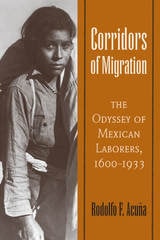
Corridors of Migration
The Odyssey of Mexican Laborers, 1600-1933Rodolfo F. Acuña
University of Arizona Press, 2007
In the San Joaquin Valley Cotton Strike of 1933, frenzied cotton farmers murdered three strikers, intentionally starved at least nine infants, wounded dozens of people, and arrested more. While the story of this incident has been recounted from the perspective of both the farmers and, more recently, the Mexican workers, this is the first book to trace the origins of the Mexican workers’ activism through their common experience of migrating to the United States.
Rodolfo F. Acuña documents the history of Mexican workers and their families from seventeenth-century Chihuahua to twentieth-century California, following their patterns of migration and describing the establishment of communities in mining and agricultural regions. He shows the combined influences of racism, transborder dynamics, and events such as the industrialization of the Southwest, the Mexican Revolution, and World War I in shaping the collective experience of these people as they helped to form the economic, political, and social landscapes of the American Southwest in their interactions with agribusiness and absentee copper barons.
Acuña follows the steps of one of the murdered strikers, Pedro Subia, reconstructing the times and places in which his wave of migrants lived. By balancing the social and geographic trends in the Mexican population with the story of individual protest participants, Acuña shows how the strikes were in fact driven by choices beyond the Mexican workers’ control. Their struggle to form communities graphically retells how these workers were continuously uprooted and their organizations destroyed by capital. Corridors of Migration thus documents twentieth-century Mexican American labor activism from its earliest roots through the mines of Arizona and the Great San Joaquin Valley cotton strike.
From a founding scholar of Chicano studies and the author of fifteen books comes the culmination of three decades of dedicated research into the causes and effects of migration and labor activism. The narrative documents how Mexican workers formed communities against all odds.
Crossing the Border
Research from the Mexican Migration ProjectJorge Durand
Russell Sage Foundation, 2004
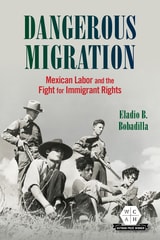
Dangerous Migration
Mexican Labor and the Fight for Immigrant RightsEladio B. Bobadilla
University of Illinois Press, 2026
Beginning with Mexican American opposition to the Bracero Program, Eladio Bobadilla traces the movement’s fault lines that formed around the issue of undocumented workers. Bobadilla reveals how internationalist and human rights discourse influenced the rise of the Chicano movement and its defense of Mexican undocumented immigrants. As time passed, anti-Mexican social, political, and legislative forces produced a nativist backlash that put immigration at the center of the United States’ culture wars and created the fantasy of undocumented workers as an existential threat.
Engaging and vivid, Dangerous Migration illuminates the history of debates over Mexican labor, the emergence of the immigrant rights activism, and the nativist movements that united Latinos with right-wing white Americans.
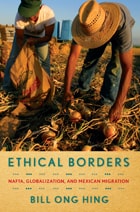
Ethical Borders
NAFTA, Globalization, and Mexican MigrationAuthored by Bill Ong Hing
Temple University Press, 2010
In his topical new book, Ethical Borders, Bill Ong Hing asks, why do undocumented immigrants from Mexico continue to enter the United States and, what would discourage this surreptitious traffic? An expert on immigration law and policy, Hing examines the relationship between NAFTA, globalization, and undocumented migration, and he considers the policy options for controlling immigration. He develops an ethical rationale for opening up the U.S./Mexican border, as well as improving conditions in Mexico so that its citizens would have little incentive to migrate.
In Ethical Borders Hing insists that reforming NAFTA is vital to ameliorating much of the poverty that drives undocumented immigration and he points to the European Union's immigration and economic development policies as a model for North America. Hing considers the world-wide economic crisis and the social problems that attend labor migration into homogenous countries, arguing for a spectrum of changes, including stricter border enforcement and more effective barriers; a path to citizenship for undocumented migrants; or a guest worker program.
Hing also situates NAFTA and its effects in the larger, and rapidly shifting, context of globalization—particularly the recent rise of China as the world's economic giant. Showing how NAFTA’s unforeseen consequences have been detrimental to Mexico, Hing passionately argues that the United States is ethically bound to address the problems in a way that puts prosperity within the grasp of all North Americans.
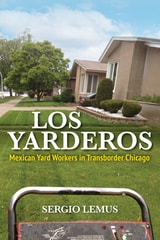
Los Yarderos
Mexican Yard Workers in Transborder ChicagoSergio Lemus
University of Illinois Press, 2025
Sergio Lemus explores the lives of these migrants and looks at the struggles they face as they work to make the city their home. Drawing on fieldwork in South Chicago, Lemus tells the stories of first and second-generation yarderos and discusses the historical, economic, cultural, and political ramifications they face as they acquire their working-class identity. Lemus’s compassionate portrait places them within America’s ongoing tradition as a nation of immigrants while analyzing their place within today’s transborder cultural moment.
Perceptive and humane, Los Yarderos reveals how a group of Mexican immigrants navigates the crossings of the borders that divide class, color hierarchies, gender, and belonging.

Martín Ramírez
Framing His Life and ArtBy Víctor M. Espinosa
University of Texas Press, 2015
Martín Ramírez, a Mexican migrant worker and psychiatric patient without formal artistic training, has been hailed by leading New York art critics as one of the twentieth century’s greatest artists. His work has been exhibited alongside masters such as José Clemente Orozco, Diego Rivera, Rufino Tamayo, Salvador Dalí, Marc Chagall, Paul Klee, and Joan Miró. A landmark exhibition of Ramírez’s work at the American Folk Art Museum in 2007 broke attendance records and garnered praise from major media, including the New York Times, New Yorker, and Village Voice.
Martín Ramírez offers the first sustained look at the life and critical reception of this acclaimed artist. Víctor Espinosa challenges the stereotype of outsider art as an indecipherable enigma by delving into Ramírez’s biography and showing how he transformed memories of his life in Mexico, as well as his experiences of displacement and seclusion in the United States, into powerful works of art. Espinosa then traces the reception of Ramírez’s work, from its first anonymous showings in the 1950s to contemporary exhibitions and individual works that have sold for as much as a half-million dollars. This eloquently told story reveals how Ramírez’s three-decades-long incarceration in California psychiatric institutions and his classification as “chronic paranoid schizophrenic” stigmatized yet also protected what his hands produced. Stripping off the labels “psychotic artist” and “outsider master,” Martín Ramírez demonstrates that his drawings are not passive manifestations of mental illness. Although he drew while confined as a psychiatric patient, the formal elements and content of Ramírez’s artwork are shaped by his experiences of cultural and physical displacement.
Mexican Immigration to the United States
Edited by George J. Borjas
University of Chicago Press, 2007
From debates on Capitol Hill to the popular media, Mexican immigrants are the subject of widespread controversy. By 2003, their growing numbers accounted for 28.3 percent of all foreign-born inhabitants of the United States. Mexican Immigration to the United States analyzes the astonishing economic impact of this historically unprecedented exodus. Why do Mexican immigrants gain citizenship and employment at a slower rate than non-Mexicans? Does their migration to the U.S. adversely affect the working conditions of lower-skilled workers already residing there? And how rapid is the intergenerational mobility among Mexican immigrant families?
This authoritative volume provides a historical context for Mexican immigration to the U.S. and reports new findings on an immigrant influx whose size and character will force us to rethink economic policy for decades to come. Mexican Immigration to the United States will be necessary reading for anyone concerned about social conditions and economic opportunities in both countries.
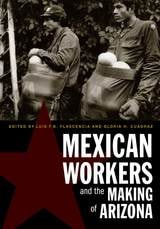
Mexican Workers and the Making of Arizona
Edited by Luis F. B. Plascencia and Gloria H. Cuádraz
University of Arizona Press, 2018
Mexican Workers and the Making of Arizona centers on the production of an elastic supply of labor, revealing how this long-standing approach to the building of Arizona has obscured important power relations, including the state’s favorable treatment of corporations vis-à-vis workers. Building on recent scholarship about Chicanas/os and others, the volume insightfully describes how U.S. industries such as railroads, mining, and agriculture have fostered the recruitment of Mexican labor, thus ensuring the presence of a surplus labor pool that expands and contracts to accommodate production and profit goals.
The volume’s contributors delve into examples of migration and settlement in the Salt River Valley; the mobilization and immobilization of cotton workers in the 1920s; miners and their challenge to a dual-wage system in Miami, Arizona; Mexican American women workers in midcentury Phoenix; the 1980s Morenci copper miners’ strike and Chicana mobilization; Arizona’s industrial and agribusiness demands for Mexican contract labor; and the labor rights violations of construction workers today.
Mexican Workers and the Making of Arizona fills an important gap in our understanding of Mexicans and Mexican Americans in the Southwest by turning the scholarly gaze to Arizona, which has had a long-standing impact on national policy and politics.
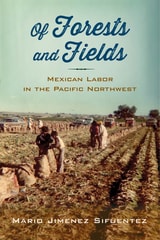
Of Forests and Fields
Mexican Labor in the Pacific NorthwestMario Jimenez Sifuentez
Rutgers University Press, 2016
Just looking at the Pacific Northwest’s many verdant forests and fields, it may be hard to imagine the intense work it took to transform the region into the agricultural powerhouse it is today. Much of this labor was provided by Mexican guest workers, Tejano migrants, and undocumented immigrants, who converged on the region beginning in the mid-1940s. Of Forests and Fields tells the story of these workers, who toiled in the fields, canneries, packing sheds, and forests, turning the Pacific Northwest into one of the most productive agricultural regions in the country.

The Duplex Nature of Indigeneity
Navigating Identity in the Ahuehuepan DiasporaFrans J. Schryer
University Press of Colorado, 2025
Using a variety of sources, perspectives, and methods, Schryer takes a duplexity approach, which allows understanding the complexity of social reality and its complementary nature—it identifies fields, clusters, and layers as interconnected components of social life. The innovative methods consist of the combination of ethnographic description and an ethnohistorical census that provides information on every person going back to approximately 1850. That census is further examined with the use of inferential and non-inferential statistical techniques, archival research in locations not normally accessible to scholars, Facebook, phone interviews conducted over several years, and help from Nahuatl-speaking people whose perspectives on the findings generate additional information and insights.
Unique in this presentation, which dips into the lives of generations of people to draw insight on those who lay claim to transnational Indigeneity, Schryer’s work contributes to research and theoretical discussion in the field of migration and globalization studies through a close examination of one Indigenous community over the course of many years, utilizing a mix of qualitative and quantitative research methods in anthropology.
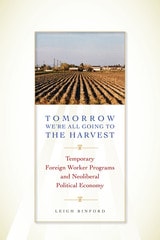
Tomorrow We're All Going to the Harvest
Temporary Foreign Worker Programs and Neoliberal Political EconomyBy Leigh Binford
University of Texas Press, 2013
From its inception in 1966, the Canadian Seasonal Agricultural Worker Program (SAWP) has grown to employ approximately 20,000 workers annually, the majority from Mexico. The program has been hailed as a model that alleviates human rights concerns because, under contract, SAWP workers travel legally, receive health benefits, contribute to pensions, are represented by Canadian consular officials, and rate the program favorably. Tomorrow We’re All Going to the Harvest takes us behind the ideology and examines the daily lives of SAWP workers from Tlaxcala, Mexico (one of the leading sending states), observing the great personal and family price paid in order to experience a temporary rise in a standard of living. The book also observes the disparities of a gutted Mexican countryside versus the flourishing agriculture in Canada, where farm labor demand remains high.
Drawn from extensive surveys and nearly two hundred interviews, ethnographic work in Ontario (destination of over 77 percent of migrants in the author’s sample), and quantitative data, this is much more than a case study; it situates the Tlaxcala-Canada exchange within the broader issues of migration, economics, and cultural currents. Bringing to light the historical genesis of “complementary” labor markets and the contradictory positioning of Mexican government representatives, Leigh Binford also explores the language barriers and nonexistent worker networks in Canada, as well as the physical realities of the work itself, making this book a complete portrait of a provocative segment of migrant labor.
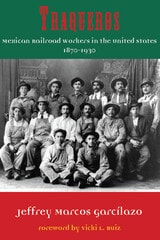
Traqueros
Mexican Railroad Workers in the United States, 1870-1930Jeffrey Marcos Garcilazo
University of North Texas Press, 2012