Results by title
9 books match the query 'Forensic Science'

Accusatory Practices
Denunciation in Modern European History, 1789-1989Edited by Sheila Fitzpatrick and Robert Gellately
University of Chicago Press, 1997
"This is a fascinating and highly original exploration of a familiar, though poorly understood, phenomenon of modern societies in general and totalitarian systems in particular. From the French Revolution to the NKVD, Gestapo, and Stasi, denunciation is analyzed both as a function of political surveillance and as deeply rooted in the social practices of community and the workplace. The book represents a refreshing amalgam of deeply archival research and theoretical rigor."—Norman M. Naimark, Stanford University

Central Sites, Peripheral Visions
Cultural and Institutional Crossings in the History of AnthropologyEdited by Richard Handler
University of Wisconsin Press, 2006
The terms "center" and "periphery" are particularly relevant to anthropologists, since traditionally they look outward from institutional "centers"-universities, museums, government bureaus-to learn about people on the "peripheries." Yet anthropology itself, as compared with economics, politics, or history, occupies a space somewhat on the margins of academe. Still, anthropologists, who control esoteric knowledge about the vast range of human variation, often find themselves in a theoretically central position, able to critique the "universal" truths promoted by other disciplines.
Central Sites, Peripheral Visions presents five case studies that explore the dilemmas, moral as well as political, that emerge out of this unique position. From David Koester's analysis of how ethnographic descriptions of Iceland marginalized that country's population, to Kath Weston's account of an offshore penal colony where officials mixed prison work with ethnographic pursuits; from Brad Evans's reflections on the "bohemianism" of both the Harlem vogue and American anthropology, to Arthur J. Ray's study of anthropologists who serve as expert witnesses in legal cases, the essays in the eleventh volume of the History of Anthropology Series reflect on anthropology's always problematic status as centrally peripheral, or peripherally central.
Finally, George W. Stocking, Jr., in a contribution that is almost a book in its own right, traces the professional trajectory of American anthropologist Robert Gelston Armstrong, who was unceremoniously expelled from his place of privilege because of his communist sympathies in the 1950s. By taking up Armstrong's unfinished business decades later, Stocking engages in an extended meditation on the relationship between center and periphery and offers "a kind of posthumous reparation," a page in the history of the discipline for a distant colleague who might otherwise have remained in the footnotes.
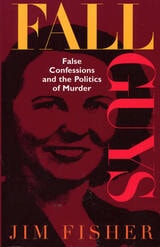
Fall Guys
False Confessions and the Politics of MurderJim Fisher
Southern Illinois University Press, 1996
Jim Fisher, criminal justice professor and former FBI agent, reveals how he uncovered the framing of two boys in a pair of unrelated murders committed in 1956 and 1958.
In the first of the cases, eleven-year-old Charlie Zubryd confessed that at the age of eight, he had murdered his widowed mother by driving a hatchet into her skull. The crime was committed in the basement of the modest Zubryd home in a rural section of Sewickley Township in western Pennsylvania, an area not far from Pittsburgh. Following intense police questioning, young Zubryd confessed to the crime in March 1959, a full twenty-eight months after the bloody murder of his mother.
Too young to prosecute, Charlie Zubryd was adopted after his confession and a brief stay in a mental ward. A childless couple gave Zubryd a new name and identity. It would be twenty years before Charlie Zubryd—now going by the name Chuck Duffy—would have any contact with his biological family.
When Zubryd/Duffy made an effort to get his real family back, he was rejected because his relatives still believed he had murdered his mother. In fact, until Fisher began to investigate the case in 1989, Chuck Duffy himself was not sure he had not killed his mother during some kind of mental blackout.
The second murder occurred in 1958, two years after the Zubryd case. Thirteen-year-old Jerry Pacek endured forty-one hours of police grilling before he confessed to raping and killing fifty-year-old Lillian Steveck as she walked home one evening from a bus stop in Breckenridge, Pennsylvania. Pacek told the same Allegheny County homicide detective who had framed Charlie Zubryd that he had killed the woman with a variety of blunt objects, none of which were ever found. The thirteen-year-old boy was tried and convicted of the murder the following spring. He was sent to Camp Hill Prison, where he remained incarcerated for ten years.
Fisher’s investigation cleared the names of both the wrongfully accused boys. Because of his investigation, the Zubryd case was reopened, which led to the identification of a vicious killer. In 1991, Fisher’s investigative efforts convinced the governor of Pennsylvania to grant a full pardon to Jerry Pacek, who as a teenager had served ten years in an adult prison for a murder he had not committed.
Jim Fisher and the Zubryd and Pacek stories have been featured on a number of nationally broadcast television programs.
Forensic Epidemiology
A Comprehensive Guide for Legal and Epidemiology ProfessionalsSana Loue
Southern Illinois University Press, 1999
Sana Loue explores the concepts of legal and epidemiological causation, the use of epidemiological data based on populations to determine causation in an individual case, and the use of epidemiological evidence in litigation, including the reliance on experts and expert witnesses.
Loue provides a guide for the attorney with little or no background in epidemiological theory and for the epidemiologist contemplating a new role as an expert witness. She assumes of her readers a working knowledge of the Federal Rules of Civil Procedure and the Federal Rules of Evidence.
Discussing the epidemiologist as expert witness, Loue covers the nature of that testimony, the purpose of the testimony, and the qualifications necessary to be regarded as an expert witness. She examines various legal theories of causation, primarily in the context of product liability and toxic tort, and addresses epidemiological principles and methods used in the process of causal inference.
Loue also focuses on legal mechanisms used to assess causation. Her concern here is with depositions and testimony and the preparation of epidemiology experts. She concludes her study by comparing the legal and epidemiological concepts of causation, using actual legal cases as examples.
Throughout the text, Loue incorporates excerpts from depositions, interrogatories, and trial testimony to provide concrete examples. She also sets up an appendix to provide nonattorney readers with an overview of the legal system. Ultimately, her goal is to foster a greater understanding between law and epidemiology.
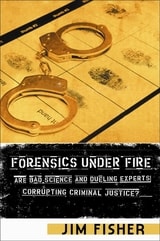
Forensics Under Fire
Are Bad Science and Dueling Experts Corrupting Criminal Justice?Jim Fisher
Rutgers University Press, 2008
Television shows like CSI, Forensic Files, and The New Detectives make it look so easy. A crime-scene photographer snaps photographs, a fingerprint technician examines a gun, uniformed officers seal off a house while detectives gather hair and blood samples, placing them carefully into separate evidence containers. In a crime laboratory, a suspect's hands are meticulously examined for gunshot residue. An autopsy is performed in order to determine range and angle of the gunshot and time-of-death evidence. Dozens of tests and analyses are performed and cross-referenced. A conviction is made. Another crime is solved. The credits roll.
The American public has become captivated by success stories like this one with their satisfyingly definitive conclusions, all made possible because of the wonders of forensic science. Unfortunately, however, popular television dramas do not represent the way most homicide cases in the United States are actually handled. Crime scenes are not always protected from contamination; physical evidence is often packaged improperly, lost, or left unaccounted for; forensic experts are not always consulted; and mistakes and omissions on the autopsy table frequently cut investigations short or send detectives down the wrong investigative path.
In Forensics Under Fire, Jim Fisher makes a compelling case that these and other problems in the practice of forensic science allow offenders to escape justice and can also lead to the imprisonment of innocent people. Bringing together examples from a host of high-profile criminal cases and familiar figures, such as the JonBenet Ramsey case and Dr. Henry Lee who presented physical evidence in the O. J. Simpson trial, along with many lesser known but fascinating stories, Fisher presents daunting evidence that forensic science has a long way to go before it lives up to its potential and the public's expectations.
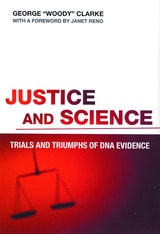
Justice and Science
Trials and Triumphs of DNA EvidenceGeorge "Woody" Clarke
Rutgers University Press, 2007
Databases of both convicted offenders and no-suspect cases demonstrate the power of DNA testing to solve the unsolvable. George “Woody” Clarke is a leading authority in legal circles and among the news media because of his expertise in DNA evidence. In this memoir, Clarke chronicles his experiences in some of the most disturbing and notorious sexual assault and murder court cases in California. He charts the beginnings of DNA testing in police investigations and the fight for its acceptance by courts and juries. He illustrates the power of science in cases he personally prosecuted or in which he assisted, including his work with the prosecution team in the trial of O. J. Simpson.
Clarke also covers cases where DNA evidence was used to exonerate. He directed a special project in San Diego County, proactively examining over six hundred cases of defendants convicted and sentenced to prison before 1993, with the goal of finding instances in which DNA typing might add new evidence and then offered testing to those inmates.
As Clarke tells the story of how he came to understand and use this new form of evidence, readers will develop a new appreciation for the role of science in the legal system.
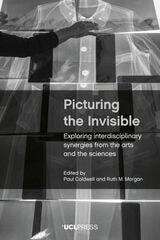
Picturing the Invisible
Exploring Interdisciplinary Synergies from the Arts and the SciencesEdited by Paul Coldwell and Ruth M. Morgan
University College London, 2022
Picturing the Invisible presents different disciplinary approaches to articulating the invisible, that which is not known or not provable. The challenge is how to articulate these concepts, not only to those within a particular academic field but beyond, to other disciplines and society at large. As our understanding of the complexity of the world grows incrementally, so does our realization that issues and problems can rarely be resolved within neat demarcations. Therefore, the authors argue, the importance of finding means of communicating across disciplines and fields must become a priority. This book brings together insights from leading academics from a wide range of disciplines, including art and design, curatorial practice, literature, forensic science, medical science, psychoanalysis and psychotherapy, philosophy, astrophysics, and architecture, who share an interest in exploring how in each discipline we strive to find expression for the invisible or unknown and to draw out and articulate some of the explicit and tacit ways of communicating those concepts that transcend traditional disciplinary boundaries.
Speaking of Crime
The Language of Criminal JusticeLawrence M. Solan, Peter M. Tiersma, and Tammy Gales
University of Chicago Press, 2025
An essential introduction to the use and misuse of language within the criminal justice system, updated for a new generation.
Does everyone understand the Miranda warning? Why do people confess to a crime they did not commit? Can linguistic experts identify who wrote an anonymous threatening letter? Since its first publication, Speaking of Crime has been answering these questions. Introducing major topics and controversies at the intersection of language and law, Lawrence M. Solan, Peter M. Tiersma, and Tammy Gales apply multidisciplinary insights to examine the complex role of language within the US justice system.
The second edition features in-depth discussions of recent cases, new legislation, and innovative research advances, and includes a new chapter on who interprets the laws governing linguistic contexts. Thoroughly updated and approachable, Speaking of Crime is a state-of-the-art survey that will be useful to scholars, students, and practitioners throughout the criminal justice system.
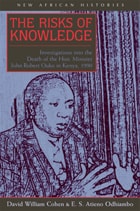
The Risks of Knowledge
Investigations into the Death of the Hon. Minister John Robert Ouko in Kenya, 1990David William Cohen
Ohio University Press, 2004
In February 1990 assailants murdered Kenya’s distinguished Minister of Foreign Affairs and International Cooperation, Robert Ouko. The horror of the attack, the images of his mutilated and burned corpse, the evidence of a notorious cover-up, and the revelations of the pressures, conflicts, and fears he faced in his last weeks have engaged Kenya’s publics for years. The Risks of Knowledge minutely examines the multiple and unfinished investigations into the crime.
Among the probes was an extensive 1990 inquiry organized by a New Scotland Yard team invited to Kenya by the government, as well as an open public commission of inquiry appointed by President Daniel arap Moi. The commission ran for seventeen months in 1990-91 before the president shut it down. International and Kenyan unrest over Ouko’s brutal death brought increasing attention to corruption and violence associated with the Moi government, leading in late 1991 to multiparty politics and in December 2002 to the elections that ended the Moi era.
This powerfully argued book raises important issues about the production of knowledge and the politics of memory that will interest a large interdisciplinary audience.