Results by title
29 books match the query 'Forest ecology'
A Garden Of Bristlecones
Tales Of Change In The Great BasinMichael P. Cohen
University of Nevada Press, 1998
An engaging, well-illustrated natural and cultural history of the oldest living organism—the bristlecone pine. Since Edmund Schulman discovered in 1958 that individual bristlecones live nearly 5,000 years, the trees have been investigated primarily for the elaborate record their rings contain. The trees have been "read' closely, with major consequences for natural and human history. Historians have read local and global environmental change. Archaeologists have rewritten the history of civilization. Writers have transformed them into figures pertinent to the human dilemmas of time and eternity. A Garden of Bristlecones investigates professional and popular conceptions as a set of narratives drawn from the outside and inside of the trees. It reveals the premises of the investigators, the nature of their inquiry, and the extent of their knowledge, while also revealing the Great Basin bristlecone itself. Illustrations by Valerie Cohen.
A Place for Inquiry, A Place for Wonder
The Andrews ForestWilliam Robbins
Oregon State University Press, 2020
In A Place for Inquiry, A Place for Wonder, historian William Robbins turns his attention to the long-overlooked Andrews Forest and argues for its importance to environmental science and policy. From its founding in 1948, the experimental forest has been the site of wide-ranging research. Beginning with postwar studies on the conversion of old-growth timber to fast-growing young stands, research at the Andrews shifted in the next few decades to long-term ecosystem investigations that focus on climate, streamflow, water quality, vegetation succession, biogeochemical cycling, and effects of forest management. The Andrews has thus been at the center of a dramatic shift in federal timber practices from industrial, intensive forest management policies to strategies emphasizing biodiversity and healthy ecosystems.
Colorado Trail in Crisis
A Naturalist’s Field Report on Climate Change in Mountain EcosystemsKarl Ford
University Press of Colorado, 2024
Using his hike along the popular five-hundred-mile Colorado Trail to present his personal observations about more than a hundred miles of dead and dying forest, Karl Ford presents a brief environmental history of these areas of the state, weaving in scientific studies about forest mortality caused by insect infestations, wildfire, drought, and loss of snowpack, and describes the poor current prospects for reforestation as the climate continues to warm. His own Lakota ancestry, as well as historical references to local Tabeguache Ute Chief Ouray and displaced Ute populations, meaningfully frames important conversations about caretaking and connection to place. Ford also proposes potential solutions to drought and forest mortality problems, as well as varying approaches and limitations to mitigation efforts.
The Colorado Trail in Crisis appeals to hikers and nature lovers seeking to learn about the natural history, beauty, and serenity of the Colorado Trail, as well as students, conservationists, and scientists researching climate change effects on Colorado mountain ecosystems.
Conifers of the New England–Acadian Forest
A Cultural HistorySteve Keating
University of Massachusetts Press, 2024
Why did white pine help spark the American Revolution? How did balsam aid the development of germ theory? What does hemlock have to do with making leather? In Conifers of the New England–Acadian Forest, microbiologist Steve Keating explores how conifers influenced the course of human history, writing in a style that is both scientific and accessible.
Keating’s study focuses on one of the most forested and wild ecoregions in North America, which extends into New York, New England, and Canada and includes Acadia National Park. Here, spruces, firs, and cedars of the northern boreal forest mix with hemlocks and pines of more temperate climates. This combination helps create the appearance, aroma, and ecology of the region, and the trees’ unique botanical traits have been ingeniously utilized by numerous peoples including the Iroquois, French explorers, beer brewers, and shipbuilders. Keating concludes with identification guides for the conifers and where they can be found in Acadia National Park.
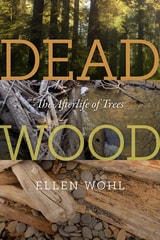
Dead Wood
The Afterlife of TreesEllen Wohl
Oregon State University Press, 2022
Ellen Wohl has thought about these questions, and In Dead Wood, she takes us through the afterlife of trees, describing the importance of standing and downed dead wood in forests, in rivers, along beaches, in the open ocean, and even at the deepest parts of the seafloor. Downed wood in the forest provides habitat for diverse plants and animals, and the progressive decay of the wood releases nutrients into the soil. Wood in rivers provides critical habitat for stream insects and fish and can accumulate in logjams that divert the river repeatedly across the valley floor, creating a floodplain mosaic that is rich in habitat and biodiversity. Driftwood on the beach helps to stabilize shifting sand, creating habitat for plants and invertebrates. Fish such as tuna congregate at driftwood in the open ocean. As driftwood becomes saturated and sinks to the ocean floor, collections of sunken wood provide habitat and nutrients for deep-sea organisms. Far from being an unsightly form of waste that needs to be cleaned from forests, beaches, and harbors, dead wood is a critical resource for many forms of life.
Dead Wood follows the afterlives of three trees: a spruce in the Colorado Rocky Mountains that remains on the floodplain after death; a redcedar in Washington that is gradually transported downstream to the Pacific; and a poplar in the Mackenzie River of Canada that is transported to the Arctic Ocean. With these three trees, Wohl encourages readers to see beyond landscapes, to appreciate the ecological processes that drive rivers and forests and other ecosystems, and demonstrates the ways that the life of an ecosystem carries on even when individual members of that system have died. Readers will discover that trees can have an exceptionally rich afterlife—one tightly interwoven with the lives of humans and ecosystems.

Edge Effects
Notes From An Oregon ForestChris Anderson
University of Iowa Press, 1993
Forests
A Naturalist’s Guide to Woodland TreesBy Laurence C. Walker
University of Texas Press, 1997
First published in 1990, Forests explores the ecological, economic, and human influences on over thirty significant types of woodlands. Laurence Walker focuses especially on the effects of site factors—climate, physiography, biology, and soils—upon the growth of various kinds of trees. Projects for amateur naturalists, reading lists, and a glossary make this the perfect introduction for general readers.
Foundations of Tropical Forest Biology
Classic Papers with CommentariesEdited by Robin L. Chazdon and T. C. Whitmore
University of Chicago Press, 2002
Foundations of Tropical Forest Biology makes essential works in the development of tropical biology available in a convenient form to both senior scholars interested in the roots of their discipline and to students encountering the field for the first time, as well as to everyone concerned with tropical conservation.
Harnessing Farms and Forests in the Low-Carbon Economy
How to Create, Measure, and Verify Greenhouse Gas OffsetsNicholas Institute for Environmental Policy Solutions and Zach Willey and Bill Chameides, editors, eds.
Duke University Press, 2007
This guide is the first comprehensive technical publication providing direction to landowners for sequestering carbon and information for traders and others who will need to verify the sequestration. It will provide invaluable direction to farmers, foresters, land managers, consultants, brokers, investors, regulators, and others interested in creating consistent, credible greenhouse gas offsets as a tradable commodity in the United States.
The guide contains a non-technical section detailing methodologies for scoping of the costs and benefits of a proposed project, quantifying offsets of various sorts under a range of situations and conditions, and verifying and registering the offsets. The technical section provides specific information for quantifying, verifying, and regulating offsets from agricultural and forestry practices.
Visit the Nicholas Institute for Environmental Policy Solutions website for audio from the press conference announcing the book.
Read the press release announcing the book.
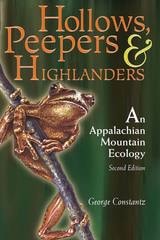
Hollows, Peepers, and Highlanders
An Appalachian Mountain EcologyGeorge Constantz
West Virginia University Press, 2004
In this revised and expanded edition of Hollows, Peepers, and Highlanders, author George Constantz, a biologist and naturalist, writes about the beauty and nature of the Appalachian landscape. While the information is scientific in nature, Constantz's accessible descriptions of the adaptation of various organisms to their environment enable the reader to enjoy learning about the Appalachian ecosystem. The book is divided into three sections: "Stage and Theater," "The Players," and "Seasonal Act." Each section sets the scene and describes the events occurring in nature. "Stage and Theatre" is comprised of chapters that describe the origins of the Appalachia region. "The Players" is an interesting and in-depth look into the ecology of animals, such as the mating rituals of different species, and the evolutionary explanation for the adaptation of Appalachian wildlife. The last section, "Seasonal Act," makes note of the changes in Appalachian weather each season and its effect on the inhabitants.
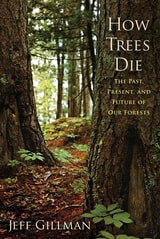
How Trees Die
The Past, Present, and Future of our ForestsJeff Gillman
Westholme Publishing, 2009
Trees have been essential to the success of human beings, providing food, shelter, warmth, transportation, and products (consider the paper you are holding). Trees are also necessary for a healthy atmosphere, literally connecting the earth with the sky. Once in wild abundance— the entire eastern North America was a gigantic forest—they have receded as we have clearcut the landscape in favor of building cities and farms, using up and abusing our forests in the process. Over the centuries, we have trained food trees, such as peach and apple trees, to produce more and better fruit at the expense of their lives. As Jeff Gillman, a specialist in the production and care of trees, explains in his acclaimed work, How Trees Die: The Past, Present, and Future of Our Forests, the death of a tree is as important to understanding our environment as how it lives. While not as readily apparent as other forms of domestication, our ancient and intimate relationship with trees has caused their lives to be inseparably entwined with ours. The environment we have created—what we put into the air and into the water, and how we change the land through farming, construction, irrigation, and highways—affects the world’s entire population of trees, while the lives of the trees under our direct care in farms, orchards, or along a city boulevard depend almost entirely on our actions. Taking the reader on a fascinating journey through time and place, the author explains how we kill trees, often for profit, but also unintentionally with kindness through overwatering or overmulching, and sometimes simply by our movements around the globe, carrying foreign insects or disease. No matter how a tree’s life ends, though, understanding the reason is essential to understanding the future of our environment.
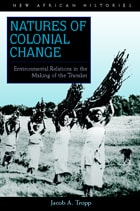
Natures of Colonial Change
Environmental Relations in the Making of the TranskeiJacob A. Tropp
Ohio University Press, 2006
In this groundbreaking study, Jacob A. Tropp explores the interconnections between negotiations over the environment and an emerging colonial relationship in a particular South African context—the Transkei—subsequently the largest of the notorious “homelands” under apartheid.
In the late nineteenth century, South Africa’s Cape Colony completed its incorporation of the area beyond the Kei River, known as the Transkei, and began transforming the region into a labor reserve. It simultaneously restructured popular access to local forests, reserving those resources for the benefit of the white settler economy. This placed new constraints on local Africans in accessing resources for agriculture, livestock management, hunting, building materials, fuel, medicine, and ritual practices.
Drawing from a diverse array of oral and written sources, Tropp reveals how bargaining over resources—between and among colonial officials, chiefs and headmen, and local African men and women—was interwoven with major changes in local political authority, gendered economic relations, and cultural practices as well as with intense struggles over the very meaning and scope of colonial rule itself.
Natures of Colonial Change sheds new light on the colonial era in the Transkei by looking at significant yet neglected dimensions of this history: how both “colonizing” and “colonized” groups negotiated environmental access and how such negotiations helped shape the broader making and meaning of life in the new colonial order.
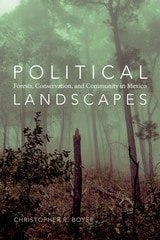
Political Landscapes
Forests, Conservation, and Community in MexicoChristopher R. Boyer
Duke University Press, 2015
Ponderosa
Big Pine of the SouthwestSylvester Allred
University of Arizona Press, 2015
Ponderosa is the first of its kind to provide an introduction to the natural and human histories of the ponderosa pine forests of the Southwest that is accessible to all who wish to enjoy the forests. The book offers knowledge on elemental aspects of the forests, such as the structure of the trees, as well as theoretical perspectives on issues such as climate change. Included are discussions of biogeography, ecology, and human and natural history, illustrated by over fifty color photographs throughout.
Allred presents his observations as if he is recalling his thoughts over the course of a walk in a ponderosa pine forest. His imagery-saturated prose provides an informal and enjoyable approach to discovering the history and environment of the ponderosa pine. Using a concise, straightforward writing style, Allred invites readers to explore the forests with him.
Ponderosa includes:
- More than 50 color photos
- Learn how to estimate the age of a tree
- See the reptiles, birds, and mammals that make their home in ponderosa pine forests
- Much more!
Rediscovering the Maine Woods
Thoreau's Legacy in an Unsettled LandJohn J. Kucich
University of Massachusetts Press, 2019
Inspired partly by this expedition, the accessible and engaging essays here offer valuable new perspectives on conservation, the cultural ties that connect Native communities to the land, and the profound influence the geography of the Maine Woods had on Thoreau and writers and activists who followed in his wake. Together, these essays offer a rich and multifaceted look at this special place and the ways in which Thoreau's Maine experiences continue to shape understandings of the environment a century and a half later.
Contributors include the volume editor, Kathryn Dolan, James S. Finley, James Francis, Richard W. Judd, Dale Potts, Melissa Sexton, Chris Sockalexis, Stan Tag, Robert M. Thorson, and Laura Dassow Walls.
Second Growth
The Promise of Tropical Forest Regeneration in an Age of DeforestationRobin L. Chazdon
University of Chicago Press, 2014
Even as human activities result in extensive fragmentation and deforestation, tropical forests demonstrate a great capacity for natural and human-aided regeneration. Although these damaged landscapes can take centuries to regain the characteristics of old growth, Chazdon shows here that regenerating—or second-growth—forests are vital, dynamic reservoirs of biodiversity and environmental services. What is more, they always have been.
With chapters on the roles these forests play in carbon and nutrient cycling, sustaining biodiversity, providing timber and non-timber products, and integrated agriculture, Second Growth not only offers a thorough and wide-ranging overview of successional and restoration pathways, but also underscores the need to conserve, and further study, regenerating tropical forests in an attempt to inspire a new age of local and global stewardship.
Silviculture and Ecology of Western U.S. Forests
John D. Bailey
Oregon State University Press, 2015
Silviculture and Ecology of Western U.S. Forests, Second Edition, is a text for students, professional forest managers, and scientists that summarizes both early and contemporary research and principles relevant to the silviculture, ecology, and multi-purpose management of western U. S. forests. Based on its authors’ significant experiences and contributions in the field, as well as nearly 1000 additional references, Silviculture and Ecology remains the only text that focuses on silviculture in western U.S. forests—providing background and basis for current biological, ecological, and managerial practices.
Detailed chapters on fire, tree growth, and management of complex stand structures, as well as shrub ecology and an ecosystem framework, are bolstered in the second edition. A new series of case studies illustrates how silvicultural practices are developed and modified as forests grow and new challenges and opportunities occur. Contemporary silvicultural practices, particularly pertaining to fire use, vegetation management, soil fertility, and fertilization have been updated, and modifications that enhance standard practices are demonstrated throughout the text.
In this comprehensive reference, readers entering the field will come to understand the significance of carefully managing forests by conscious design, and experienced silviculturists will benefit from the edition’s up-to-date information, providing forest users with a greater range of ecosystem services and consumable products alike.
The Behavioral Ecology of Efe Pygmy Men in the Ituri Forest, Zaire
Robert C. Bailey
University of Michigan Press, 1991
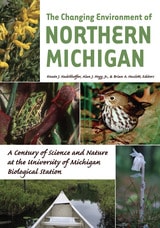
The Changing Environment of Northern Michigan
A Century of Science and Nature at the University of Michigan Biological StationKnute J. Nadelhoffer, Alan J. Hogg, Jr., Brian A. Hazlett, editors
University of Michigan Press, 2009
Northern Michigan is undergoing unprecedented changes in land use, climate, resource extraction, and species distributions. For the last hundred years, the University of Michigan Biological Station has monitored these environmental transformations. Stretching 10,000 acres along Burt and Douglas Lakes in the northern Lower Peninsula and 3,200 acres on Sugar Island near Sault Ste. Marie, Michigan, the station has played host to nearly 10,000 students and a steady stream of top scientists in the fields of biology, ecology, geology, archeology, and climatology.
The Changing Environment of Northern Michigan collects essays by some of these scientists, who lead readers on virtual field trips exploring the history of people and science at the station itself, the relations of indigenous people to the land, the geophysical history of the region, characteristics of terrestrial and aquatic ecosystems, key groups of organisms and their relations to local habitats, and perspectives on critical environmental challenges of today and their effects on the region. Accompanying the chapters are color illustrations and photographs that bring the station's pristine setting to life.
Like the station itself, the book provides a solid background for better appreciating the relationships among living and nonliving parts of northern Michigan, for anyone interested in exploring the region's forests, fields, and wetlands; wading or paddling down its rivers; or swimming or floating across its lakes.
Knute J. Nadelhoffer is Director of the University of Michigan Biological Station and Professor of Ecology and Evolutionary Biology at the University of Michigan.
Alan J. Hogg, Jr., teaches science writing at the University of Michigan as a faculty member of the Sweetland Writing Center. His Ph.D. research explored the effects of ozone and nitrogen oxides on University of Michigan Biological Station forests.
Brian A. Hazlett is Professor Emeritus of Zoology at the University of Michigan.
The Changing Nature of the Maine Woods
Andrew M. Barton
University of New Hampshire Press, 2012
The Changing Nature of the Maine Woods is both a fascinating introduction to the forests of Maine and a detailed but accessible narrative of the dynamism of these ecosystems. This is natural history with a long view, starting with an overview of the state's geological history, the reemergence of the forest after glacial retreat, and the surprising changes right up to European arrival. The authors create a vivid picture of Maine forests just before the impact of Euro-Americans and trace the profound transformations since settlement.
Ambitious in its geographic range, this book explores how and why Maine forests differ across the state, from the top of Mount Katahdin to the coast. Through groundbreaking research and engaging narratives, the authors assess key ecological forces such as climate change, insects and disease, nonnative organisms, natural disturbance, and changing land use to create a dramatic portrait of Maine forests—past, present, and future.
This book both synthesizes the latest scientific discoveries regarding the changing forest and relates the findings to an educated lay and academic audience.
The Community Forests of Mexico
Managing for Sustainable LandscapesEdited by David Barton Bray, Leticia Merino-Pérez, and Deborah Barry
University of Texas Press, 2005
Mexico leads the world in community management of forests for the commercial production of timber. Yet this success story is not widely known, even in Mexico, despite the fact that communities around the globe are increasingly involved in managing their own forest resources. To assess the achievements and shortcomings of Mexico's community forest management programs and to offer approaches that can be applied in other parts of the world, this book collects fourteen articles that explore community forest management from historical, policy, economic, ecological, sociological, and political perspectives.
The contributors to this book are established researchers in the field, as well as many of the important actors in Mexico's nongovernmental organization sector. Some articles are case studies of community forest management programs in the states of Michoacán, Oaxaca, Durango, Quintana Roo, and Guerrero. Others provide broader historical and contemporary overviews of various aspects of community forest management. As a whole, this volume clearly establishes that the community forest sector in Mexico is large, diverse, and has achieved unusual maturity in doing what communities in the rest of the world are only beginning to explore: how to balance community income with forest conservation. In this process, Mexican communities are also managing for sustainable landscapes and livelihoods.
The Southern Forest
A ChronicleBy Laurence C. Walker
University of Texas Press, 1991
When the first European explorers reached the southern shores of North America in the early seventeenth century, they faced a solid forest that stretched all the way from the Atlantic coast to eastern Texas and Oklahoma. The ways in which they and their descendants used—and abused—the forest over the next nearly four hundred years form the subject of The Southern Forest.
In chapters on the explorers, pioneers, lumbermen, boatbuilders, and foresters, Laurence Walker chronicles the constant demands that people have made on forest resources in the South. He shows how the land's very abundance became its greatest liability, as people overhunted the animals, clearcut the forests, and wore out the soil with unwise farming practices—all in a mistaken belief that the forest's bounty (including new ground to be broken) was inexhaustible.
With the advent of professional forestry in the twentieth century, however, the southern forest has made a comeback. A professional forester himself, Walker speaks from experience of the difficulties that foresters face in balancing competing interests in the forest. How, for example, does one reconcile the country's growing demand for paper products with the insistence of environmental groups that no trees be cut? Should national forests be strictly recreational areas, or can they support some industrial logging? How do foresters avoid using chemical pesticides when the public protests such natural management practices as prescribed burning and tree cutting?
This personal view of the southern forest adds a new dimension to the study of southern history and culture. The primeval southern forest is gone, but, with careful husbandry on the part of all users, the regenerated southern forest may indeed prove to be the inexhaustible resource of which our ancestors dreamed.
Tongass Odyssey
Seeing the Forest Ecosystem through the Politics of TreesJohn Schoen
University of Alaska Press, 2020
Toward a Natural Forest
The Forest Service in Transition (A Memoir)Jim Furnish
Oregon State University Press, 2015
The Forest Service stumbled in responding to a wave of lawsuits from environmental groups in the late 20th Century—a phenomenon best symbolized by the spotted owl controversy that shut down logging on public forests in the Pacific Northwest in the 1990s. The agency was brought to its knees, pitted between a powerful timber industry that had been having its way with the national forests for decades, and organized environmentalists who believed public lands had been abused and deserved better stewardship.
Toward a Natural Forest offers an insider’s view of this tumultuous time in the history of the Forest Service, presenting twin tales of transformation, both within the agency and within the author’s evolving environmental consciousness. While stewarding our national forests with the best of intentions, had the Forest Service diminished their natural essence and ecological values? How could one man confront the crisis while remaining loyal to his employer?
In this revealing memoir, Furnish addresses the fundamental human drive to gain sustenance from and protect the Earth, believing that we need not destroy it in the process. Drawing on the author’s personal experience and his broad professional knowledge, Toward a Natural Forest illuminates the potential of the Forest Service to provide strong leadership in global conservation efforts. Those interested in our public lands—environmentalists, natural resource professionals, academics, and historians—will find Jim Furnish’s story deeply informed, thought-provoking, and ultimately inspiring.
Trees and Forests of Tropical Asia
Exploring TapovanPeter Ashton and David Lee
University of Chicago Press, 2022
Trees and Forests of Tropical Asia invites readers on an expedition into the leafy, humid, forested landscapes of tropical Asia—the so-called tapovan, a Sanskrit word for the forest where knowledge is attained through tapasya, or inner struggle. Peter Ashton and David Lee, two of the world’s leading scholars on Asian tropical rain forests, reveal the geology and climate that have produced these unique forests, the diversity of species that inhabit them, the means by which rain forest tree species evolve to achieve unique ecological space, and the role of humans in modifying the landscapes over centuries. Following Peter Ashton’s extensive On the Forests of Tropical Asia, the first book to describe the forests of the entire tropical Asian region from India east to New Guinea, this new book provides a more condensed and updated overview of tropical Asian forests written accessibly for students as well as tropical forest biologists, ecologists, and conservation biologists.
Trees, Truffles, and Beasts
How Forests FunctionMaser, Chris
Rutgers University Press, 2008
Because today's decisions are tomorrow's consequences, every small effort makes a difference, but a broader understanding of our environmental problems is necessary to the development of sustainable ecosystem policies. In Trees, Truffles, and Beasts, Chris Maser, Andrew W. Claridge, and James M. Trappe make a compelling case that we must first understand the complexity and interdependency of species and habitats from the microscopic level to the gigantic. Comparing forests in the Pacific Northwestern United States and Southeastern mainland of Australia, the authors show how easily observable speciesùtrees and mammalsùare part of a complicated infrastructure that includes fungi, lichens, and organisms invisible to the naked eye, such as microbes.
Eminently readable, this important book shows that forests are far more complicated than most of us might think, which means simplistic policies will not save them. Understanding the biophysical intricacies of our life-support systems just might.
Tropical Forest Diversity and Dynamism
Findings from a Large-Scale Plot NetworkEdited by Elizabeth Losos and Egbert Giles Leigh Jr.
University of Chicago Press, 2004
Written by experts in the field of tropical ecology, Tropical Forest Diversity and Dynamism will appeal to students and professionals with an interest in community ecology and patterns of diversity.
Understories
The Political Life of Forests in Northern New MexicoJake Kosek
Duke University Press, 2006
Kosek traces the histories of forest extraction and labor exploitation in northern New Mexico, where Hispano residents have forged passionate attachments to place. He describes how their sentiments of dispossession emerged through land tenure systems and federal management programs that remade forest landscapes as exclusionary sites of national and racial purity. Fusing fine-grained ethnography with insights gleaned from cultural studies and science studies, Kosek shows how the nationally beloved Smokey the Bear became a symbol of white racist colonialism for many Hispanos in the region, while Los Alamos National Laboratory, at once revered and reviled, remade regional ecologies and economies. Understories offers an innovative vision of environmental politics, one that challenges scholars as well as activists to radically rework their understandings of relations between nature, justice, and identity.
Wild Forest Home
Stories of Conservation in the Pacific NorthwestBetsy L. Howell
University of Utah Press, 2024
The twenty-five essays in Wild Forest Home chronicle Howell’s career and personal experiences studying the wildlife of the Pacific Northwest during the litigious listing of the northern spotted owl and marbled murrelet under the Endangered Species Act and the Clinton administration’s adoption of the seminal 1994 Northwest Forest Plan. Meanwhile, Howell toiled on fire crews, searched for rare species, helped to monitor fishers reintroduced to the Olympic Peninsula, tested amphibians for deadly diseases, became a writer, and mourned the deaths of her parents. This captivating memoir seamlessly blends story and science to reveal a unique portrait of the struggles and joys of one wildlife biologist.