Results by title
16 books match the query 'Forest management'
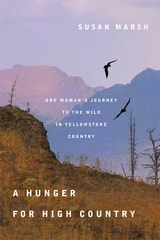
A Hunger for High Country
One Woman’s Journey to the Wild in Yellowstone CountrySusan Marsh
Oregon State University Press, 2014

A Place for Inquiry, A Place for Wonder
The Andrews ForestWilliam Robbins
Oregon State University Press, 2020
In A Place for Inquiry, A Place for Wonder, historian William Robbins turns his attention to the long-overlooked Andrews Forest and argues for its importance to environmental science and policy. From its founding in 1948, the experimental forest has been the site of wide-ranging research. Beginning with postwar studies on the conversion of old-growth timber to fast-growing young stands, research at the Andrews shifted in the next few decades to long-term ecosystem investigations that focus on climate, streamflow, water quality, vegetation succession, biogeochemical cycling, and effects of forest management. The Andrews has thus been at the center of a dramatic shift in federal timber practices from industrial, intensive forest management policies to strategies emphasizing biodiversity and healthy ecosystems.
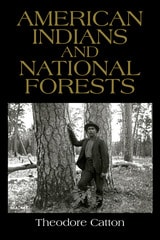
American Indians and National Forests
Theodore Catton
University of Arizona Press, 2016
Marginalized in American society and long denied a seat at the table of public land stewardship, American Indian tribes have at last taken their rightful place and are making themselves heard. Weighing indigenous perspectives on the environment is an emerging trend in public land management in the United States and around the world. The Forest Service has been a strong partner in that movement over the past quarter century.

Changing Pacific Forests
Historical Perspectives on the Pacific Basin Forest EconomyJohn Dargavel and Richard P. Tucker, eds.
Duke University Press, 1992
Drawing on a 1991 conference sponsored by the Forest History Society and the International Union of Forestry Research Organizations held in Honolulu, these papers address a range of topics related to the changing Pacific forests, including the remnants of colonialism, the emergence of the Third World, people and resources caught in the middle of policy decisions, land management, national forests, and subsistence use of the forest by indigenous peoples. Essays also explore macroeconomic theories of international trade and the interests of the United States and the former Soviet Union in the economic health of the region. Changing Pacific Forests will be of interest to scholars of the economy and environment of the Pacific Basin as well as of land management and the history of land use in general.
Contributors. Charles S. Backman, Thomas R. Cox, John Dargavel, Elizabeth Flint, Lim Hin Fui, G. R. Henning, Kenneth E. Jackson, Hiroaki Kakizawa, Nicholas K. Menzies, Andrew Price, John F. Richards, Jr., M. M. Roche, I. Gustin M. Tantra, Conrad Totman, Richard P. Tucker, Thomas R. Waggener
Emerging Threats to Tropical Forests
Edited by William F. Laurance and Carlos A. Peres
University of Chicago Press, 2006
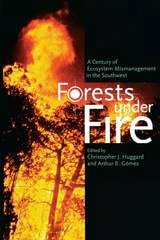
Forests under Fire
A Century of Ecosystem Mismanagement in the SouthwestEdited by Christopher J. Huggard and Arthur R. Gómez
University of Arizona Press, 2001
In this book, leading environmental historians show us what has been happening to these fragile woodlands. Taking us from lumber towns to Indian reservations to grazing lands, Forests under Fire reveals the interaction of Anglos, Hispanics, and Native Americans with the forests of the American Southwest. It examines recent controversies ranging from red squirrel conservation on Mt. Graham to increased tourism in our national forests. These case studies offer insights into human-forest relationships in places such as the Coconino National Forest, the Vallecitos Sustained Yield Unit, and the Gila Wilderness Area while also drawing on issues and concerns about similar biospheres in other parts of the West.
Over the past century, forest management has evolved from a field dominated by the "conservationist" perspective—with humans exploiting natural resources-to one that emphasizes biocentrism, in which forests are seen as dynamic ecosystems. Yet despite this progressive shift, the assault on our forests continues through overgrazing of rangelands, lumbering, eroding mountainsides, fire suppression, and threats to the habitats of endangered species. Forests under Fire takes a closer look at the people calling the shots in our national forests, from advocates of timber harvesting to champions of ecosystem management, and calls for a reassessment of our priorities—before our forests are gone.
Contents
Introduction: Toward a Twenty-First-Century Forest Ecosystem Management Strategy / Christopher J. Huggard
Industry and Indian Self-Determination: Northern Arizona’s Apache Lumbering Empire, 1870-1970 / Arthur R. Gómez
A Social History of McPhee: Colorado’s Largest Lumber Town / Duane A. Smith
The Vallecitos Federal Sustained-Yield Unit: The (All Too) Human Dimension of Forest Management in Northern New Mexico, 1945-1998 / Suzanne S. Forrest
Grazing the Southwest Borderlands: The Peloncillo-Animas District of the Coronado National Forest in Arizona and New Mexico, 1906-1996 / Diana Hadley
America’s First Wilderness Area: Aldo Leopold, the Forest Service, and the Gila of New Mexico, 1924-1980 / Christopher J. Huggard
"Where There’s Smoke": Wildfire Policy and Suppression in the American Southwest / John Herron
Struggle in an Endangered Empire: The Search for Total Ecosystem Management in the Forests of Southern Utah, 1976-1999 / Thomas G. Alexander
Biopolitics: A Case Study of Political Influence on Forest Management Decisions, Coronado National Forest, Arizona, 1980s-1990s / Paul W. Hirt
Epilogue: Seeing the Forest Not for the Trees: The Future of Southwestern Forests in Retrospect / Hal K. Rothman
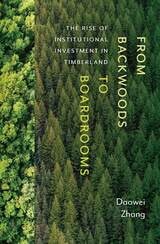
From Backwoods to Boardrooms
The Rise of Institutional Investment in TimberlandDaowei Zhang
Oregon State University Press, 2021
Through a historical examination of key events and players, prevailing management philosophies, public policy, and institutional factors, Daowei Zhang searches for an economic explanation and assesses the impact of these ownership revolutions with a three-pronged approach. First, he explains why industrial firms were able to profit from owning forestlands, and how the shift to institutional ownership came about. Second, he compares private timberland investments and public equity investments with respect to risk-adjusted returns and other dimensions of interest to investors and forest managers, including alignment of interests, capacity to exploit market inefficiencies, and their forest management and conservation records. Finally, he provides thoughtful commentary on the future of institutional timberland investments and global forest sustainability.
From Backwoods to Boardrooms is essential reading for forest managers, investors, and anyone interested in understanding the workings of the modern forest sector and the future of forest sustainability.
George W Bush's Healthy Fore
J Vaughn
University Press of Colorado, 2005
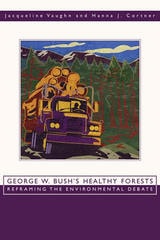
George W. Bush's Healthy Forests
Reframing the Environmental DebateJacqueline Vaughn
University Press of Colorado, 2005
The authors show how the administration used news events such as wildfires to propel legislation through Congress. Focusing blame for wildfires on legal obstacles and environmentalists' use of appeals to challenge fuel-reduction projects, the administration restricted opportunities for environmental analysis, administrative appeals, and litigation. The authors argue that these tools have a history of use by diverse interests and have long protected Americans' right to question government decisions.
This readable study identifies the players, events, and strategies that expedited the policy shift and contextualizes it in the president's career and in legislative and administrative history. Revealing a policy change with major implications for the future of public lands and public process, George W. Bush's Healthy Forests will become required reading in environmental studies and political science.
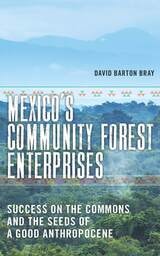
Mexico’s Community Forest Enterprises
Success on the Commons and the Seeds of a Good AnthropoceneDavid Barton Bray
University of Arizona Press, 2020
Mexico presents a unique case in which much of the nation’s forests were placed as commons in the hands of communities, who, with state support and their own entrepreneurial vigor, created community forest enterprises (CFEs). David Barton Bray, who has spent more than thirty years engaged with and researching Mexican community forestry, shows that this reform has transformed forest management in that country at a scale and level of maturity unmatched anywhere else in the world.
For decades Mexico has been conducting a de facto large-scale experiment in the design of a national social-ecological system (SES) focused on community forests. What happens when you give subsistence communities rights over forests, as well as training, organizational support, equipment, and financial capital? Do the communities destroy the forest in the name of economic development, or do they manage them sustainably, generating current income while maintaining intergenerational value as a resource for their children? Bray shares the scientific and social evidence that can now begin to answer these questions. This is an invaluable resource for students, researchers, and the interested public on the future of global forest resilience and the possibilities for a good Anthropocene.
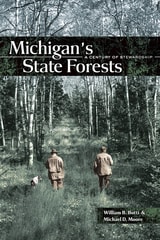
Michigan's State Forests
A Century of StewardshipWilliam B. Botti
Michigan State University Press, 2006
It has been said that Michigan’s nineteenth century white pine stands were the finest the world has ever seen. Dense, parklike stands, more than 150 feet tall, covered vast areas northward from the Bay City– Muskegon line. The sheer quantity of timber lured many adventurous entrepreneurs and enterprising farmers to Michigan. Lumber became a mainstay of Michigan’s economy as logging interests and railroad entrepreneurs became adept at harvesting, transporting, and processing pine logs. Many considered the pine to be practically limitless.
In October of 1871, the first indication of a troubled future occurred when Michigan settlers experienced fires unlike any they had ever seen. Following two months of serious drought, and fed by hundreds of small fires set by land-clearing operations, much of northern Lower Michigan erupted in flames; dry winds fanned the many small fires into one unbelievable conflagration that swept entirely across the Lower Peninsula, from Lake Michigan to Lake Huron. Many towns were reduced to ashes, among them Holland, Glen Haven, Huron City, Sand Beach, White Rock, and Forestville. Navigation was interrupted on Lake Huron and as far downriver as Detroit because of the heavy smoke. More than 200 people lost their lives.
Michigan’s State Forests recounts how an abandoned, cutover, and often burned wilderness has been converted once again into highly productive and protected public lands. For more than 100 years, these lands have been preserved, managed and developed to form one of Michigan’s great assets, not only for economic development but also as enhancements to our quality of life.
Political Landscapes
Forests, Conservation, and Community in MexicoChristopher R. Boyer
Duke University Press, 2015
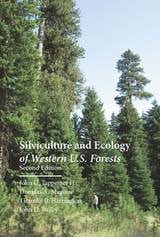
Silviculture and Ecology of Western U.S. Forests
John D. Bailey
Oregon State University Press, 2015
Silviculture and Ecology of Western U.S. Forests, Second Edition, is a text for students, professional forest managers, and scientists that summarizes both early and contemporary research and principles relevant to the silviculture, ecology, and multi-purpose management of western U. S. forests. Based on its authors’ significant experiences and contributions in the field, as well as nearly 1000 additional references, Silviculture and Ecology remains the only text that focuses on silviculture in western U.S. forests—providing background and basis for current biological, ecological, and managerial practices.
Detailed chapters on fire, tree growth, and management of complex stand structures, as well as shrub ecology and an ecosystem framework, are bolstered in the second edition. A new series of case studies illustrates how silvicultural practices are developed and modified as forests grow and new challenges and opportunities occur. Contemporary silvicultural practices, particularly pertaining to fire use, vegetation management, soil fertility, and fertilization have been updated, and modifications that enhance standard practices are demonstrated throughout the text.
In this comprehensive reference, readers entering the field will come to understand the significance of carefully managing forests by conscious design, and experienced silviculturists will benefit from the edition’s up-to-date information, providing forest users with a greater range of ecosystem services and consumable products alike.
That Which Roots Us
Environmental Issues in the Pacific Northwest & BeyondMarion Dresner
University of Nevada Press, 2023
A work of natural and environmental history.
That Which Roots Us is a work of natural and environmental history that explores the origins of and resolutions to some of the United States’ environmental problems. Marion Dresner discusses the roots of Euro-American environmental exploitative action, starting with the environmental consequences of having treated Pacific Northwest forests as commodities. She shares her experiences visiting sites where animal-centered ice age culture changed to human-centered culture thousands of years ago with the advent of farming. The book explores the origins of the romantic philosophical movement, which arose out of the debilitating conditions of the industrial era. Those romantic attitudes toward nature inspired the twentieth-century preservation movement and America’s progressively modern conservation attitudes.
The book is centered around environmental issues in the Pacific Northwest, contrasting utilitarian views of nature with Native American practices of respect and reciprocity. The elements that make That Which Roots Us a truly unique and important contribution to environmental literature are the author’s personal recollections and interactions with the landscape. Ultimately, Dresner offers hope for a new stewardship of the land and a focus on science literacy and direct experience in the natural world as the most grounded way of knowing the planet.
Understories
The Political Life of Forests in Northern New MexicoJake Kosek
Duke University Press, 2006
Kosek traces the histories of forest extraction and labor exploitation in northern New Mexico, where Hispano residents have forged passionate attachments to place. He describes how their sentiments of dispossession emerged through land tenure systems and federal management programs that remade forest landscapes as exclusionary sites of national and racial purity. Fusing fine-grained ethnography with insights gleaned from cultural studies and science studies, Kosek shows how the nationally beloved Smokey the Bear became a symbol of white racist colonialism for many Hispanos in the region, while Los Alamos National Laboratory, at once revered and reviled, remade regional ecologies and economies. Understories offers an innovative vision of environmental politics, one that challenges scholars as well as activists to radically rework their understandings of relations between nature, justice, and identity.
Working with Your Woodland
A Landowner’s GuideMollie Beattie, Charles Thompson, and Lynn Levine
University Press of New England, 1993