Results by title
10 books match the query 'Forest policy'
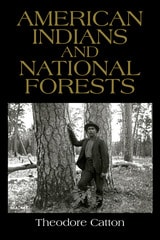
American Indians and National Forests
Theodore Catton
University of Arizona Press, 2016
Marginalized in American society and long denied a seat at the table of public land stewardship, American Indian tribes have at last taken their rightful place and are making themselves heard. Weighing indigenous perspectives on the environment is an emerging trend in public land management in the United States and around the world. The Forest Service has been a strong partner in that movement over the past quarter century.
Forests under Fire
A Century of Ecosystem Mismanagement in the SouthwestEdited by Christopher J. Huggard and Arthur R. Gómez
University of Arizona Press, 2001
In this book, leading environmental historians show us what has been happening to these fragile woodlands. Taking us from lumber towns to Indian reservations to grazing lands, Forests under Fire reveals the interaction of Anglos, Hispanics, and Native Americans with the forests of the American Southwest. It examines recent controversies ranging from red squirrel conservation on Mt. Graham to increased tourism in our national forests. These case studies offer insights into human-forest relationships in places such as the Coconino National Forest, the Vallecitos Sustained Yield Unit, and the Gila Wilderness Area while also drawing on issues and concerns about similar biospheres in other parts of the West.
Over the past century, forest management has evolved from a field dominated by the "conservationist" perspective—with humans exploiting natural resources-to one that emphasizes biocentrism, in which forests are seen as dynamic ecosystems. Yet despite this progressive shift, the assault on our forests continues through overgrazing of rangelands, lumbering, eroding mountainsides, fire suppression, and threats to the habitats of endangered species. Forests under Fire takes a closer look at the people calling the shots in our national forests, from advocates of timber harvesting to champions of ecosystem management, and calls for a reassessment of our priorities—before our forests are gone.
Contents
Introduction: Toward a Twenty-First-Century Forest Ecosystem Management Strategy / Christopher J. Huggard
Industry and Indian Self-Determination: Northern Arizona’s Apache Lumbering Empire, 1870-1970 / Arthur R. Gómez
A Social History of McPhee: Colorado’s Largest Lumber Town / Duane A. Smith
The Vallecitos Federal Sustained-Yield Unit: The (All Too) Human Dimension of Forest Management in Northern New Mexico, 1945-1998 / Suzanne S. Forrest
Grazing the Southwest Borderlands: The Peloncillo-Animas District of the Coronado National Forest in Arizona and New Mexico, 1906-1996 / Diana Hadley
America’s First Wilderness Area: Aldo Leopold, the Forest Service, and the Gila of New Mexico, 1924-1980 / Christopher J. Huggard
"Where There’s Smoke": Wildfire Policy and Suppression in the American Southwest / John Herron
Struggle in an Endangered Empire: The Search for Total Ecosystem Management in the Forests of Southern Utah, 1976-1999 / Thomas G. Alexander
Biopolitics: A Case Study of Political Influence on Forest Management Decisions, Coronado National Forest, Arizona, 1980s-1990s / Paul W. Hirt
Epilogue: Seeing the Forest Not for the Trees: The Future of Southwestern Forests in Retrospect / Hal K. Rothman
From Backwoods to Boardrooms
The Rise of Institutional Investment in TimberlandDaowei Zhang
Oregon State University Press, 2021
Through a historical examination of key events and players, prevailing management philosophies, public policy, and institutional factors, Daowei Zhang searches for an economic explanation and assesses the impact of these ownership revolutions with a three-pronged approach. First, he explains why industrial firms were able to profit from owning forestlands, and how the shift to institutional ownership came about. Second, he compares private timberland investments and public equity investments with respect to risk-adjusted returns and other dimensions of interest to investors and forest managers, including alignment of interests, capacity to exploit market inefficiencies, and their forest management and conservation records. Finally, he provides thoughtful commentary on the future of institutional timberland investments and global forest sustainability.
From Backwoods to Boardrooms is essential reading for forest managers, investors, and anyone interested in understanding the workings of the modern forest sector and the future of forest sustainability.
George W Bush's Healthy Fore
J Vaughn
University Press of Colorado, 2005
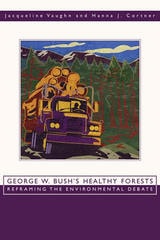
George W. Bush's Healthy Forests
Reframing the Environmental DebateJacqueline Vaughn
University Press of Colorado, 2005
The authors show how the administration used news events such as wildfires to propel legislation through Congress. Focusing blame for wildfires on legal obstacles and environmentalists' use of appeals to challenge fuel-reduction projects, the administration restricted opportunities for environmental analysis, administrative appeals, and litigation. The authors argue that these tools have a history of use by diverse interests and have long protected Americans' right to question government decisions.
This readable study identifies the players, events, and strategies that expedited the policy shift and contextualizes it in the president's career and in legislative and administrative history. Revealing a policy change with major implications for the future of public lands and public process, George W. Bush's Healthy Forests will become required reading in environmental studies and political science.

Origins of the National Forests
Harold K. Steen, ed.
Duke University Press, 1992
The national forests are a major source of wood, water, minerals, forage, animal life and habitat, and wilderness. Yet questions of who controls and who benefits from the resources have posed problems and conflicts from the origins of the Forest Service to the present. Based on a 1991 Forest History Society conference, the essays collected here discuss a range of important topics surrounding our national forests, including the relationship between the federal and state systems that regulate the forests; the privately owned lands within the forests that are governed by federal statutes, state laws, and county ordinances; the ill-defined rights of those who lived on the land long before it was a national forest and were forced off the land; and the effect of early policymaking decisions made within the framework of the emerging Conservation Movement.
Contributors. Ron Arnold, Pamela A. Conners, Mary S. Culpin, Stanley Dempsey, Peter Gillis, Donn E. Headley, Robert L. Hendricks, Stephen Larrabee, Patricia Nelson Limerick, Dennis L. Lynch, Michael McCarthy, Char Miller, Joseph A. Miller, James Muhn, Kevin Palmer, Donald Pisani, John F. Reiger, William Rowley, Michael Ryan, William E. Shands, Harold K. Steen, Richard White, Gerald W. Williams
Political Landscapes
Forests, Conservation, and Community in MexicoChristopher R. Boyer
Duke University Press, 2015
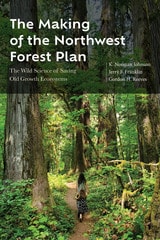
The Making of the Northwest Forest Plan
The Wild Science of Saving Old Growth EcosystemsK. Norman Johnson
Oregon State University Press, 2023
Tree sitters. Logger protests. Dying timber towns. An iconic species on the brink. The Timber Wars consumed the Pacific Northwest in the late 1980s and early1990s and led political leaders to ask scientists for a solution. The Northwest Forest Plan was the result.
For most of the twentieth century, the central theme of federal forest management in the Pacific Northwest had been logging old-growth forests to provide a sustained yield of timber. During the 1970s and 1980s, however, a series of studies by young scientists highlighted the destructive impact of that logging on northern spotted owls, salmon, and the old-growth ecosystem itself.
Combining this new science with newly minted environmental laws like the Endangered Species Act, environmental activists obtained court injunctions to stop old-growth logging on federal land, setting off a titanic struggle in the Pacific Northwest to find a way to accommodate conservation imperatives as well as the logging that provided employment for tens of thousands of people. That effort involved years of controversy and debate, federal courts, five science assessments, Congress, and eventually the president of the United States. It led to creation of the Northwest Forest Plan, which sharply and abruptly shifted the primary goal of federal forestry toward conserving the species and ecosystems of old-growth forests. Scientists went from spectators to planners and guides, employing their latest scientific findings and expertise to create a forest plan for 20 million acres that would satisfy the courts. The largest upheaval in federal forest management in history had occurred, along with a precipitous decline in timber harvest, and there was no going back.
In this book, three of the scientists who helped craft that change tell the story as they know it: the causes, development, adoption, and implementation of the Northwest Forest Plan. The book also incorporates personal reflections from the authors, short commentaries and histories from key figures— including spotted owl expert Eric Forsman—and experiences from managers who implemented the Plan as best they could. Legal expert Susan Jane M. Brown helped interpret court cases and Debora Johnson turned spatial data into maps. The final chapters cover the Plan’s ongoing significance and recommendations for conserving forest and aquatic ecosystems in an era of megafires and climate change.
Understories
The Political Life of Forests in Northern New MexicoJake Kosek
Duke University Press, 2006
Kosek traces the histories of forest extraction and labor exploitation in northern New Mexico, where Hispano residents have forged passionate attachments to place. He describes how their sentiments of dispossession emerged through land tenure systems and federal management programs that remade forest landscapes as exclusionary sites of national and racial purity. Fusing fine-grained ethnography with insights gleaned from cultural studies and science studies, Kosek shows how the nationally beloved Smokey the Bear became a symbol of white racist colonialism for many Hispanos in the region, while Los Alamos National Laboratory, at once revered and reviled, remade regional ecologies and economies. Understories offers an innovative vision of environmental politics, one that challenges scholars as well as activists to radically rework their understandings of relations between nature, justice, and identity.
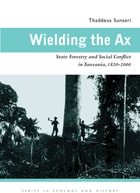
Wielding the Ax
State Forestry and Social Conflict in Tanzania, 1820–2000Thaddeus Sunseri
Ohio University Press, 2009
Forests have been at the fault lines of contact between African peasant communities in the Tanzanian coastal hinterland and outsiders for almost two centuries. In recent decades, a global call for biodiversity preservation has been the main challenge to Tanzanians and their forests.
Thaddeus Sunseri uses the lens of forest history to explore some of the most profound transformations in Tanzania from the nineteenth century to the present. He explores anticolonial rebellions, the world wars, the depression, the Cold War, oil shocks, and nationalism through their intersections with and impacts on Tanzania’s coastal forests and woodlands. In Wielding the Ax, forest history becomes a microcosm of the origins, nature, and demise of colonial rule in East Africa and of the first fitful decades of independence.
Wielding the Ax is a story of changing constellations of power over forests, beginning with African chiefs and forest spirits, both known as “ax–wielders,” and ending with international conservation experts who wield scientific knowledge as a means to controlling forest access. The modern international concern over tropical deforestation cannot be understood without an awareness of the long–term history of these forest struggles.