Results by title
2 books match the query 'Foster Care System'
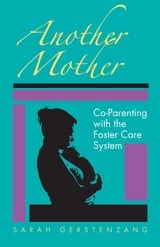
Another Mother
Co-Parenting with the Foster Care SystemSarah Gerstenzang
Vanderbilt University Press, 2007
One night after midnight social workers brought a baby girl to the author's home, and her life as a foster mother began. A social worker herself, Gerstenzang discovered that raising Cecilia, despite all the personal joys, would be a complex and frustrating process of "co-parenting" with the foster care system in New York City. Foster parents are in great demand, but they are not necessarily treated well. We follow the author through the home visits, the Early Intervention evaluation, the WIC program that (with much bureaucratic hassle) provides free formula and cereal, and the mandatory parenting training sessions. She comments, "When Michael and I became foster parents, we learned how stigmatizing, demoralizing, and just plain inconvenient and time-consuming being part of the 'unentitled' population can be. With the exception of Early Intervention, we often felt that the programs were more concerned with regulating our behavior than with providing services."
Regular meetings with the birth family were also part of the process. Not only were they awkward for all concerned, but each visit involved a commute of several hours. One social worker admitted that she preferred a foster parent who didn't work because that person could more easily comply with the time-consuming regulations. Sarah and her husband Michael also agonize over complying with special regulations about hiring babysitters or traveling ("anytime we left New York State we needed to ask the agency's permission, which in turn had to get the signed consent from the birth mother").
Central to Another Mother is the issue of transracial placement. Sarah remembers, "That first day the contrast between my pale skin and Cecilia's brown skin seemed glaring. Not only did I feel that I had someone else's child, I felt that I had a child from another culture. Would I owe someone an explanation?" (Gerstenzang is recalling the 1972 opposition of the National Association of Black Social Workers.) Her account is full of anecdotes and reflections about race: acceptance and prejudice from others; the feelings of her two children about having a sibling of a different race; and culture keeping, beginning with skin and hair care.
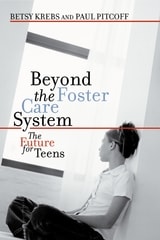
Beyond The Foster Care System
The Future for TeensBetsy Krebs
Rutgers University Press, 2006
Each year tens of thousands of teenagers are released from the foster care system in the United States without high school degrees or strong family relationships. Two to four years after discharge, half of these young people still do not have either a high school diploma or equivalency degree, and fewer than ten percent enter college. Nearly a third end up on public assistance within fifteen months, and eventually more than a third will be arrested or convicted of a crime.
In this richly detailed and often surprising exploration of the foster care system, Betsy Krebs and Paul Pitcoff argue that the existing structure sets kids up to fail by inadequately preparing them for adult life. Foster care programs traditionally emphasize goals of reuniting children with family or placing children into adoptive homes. But neither of these outcomes is likely for adolescents. Krebs and Pitcoff contend that the primary goal of foster care for teenagers should be rigorous preparation for a fully productive adult life and that the standard life skills curriculum is woefully inadequate for this purpose.
The authors, who together cofounded the Youth Advocacy Center in New York City, draw on their fifteen years of experience working with teens and the foster care system to introduce new ways to teach teens to be responsible for themselves and to identify and develop their potential. They also explore what sorts of resources-legal, financial, and human-will need to come from inside and outside the system to more fully humanize the practice of foster care. Ultimately, Krebs and Pitcoff argue that change must involve the participation of caring communities of volunteers who want to see disadvantaged youth succeed as well as developing methods to empower teens to take control of their lives.
Bringing together a series of inspiring, real-life accounts, Beyond the Foster Care System introduces readers to a number of dynamic young people who have participated in the Youth Advocacy Center's programs and who have gone on to apply these lessons to other areas of life. Their stories demonstrate that more successful alternatives to the standard way of providing foster care are not only imaginable, but possible. With the practical improvements Krebs and Pitcoff outline, teens can learn the skills of effective self-advocacy, become better prepared for the transition to full independence, and avoid becoming the statistics that foster care has so often produced in the past.