Results by title
6 books match the query 'Frankel, Jeffrey A.'
Managing Currency Crises in Emerging Markets
Edited by Michael P. Dooley and Jeffrey A. Frankel
University of Chicago Press, 2003
The management of financial crises in emerging markets is a vital and high-stakes challenge in an increasingly global economy. For this reason, it's also a highly contentious issue in today's public policy circles. In this book, leading economists-many of whom have also participated in policy debates on these issues-consider how best to reduce the frequency and cost of such crises.
The contributions here explore the management process from the beginning of a crisis to the long-term effects of the techniques used to minimize it. The first three chapters focus on the earliest responses and the immediate defense of a currency under attack, exploring whether unnecessary damage to economies can be avoided by adopting the right response within the first few days of a financial crisis. Next, contributors examine the adjustment programs that follow, considering how to design these programs so that they shorten the recovery phase, encourage economic growth, and minimize the probability of future difficulties. Finally, the last four papers analyze the actual effects of adjustment programs, asking whether they accomplish what they are designed to do-and whether, as many critics assert, they impose disproportionate costs on the poorest members of society.
Recent high-profile currency crises have proven not only how harmful they can be to neighboring economies and trading partners, but also how important policy responses can be in determining their duration and severity. Economists and policymakers will welcome the insightful evaluations in this important volume, and those of its companion, Sebastian Edwards and Jeffrey A. Frankel's Preventing Currency Crises in Emerging Markets.
[more]
Preventing Currency Crises in Emerging Markets
Edited by Sebastian Edwards and Jeffrey A. Frankel
University of Chicago Press, 2002
Economists and policymakers are still trying to understand the lessons recent financial crises in Asia and other emerging market countries hold for the future of the global financial system. In this timely and important volume, distinguished academics, officials in multilateral organizations, and public and private sector economists explore the causes of and effective policy responses to international currency crises.
Topics covered include exchange rate regimes, contagion (transmission of currency crises across countries), the current account of the balance of payments, the role of private sector investors and of speculators, the reaction of the official sector (including the multilaterals), capital controls, bank supervision and weaknesses, and the roles of cronyism, corruption, and large players (including hedge funds).
Ably balancing detailed case studies, cross-country comparisons, and theoretical concerns, this book will make a major contribution to ongoing efforts to understand and prevent international currency crises.
[more]
Regionalism and Rivalry
Japan and the U.S. in Pacific AsiaEdited by Jeffrey A. Frankel and Miles Kahler
University of Chicago Press, 1993
As Japan's newfound economic power leads to increased political power, there is concern that Japan may be turning East Asia into a regional economic bloc to rival the U.S. and Europe. In Regionalism and Rivalry, leading economists and political scientists address this concern by looking at three central questions: Is Japan forming a trading bloc in Pacific Asia? Does Japan use foreign direct investment in Southeast Asia to achieve national goals? Does Japan possess the leadership qualities necessary for a nation assuming greater political responsibility in international affairs?
The authors contend that although intraregional trade in East Asia is growing rapidly, a trade bloc is not necessarily forming. They show that the trade increase can be explained entirely by factors independent of discriminatory trading arrangements, such as the rapid growth of East Asian economies. Other chapters look in detail at cases of Japanese direct investment in Southeast Asia and find little evidence of attempts by Japan to use the power of its multinational corporations for political purposes. A third group of papers attempt to gauge Japan's leadership characteristics. They focus on Japan's "technology ideology," its contributions to international public goods, international monetary cooperation, and economic liberalization in East Asia.
The authors contend that although intraregional trade in East Asia is growing rapidly, a trade bloc is not necessarily forming. They show that the trade increase can be explained entirely by factors independent of discriminatory trading arrangements, such as the rapid growth of East Asian economies. Other chapters look in detail at cases of Japanese direct investment in Southeast Asia and find little evidence of attempts by Japan to use the power of its multinational corporations for political purposes. A third group of papers attempt to gauge Japan's leadership characteristics. They focus on Japan's "technology ideology," its contributions to international public goods, international monetary cooperation, and economic liberalization in East Asia.
[more]
The Internationalization of Equity Markets
Edited by Jeffrey A. Frankel
University of Chicago Press, 1994
This timely volume addresses three important recent trends in the internationalization of United States equity markets: extensive market integration through foreign investment and links among stock prices around the world; increasing securitization as countries such as Japan come to rely more than ever before on markets in equities and bonds at the expense of banks; and the opening of national financial systems of newly industrializing countries to international financial flows and institutions, as governments remove capital controls and other barriers.
Eight essays examine such issues as the current extent of international market integration, gains to U.S. investors through international diversification, home-country bias in investing, the role of time and location around the world in stock trading, and the behavior of country funds. Other, long-standing questions about equity markets are also addressed, including market efficiency and the accuracy of models of expected returns, with a particular focus on variances, covariances, and the price of risk according to the Capital Asset Pricing Model.
Eight essays examine such issues as the current extent of international market integration, gains to U.S. investors through international diversification, home-country bias in investing, the role of time and location around the world in stock trading, and the behavior of country funds. Other, long-standing questions about equity markets are also addressed, including market efficiency and the accuracy of models of expected returns, with a particular focus on variances, covariances, and the price of risk according to the Capital Asset Pricing Model.
[more]
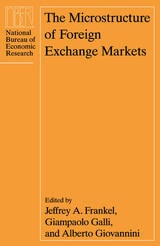
The Microstructure of Foreign Exchange Markets
Edited by Jeffrey A. Frankel, Giampaolo Galli, and Alberto Giovannini
University of Chicago Press, 1996
The foreign exchange market is the largest, fastest-growing financial market in the world. Yet conventional macroeconomic approaches do not explain why people trade foreign exchange. At the same time, they fail to explain the short-run determinants of the exchange rate.
These nine innovative essays use a microstructure approach to analyze the workings of the foreign exchange market, with special emphasis on institutional aspects and the actual behavior of market participants. They examine the volume of transactions, heterogeneity of traders, the time of day and location of trading, the bid-ask spread, and the high level of exchange rate volatility that has puzzled many observers. They also consider the structure of the market, including such issues as nontransparency, asymmetric information, liquidity trading, the use of automated brokers, the relationship between spot and derivative markets, and the importance of systemic risk in the market.
This timely volume will be essential reading for anyone interested in the economics of international finance.
[more]
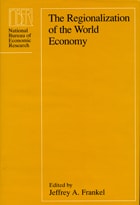
The Regionalization of the World Economy
Edited by Jeffrey A. Frankel
University of Chicago Press, 1997
Regional economic arrangements such as free trade areas (FTAs), customs unions, and currency blocs, have become increasingly prevalent in the world economy. Both pervasive and controversial, regionalization has some economists optimistic about the opportunities it creates and others fearful that it may corrupt fragile efforts to encourage global free trade.
Including both empirical and theoretical studies, this volume addresses several important questions: Why do countries adopt FTAs and other regional trading arrangements? To what extent have existing regional arrangements actually affected patterns of trade? What are the welfare effects of such arrangements? Several chapters explore the economic effects of regional arrangements on patterns of trade, either on price differentials or via the gravity model on bilateral trade flows. In addition, this book examines the theoretical foundation of the gravity model. Making extensive use of the gravity model of bilateral trade, several chapters explore the economic effects of regional arrangements. In addition, this book examines the theoretical foundation of the gravity model.
Including both empirical and theoretical studies, this volume addresses several important questions: Why do countries adopt FTAs and other regional trading arrangements? To what extent have existing regional arrangements actually affected patterns of trade? What are the welfare effects of such arrangements? Several chapters explore the economic effects of regional arrangements on patterns of trade, either on price differentials or via the gravity model on bilateral trade flows. In addition, this book examines the theoretical foundation of the gravity model. Making extensive use of the gravity model of bilateral trade, several chapters explore the economic effects of regional arrangements. In addition, this book examines the theoretical foundation of the gravity model.
[more]