Results by title
7 books match the query 'Franklin, Benjamin'

Benjamin Franklin and His Gods
Kerry S. Walters
University of Illinois Press, 1999
the towering figure--and mind--of Benjamin Franklin. A Renaissance man
in a Revolutionary time, Franklin had interests and knowledge not only
in religion but in literature, philosophy, politics, publishing, history,
and scientific inquiry, among many other disciplines.
Kerry S. Walters examines Franklin's search for the Divine using a similar,
multifaceted approach--and in so doing has created the first extended
treatment of Franklin's religious thought in thirty years. Walters brings
the same intellectual range and depth to the understanding of Franklin's
beliefs that Franklin brought to his own quest. What emerges from this
pilgrimage into the soul of one of America's greatest figures is a very
human Benjamin Franklin who grew with the accumulation of knowledge to
arrive at a "theistic perspectivism," which provided him with
a philosophical explanation for the diversity of religious faiths--and
a justification for the liberty of conscience he advocated throughout
his life.
Benjamin Franklin and His Gods is an original and beautifully
challenging spiritual and intellectual biography. Destined to be a classic.
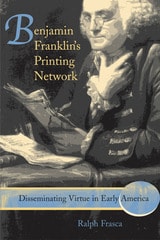
Benjamin Franklin's Printing Network
Disseminating Virtue in Early AmericaRalph Frasca
University of Missouri Press, 2005
Benjamin Franklin, Pennsylvania, and the First Nations
The Treaties of 1736-62Edited by Susan Kalter
University of Illinois Press, 2006
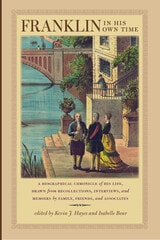
Franklin in His Own Time
A Biographical Chronicle of His Life, Drawn from Recollections, Interviews, and Memoirs by Family, Friends, and AssociatesKevin J. Hayes
University of Iowa Press, 2011
@font-face { font-family: "Courier New";}@font-face { font-family: "Times";}@font-face { font-family: "Cambria";}@font-face { font-family: "Palatino";}p.MsoNormal, li.MsoNormal, div.MsoNormal { margin: 0in 0in 0.0001pt; font-size: 12pt; font-family: "Times New Roman"; }div.Section1 { page: Section1; }
In his time Benjamin Franklin (1706–1790) was the most famous American in the world. Even those personally unacquainted with the man knew him as the author of Poor Richard’s Almanack, as a pioneer in the study of electricity and a major figure in the American Enlightenment, as the creator of such life-changing innovations as the lightning rod and America’s first circulating library, and as a leader of the American Revolution. His friends also knew him as a brilliant conversationalist, a great wit, an intellectual filled with curiosity, and most of all a master anecdotist whose vast store of knowledge complemented his conversational skills. In Franklin in His Own Time, by reprinting the original documents in which those anecdotes occur, Kevin Hayes and Isabelle Bour restore those oft-told stories to their cultural contexts to create a comprehensive narrative of his life and work.
The thirty-five recollections gathered in Franklin in His Own Time form an animated, collaborative biography designed to provide a multitude of perspectives on the “First American.” Opening with an account by botanist Peter Kalm showing that Franklin was doing all he could to encourage the development of science in North America, it includes on-the-spot impressions from Daniel Fisher’s diary, the earliest surviving interview with Franklin, recollections from James Madison and Abigail Adams, Manasseh Cutler’s detailed description of the library at Franklin Court, and extracts from Alexander Hamilton’s unvarnished Minutes of the Tuesday Club. Franklin’s political missions to Great Britain and France, where he took full advantage of rich social and intellectual opportunities, are a source of many reminiscences, some published here in new translations. Genuine memories from such old friends as Thomas Jefferson and John Adams, as opposed to memories influenced by the Autobiography, clarify Franklin’s reputation. Robert Carr may have been the last remaining person who knew Franklin personally, and thus his recollections are particularly signific
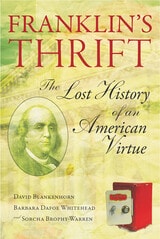
Franklin's Thrift
The Lost History of an American VirtueDavid Blankenhorn
Templeton Press, 2009
Americans today often think of thrift as a negative value—a miserly hoarding of resources and a denial of pleasure. Even more telling, many Americans don’t even think of thrift at all anymore. Franklin’s Thrift challenges this state of mind by recovering the rich history of thrift as a quintessentially American virtue.
The contributors to this volume trace how the idea and practice of thrift have been a vital part of the American vision of economic freedom and social abundance. For Benjamin Franklin, who personified and promoted the idea, thrift meant working productively, consuming wisely, saving proportionally, and giving generously. Franklin’s thrift became the cornerstone of a new kind of secular faith in the ordinary person’s capacity to shape his lot and fortune in life. Later chapters document how thrift moved into new domains in the nineteenth and twentieth centuries. It became the animating idea behind social movements to promote children’s school savings, create mutual savings banks and credit unions for working men and women, establish a federal savings bond program, and galvanize the nation to conserve resources during two world wars.
Historians, enthusiasts of Americana or traditional American virtues, and anyone interested in resolving our society’s current financial woes will find much to treasure in this diverse collection, with topics ranging from the inspirational lessons we can learn from the film It’s a Wonderful Life to a history of the roles played by mutual savings banks, credit unions, and thrift stores in America’s national thrift movement. It also includes actual policy recommendations for our present situation.
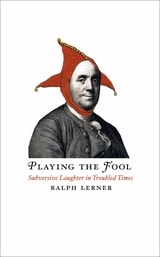
Playing the Fool
Subversive Laughter in Troubled TimesRalph Lerner
University of Chicago Press, 2009
The role of the fool is to provoke the powerful to question their convictions, preferably while avoiding a beating. Fools accomplish this not by hectoring their audience, but by broaching sensitive topics indirectly, often disguising their message in a joke or a tale. Writers and thinkers throughout history have adopted the fool’s approach, and here Ralph Lerner turns to six of them—Thomas More, Francis Bacon, Robert Burton, Pierre Bayle, Benjamin Franklin, and Edward Gibbon—to elucidate the strategies these men employed to persuade the heedless, the zealous, and the overly confident to pause and reconsider.
As Playing the Fool makes plain, all these men lived through periods marked by fanaticism, particularly with regard to religion and its relation to the state. In such a troubled context, advocating on behalf of skepticism and against tyranny could easily lead to censure, or even, as in More’s case, execution. And so, Lerner reveals, these serious thinkers relied on humor to move their readers toward a more reasoned understanding of the world and our place in it. At once erudite and entertaining, Playing the Fool is an eloquently thought-provoking look at the lives and writings of these masterly authors.

We Have All Gone Away
Curtis Harnack
University of Iowa Press, 1973