Results by title
15 books match the query 'Franklin, John Hope'
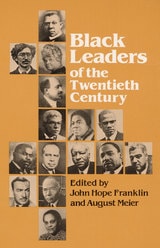
Black Leaders of the Twentieth Century
Edited by John Hope Franklin and August Meier
University of Illinois Press, 1982
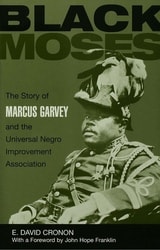
Black Moses
The Story of Marcus Garvey and the Universal Negro Improvement AssociationE. David Cronon; Foreward by John Hope Franklin
University of Wisconsin Press, 1960
In the early twentieth century, Marcus Garvey sowed the seeds of a new black pride and determination. Attacked by the black intelligentsia and ridiculed by the white press, this Jamaican immigrant astonished all with his black nationalist rhetoric. In just four years, he built the Universal Negro Improvement Association (UNIA), the largest and most powerful all-black organization the nation had ever seen. With hundreds of branches, throughout the United States, the UNIA represented Garvey’s greatest accomplishment and, ironically, the source of his public disgrace. Black Moses brings this controversial figure to life and recovers the significance of his life and work.
“Those who are interested in the revolutionary aspects of the twentieth century in America should not miss Cronon’s book. It makes exciting reading.”—The Nation
“A very readable, factual, and well-documented biography of Marcus Garvey.”—The Crisis, NAACP
“In a short, swiftly moving, penetrating biography, Mr. Cronon has made the first real attempt to narrate the Garvey story. From the Jamaican's traumatic race experiences on the West Indian island to dizzy success and inglorious failure on the mainland, the major outlines are here etched with sympathy, understanding, and insight.”—Mississippi Valley Historical Review (Now the Journal of American History).
“Good reading for all serious history students.”—Jet
“A vivid, detailed, and sound portrait of a man and his dreams.”—Political Science Quarterly
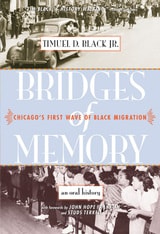
Bridges of Memory
Chicago's First Wave of Black MigrationTimuel D. Black Jr.
Northwestern University Press, 2005
Co-published with the DuSable Museum of African American History
Recipient of 2007 The Hyde Park Historical Society Paul Cornell Award
A collection of interviews with African Americans who came to Chicago from the South. In their first great migration to Chicago that began during World War I, African Americans came from the South seeking a better life--and fleeing a Jim Crow system of racial prejudice, discrimination, and segregation. What they found was much less than what they'd hoped for, but it was much better than what they'd come from--and in the process they set in motion vast changes not only in Chicago but also in the whole fabric of American society. This book, the first of three volumes, revisits this momentous chapter in American history with those who lived it.
Oral history of the first order, Bridges of Memory lets us hear the voices of those who left social, political, and economic oppression for political freedom and opportunity such as they'd never known--and for new forms of prejudice and segregation. These children and grandchildren of ex-slaves found work in the stockyards and steel mills of Chicago, settled and started small businesses in the "Black Belt" on the South Side, and brought forth the jazz, blues, and gospel music that the city is now known for. Historian Timuel D. Black, Jr., himself the son of first-generation migrants to Chicago, interviews a wide cross-section of African Americans whose remarks and reflections touch on issues ranging from fascism to Jim Crow segregation to the origin of the blues. Their recollections comprise a vivid record of a neighborhood, a city, a society, and a people undergoing dramatic and unprecedented changes.
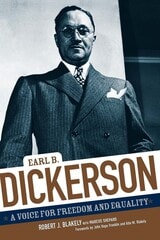
Earl B. Dickerson
A Voice for Freedom and EqualityRobert J. Blakely
Northwestern University Press, 2006
At fifteen, Earl Burrus Dickerson stowed away on a train in Canton, Mississippi, fleeing the racial oppression of his native South. But Chicago, the boy's destination, was no haven of racial fairness and equality. His flight north was in fact the beginning of a journey that would last a lifetime--and would forever pit Dickerson against the forces of racial injustice. Earl B. Dickerson's story, told here for the first time, is one of courage and character, of remarkable accomplishment in the face of terrible odds; it is also emblematic of the twentieth-century struggle for civil rights--a crucial chapter of African American history as it was lived by one uncompromising individual.
In this book, Robert J. Blakely tells how Dickerson (1891-1986) worked his way through preparatory schools and college, a segregated officer's training school, and law school at the University of Chicago. The story follows Dickerson's career as general counsel to the first insurance company owned and operated by African Americans; the first African American Democratic alderman elected to the Chicago City Council; a member of FDR's first Fair Employment Practices Committee; leader of the movement that broke the color barrier to membership in the Illinois Bar Association; and, perhaps most famously, the power behind Hansberry v. Lee, the U.S. Supreme Court case that marked the beginning of the end of restrictive real estate covenants--one of the most pernicious legal tools of segregation in the North. Blakely gives us a sense of the man behind the achievements, the life that defied conventions and statistics, and the world in which "the dean of Chicago's black lawyers" became a pioneering architect for equal opportunity in American life.
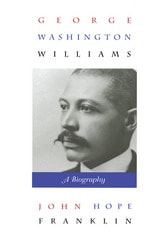
George Washington Williams
A BiographyJohn Hope Franklin
Duke University Press, 1998
Williams, who lived from 1849 to 1891, had a remarkable career as soldier, minister, journalist, lawyer, politician, freelance diplomat, and African traveler, as well as a historian. While Franklin reveals the accomplishments of this neglected figure and emphasizes the racism that curtailed Williams’s many talents, he also highlights the personal weaknesses that damaged Williams’s relationships and career. Williams led the way in presenting African American history accurately through the use of oral history and archival research, sought to legitimize it as a field of historical study, and spoke out in support of an American Negro Historical Society and as a critic of European imperialism in Africa. He also became erratic and faithless to his family and creditors and died at the age of forty-one, destitute and alienated from family and friends. George Washington Williams is nothing less than a classic biography of a brilliant though flawed individual whose History of the Negro Race in America remains a landmark in African American history and American intellectual history.
Knowing Him by Heart
African Americans on Abraham LincolnEdited by Frederick Hord and Matthew D. Norman
University of Illinois Press, 2023
Winner of an Abraham Lincoln Institute Book Award
Though not blind to Abraham Lincoln's imperfections, Black Americans long ago laid a heartfelt claim to his legacy. At the same time, they have consciously reshaped the sixteenth president's image for their own social and political ends. Frederick Hord and Matthew D. Norman's anthology explores the complex nature of views on Lincoln through the writings and thought of Frederick Douglass, Ida B. Wells-Barnett, Mary McLeod Bethune, Thurgood Marshall, Malcolm X, Gwendolyn Brooks, Barbara Jeanne Fields, Barack Obama, and dozens of others. The selections move from speeches to letters to book excerpts, mapping the changing contours of the bond--emotional and intellectual--between Lincoln and Black Americans over the span of one hundred and fifty years.
A comprehensive and valuable reader, Knowing Him by Heart examines Lincoln’s still-evolving place in Black American thought.
Racial Equality in America
John Hope Franklin
University of Missouri Press, 1976
This is distinguished historian John Hope Franklin's eloquent and forceful meditation on the persistent disparity between the goal of racial equality in America and the facts of discrimination.
In a searing critique of Thomas Jefferson, Franklin shows that this spokesman for democracy did not include African Americans among those "created equal." Franklin chronicles the events of the nineteenth century that solidified inequality in America and shows how emancipation dealt only with slavery, not with inequality.
In the twentieth century, America finally confronted the fact that equality is indivisible: it must not be divided so that it is extended to some at the expense of others. Once this indivisibility is accepted, Franklin charges, America faces the monumental task of overcoming its long heritage of inequality.
Racial Equality in America is a powerful reminder that our history is more than a record of idealized democratic traditions and institutions. It is a dramatic message to all Americans, calling them to know their history and themselves.
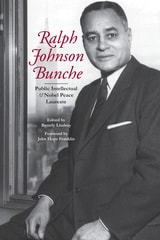
Ralph Johnson Bunche
Public Intellectual and Nobel Peace LaureateEdited by Beverly Lindsay; Foreword by John Hope Franklin
University of Illinois Press, 2007
Nobel Peace Prize winner Ralph Johnson Bunche (1904-71) was one of the twentieth century’s foremost diplomats and intellectuals. In the wake of centennial celebrations of his birth, leading scholars and diplomats assess Bunche’s historical importance and enduring impact on higher education, public policy, and international politics. Their essays reveal not only the breadth of Bunche’s influence, such as his United Nations work to broker peace during times of civil war in Africa, the Middle East, and Asia, but also the depth of his intellectual perspectives on race, civil rights, higher education, and international law. Probing his publications, speeches, and public policy initiatives, the volume offers telling insights into the critical roles of universities, public intellectuals, and diplomats in working together to find solutions to domestic and international problems through public and scholarly engagement. In this way, the volume highlights the very connections that Bunche exhibited as an academic, intellectual, and diplomat.
Contributors include Lorenzo DuBois Baber, John Hope Franklin, Jonathan Scott Holloway, Charles P. Henry, Ben Keppel, Beverly Lindsay, Princeton Lyman, Edwin Smith, and Hanes Walton Jr.
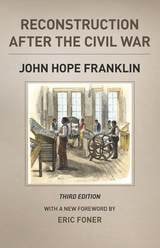
Reconstruction after the Civil War, Third Edition
John Hope Franklin
University of Chicago Press, 2012
Reconstruction after the Civil War explores the role of former slaves during this period in American history. Looking past popular myths and controversial scholarship, John Hope Franklin uses his astute insight and careful research to provide an accurate, comprehensive portrait of the era. His arguments concerning the brevity of the North’s occupation, the limited power wielded by former slaves, the influence of moderate southerners, the flawed constitutions of the radical state governments, and the downfall of Reconstruction remain compelling today. This new edition of Reconstruction after the Civil War also includes a foreword by Eric Foner and a perceptive essay by Michael W. Fitzgerald.
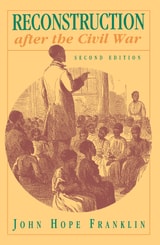
Reconstruction after the Civil War
Second EditionJohn Hope Franklin
University of Chicago Press, 1994
Now Franklin has updated his work to acknowledge the enormous body of research and scholarship that followed in the wake of the first edition. New are Franklin’s references to important, later texts that enrich the original narrative. In addition, the extensive bibliography has been thoroughly revised.
What has not changed, however, is the foundation Franklin has laid. Still compelling are his arguments concerning the brevity of the North’s military occupation of the South, the limited amount of power wielded by former slaves, the influence of moderate southerners, the flaws of the constitutions drawn up by the Radical state governments, and the reasons for the downfall of Reconstruction.
Remembering Brown at Fifty
The University of Illinois Commemorates Brown v. Board of EducationEdited by Orville Vernon Burton and David O'Brien
University of Illinois Press, 2009
Inspired by the University of Illinois's celebration of the Brown v. Board of Education decision's fiftieth anniversary, this collection addresses the significance of Brown in the contributors' lives or work in education and civil rights. Several authors describe their personal roles in the Brown case or similar cases, while others examine and illustrate events, performances, and exhibitions that were part of the anniversary commemoration. The book not only explores the repercussions of the Brown decision, but also stands as a historic document in its own right, preserving the reactions of many prominent intellectuals, artists, and activists fifty years after the decision.
Contributors are Kal Alston, Margaret L. Andersen, Kathryn H. Anthony, Nathaniel C. Banks, Bernice McNair Barnett, Christopher Benson, Ed Blankenheim, Julian Bond, Orville Vernon Burton, Jason Chambers, Constance Curry, Joseph A. De Laine Jr., Mary L. Dudziak, Joe R. Feagin, John Hope Franklin, Ophelia De Laine Gona, Lani Guinier, Darlene Clark Hine, Freeman A. Hrabowski III, John Jennings, Ralph Lemon, George Lipsitz, Jim Loewen, Laughlin McDonald, David O'Brien, James C. Onderdonk, Sekou Sundiata, Christopher Teal, Nicholas Watkins, Carrie Mae Weems, Juan Williams, and Joy Ann Williamson.
The Color Line
Legacy for the Twenty-First CenturyJohn Hope Franklin
University of Missouri Press, 1993
The Color Line
Legacy for the Twenty-First CenturyJohn Hope Franklin
University of Missouri Press, 1993
The Militant South, 1800-1861
John Hope Franklin
University of Illinois Press, 2002
Franklin asserts that the South was dominated by militant white men who resorted to violence in the face of social, personal, or political conflict. Fueled by their defense of slavery and a persistent desire to keep the North out of their affairs, Southerners adopted a vicious bellicosity that intensified as war drew nearer.
Drawing from Southern newspapers, government archives, memoirs, letters, and firsthand accounts, Franklin masterfully details the sources and consequences of antebellum aggression in the South. First published in 1956, this classic volume is an enduring and impeccably researched contribution to Southern history. This paperback edition features a new preface in which the author discusses controversial responses to the book.
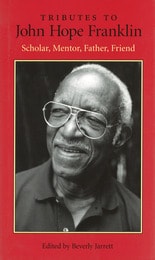
Tributes to John Hope Franklin
Scholar, Mentor, Father, FriendEdited by Beverly Jarrett
University of Missouri Press, 2003