Results by title
8 books match the query 'Free Will & Determinism'
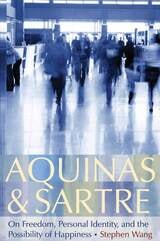
Aquinas and Sartre
On Freedom, Personal Identity, and the Possibility of HappinessStephen Wang
Catholic University of America Press, 2009
Do Not Reisist the Spirit's Call
Michael D. Torre
Catholic University of America Press, 2013
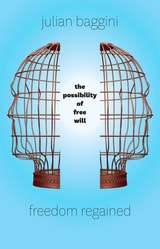
Freedom Regained
The Possibility of Free WillJulian Baggini
University of Chicago Press, 2015
Freedom Regained brings the issues raised by the possibilities—and denials—of free will to thought-provoking life, drawing on scientific research and fascinating encounters with everyone from artists to prisoners to dissidents. He looks at what it means for us to be material beings in a universe of natural laws. He asks if there is any difference between ourselves and the brains from which we seem never able to escape. He throws down the wildcards and plays them to the fullest: What about art? What about addiction? What about twins? And he asks, of course, what this all means for politics.
Ultimately, Baggini challenges those who think free will is an illusion. Moving from doubt to optimism to a hedged acceptance of free will, he ultimately lands on a satisfying conclusion: it is something we earn. The result is a highly engaging, new, and more positive understanding of our sense of personal freedom, a freedom that is definitely worth having.
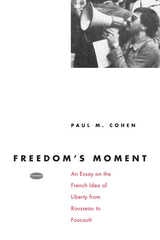
Freedom's Moment
An Essay on the French Idea of Liberty from Rousseau to FoucaultPaul M. Cohen
University of Chicago Press, 1997
Arranged not according to the lives and times of its protagonists but to the narrative themes and structures they held in common, Cohen’s study discerns a single master narrative of liberty in modern France. He captures these radicals, whose tradition bids them to resist the authority of power structures and public opinion. They denounce bourgeois and utilitarian values, the power of Church and State, and the corrupting influence of everyday politics, and they dream of a revolutionary rupture, a fleeting instant of sometimes violent but always meaningful transgression.
An eloquent and insightful work on French political culture, Freedom's Moment also helps explain how France, even as it has oscillated between political stagnation and crisis, has held onto its faith that liberty, equality, and fraternity remain within its grasp.
Examines the ideas of Rousseau, Robespierre, Stendahl, Michelet, Bergson, Peguy, Sartre, and Foucault.
Necessity or Contingency
The Master ArgumentJules Vuillemin
CSLI, 1996
Subjects of the World
Darwin's Rhetoric and the Study of Agency in NaturePaul Sheldon Davies
University of Chicago Press, 2009
Being human while trying to scientifically study human nature confronts us with our most vexing problem. Efforts to explicate the human mind are thwarted by our cultural biases and entrenched infirmities; our first-person experiences as practical agents convince us that we have capacities beyond the reach of scientific explanation. What we need to move forward in our understanding of human agency, Paul Sheldon Davies argues, is a reform in the way we study ourselves and a long overdue break with traditional humanist thinking.
Davies locates a model for change in the rhetorical strategies employed by Charles Darwin in On the Origin of Species. Darwin worked hard to anticipate and diminish the anxieties and biases that his radically historical view of life was bound to provoke. Likewise, Davies draws from the history of science and contemporary psychology and neuroscience to build a framework for the study of human agency that identifies and diminishes outdated and limiting biases. The result is a heady, philosophically wide-ranging argument in favor of recognizing that humans are, like everything else, subjects of the natural world—an acknowledgement that may free us to see the world the way it actually is.

The Coherence of Kant's Doctrine of Freedom
Bernard Carnois
University of Chicago Press, 1987
Widely praised when first published in France, The Coherence of Kant's Doctrine of Freedom articulates and interrelates the disparate senses of freedom in Kant's work. Bernard Carnois organizes all Kant's usages into a logical "grammar," isolating and defining the individual meanings and pointing out their implications and limits. In a first step, he shows how Kant's notion of intelligible character makes possible a synthesis of transcendental freedom, as a problematic concept of theoretical reason, and practical freedom, as a fact demonstrated by experience. He then develops the concept of freedom under the rubric of the will's autonomy in the context of the moral law. And finally, Carnois persistently explores the role of negativity in Kant's idea of freedom. For within the magisterial coherence of the system the imperfection of human finitude is inscribed. This introduces the "history" of our freedom—a freedom which posits itself, but then inevitably denies itself, even while preserving the possibility of its regeneration.
The only work in English to consider in detail all of Kant's writings on freedom, this book also introduces French Kant scholars whose works have often been unavailable to English-speaking readers. As both an interpretation of Kant and a trenchant analysis of the relationship between ethical commitments and metaphysical assumptions, it will be a useful addition to moral, religious, and political philosophy as well as to Kant scholarship.
Weakness of Will from Plato to the Present (Studies in Philosophy and the History of Philosophy, Volume 49)
Tobias Hoffmann
Catholic University of America Press, 2008