Results by title
16 books match the query 'French Revolution'
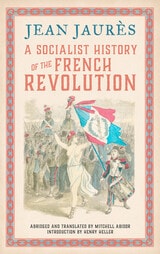
A Socialist History of the French Revolution
Jean Jaurés
Pluto Press, 2021
Jean Jaurès was the celebrated French Socialist Party leader, assassinated in 1914 for trying to use diplomacy and industrial action to prevent the outbreak of war. Published just a few years before his death, his magisterial A Socialist History of the French Revolution has endured for over a century.
Written in the midst of his activities as leader of the Socialist Party and editor of its newspaper, L'Humanite, Jaurès intended the book to serve as both a guide and an inspiration to political activity; even now it can serve to do just that.
Jaurès's verve, originality, and willingness to criticize all players in this epic drama make this a truly moving addition to the shelf of great books on the French Revolution. Mitchell Abidor's abridged translation of Jaurès's original six volumes makes this exceptional work truly accessible to an Anglophone audience.
Echoes of the Marseillaise
Two Centuries Look Back on the French RevolutionHobsbawm, Eric
Rutgers University Press, 1990
We can learn a great deal from studying the French Revolution itself, but we can also learn from studying the ways in which scholars have interpreted the French Revolution, and from the ways their views have changed. For over a century following the Revolution, commentators and scholars spoke of it in glowing terms. But in the past three decades, revisionist historians have become skeptical. Eric Hobsbawm reiterates the centrality of the Revolution for history on a global basis. He argues that those who wrote about the Revolution in the nineteenth century were convinced it had changed their lives dramatically, improving the economy and the lot of peasants. They saw the Revolution as a prototype of of the bourgeois revolution, enabling the middle class to gain power from the ruling class of aristocrats. Many believed proletarian revolutions would inevitably follow. In the years between 1917 and the 1960s, Marxists continued to use the French Revolution as a point of reference, paying increasing attention to the social and economic factors in the Revolution, not only to the political factors. In the 1970s and 1980s, many historians began to argue that the Revolution achieved modest results at disproportionate costs. Hobsbawm argues that this massive historiographical reaction against the centrality of the Revolution reflects the personal politics of those contemporary historians for whom Marxism and communism are now out of favor. They are, he maintains, wrong. The Revolution transformed the world permanently and introduced forces that continue to transform it.
Echoes of the Marseillaise
Two Centuries Look Back on the French RevolutionHobsbawm, Eric
Rutgers University Press, 2019
E.J. Hobsbawm’s classic historiographic study—written at the very moment when a new set of revolutions swept through the Eastern Bloc and brought down the Iron Curtain—explores how the French Revolution was perceived over the following two centuries. He traces how the French Revolution became integral to nineteenth-century political discourse, when everyone from bourgeois liberals to radical socialists cited these historical events, even as they disagreed on what their meaning. And he considers why references to the French Revolution continued to inflame passions into the twentieth century, as a rhetorical touchstone for communist revolutionaries and as a boogeyman for social conservatives.
Echoes of the Marseillaise is a stimulating examination of how the same events have been reimagined by different generations and factions to serve various political agendas. It will give readers a new appreciation for how the French Revolution not only made history, but also shaped our fundamental notions about history itself.

Jean Paul Marat
Tribune of the French RevolutionClifford D. Conner
Pluto Press, 2012
Jean-Paul Marat’s role in the French Revolution has long been a matter of controversy among historians. Often he has been portrayed as a violent, sociopathic demagogue. This biography challenges that interpretation and argues that without Marat’s contributions as an agitator, tactician, and strategist, the pivotal social transformation that the Revolution accomplished might well not have occurred.
Clifford D. Conner argues that what was unique about Marat - which set him apart from all other major figures of the Revolution, including Danton and Robespierre - was his total identification with the struggle of the propertyless classes for social equality.
This is an essential book for anyone interested in the history of the revolutionary period and the personalities that led it.
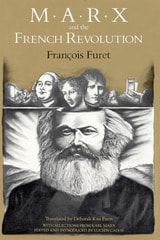
Marx and the French Revolution
François Furet
University of Chicago Press, 1988
With his early critique of Hegel, Marx started moving toward his fundamental thesis: that the state is a product of civil society and that the French Revolution was the triumph of bourgeois society. Furet's interpretation follows the evolution of this idea and examines the dilemmas it created for Marx as he considered all the faces the new state assumed over the course of the Revolution: the Jacobin Terror following the constitutional monarchy, Bonaparte's dictatorship following the parliamentary republic.
The problem of reconciling his theory with the reality of the Revolution's various manifestations is one of the major difficulties Marx contended with throughout his work. The hesitation, the remorse, and the contradictions of the resulting analyses offer a glimpse of a great thinker struggling with the constraints of his own system. Marx never did elaborate a theory of an autonomous state, but he never stopped wrestling with the challenge to his doctrine posed by late eighteenth-century France, whose changing conditions and successive regimes prompted some of his most intriguing and, until now, unexplored thought.

Molière, the French Revolution, and the Theatrical Afterlife
Leon, Mechele
University of Iowa Press, 2009
Leon begins by analyzing the performance of Molière’s plays during the Revolution, showing how his privileged position as royal servant was disrupted by the practical conditions of the revolutionary theatre. Next she explores Molière’s relationship to Louis XIV, Tartuffe, and the social function of his comedy, using Rousseau’s famous critique of Molière as well as appropriations of George Dandin in revolutionary iconography to discuss how Moliérean laughter was retooled to serve republican interests. After examining the profusion of plays dealing with his life in the latter years of the Revolution, she looks at the exhumation of his remains and their reentombment as the tangible manifestation of his passage from Ancien Régime favorite to new national icon.
The great Molière is appreciated by theatre artists and audiences worldwide, but for the French people it is no exaggeration to say that the Father of French Comedy is part of their national soul. By showing how he was represented, reborn, and reburied in the new France—how the revolutionaries asserted his relevance for their tumultuous time in ways that were audacious, irreverent, imaginative, and extreme—Leon clarifies the important role of theatrical figures in preserving and portraying a nation’s history.

Politicizing Gender
Narrative Strategies in the Aftermath of the French RevolutionKadish, Doris Y
Rutgers University Press, 1991

Representing the French Revolution
Literature, Historiography, and ArtEdited by James A. W. Heffernan
Brandeis University Press, 1992

Soldiers of the French Revolution
Alan Forrest
Duke University Press, 1989
Revolutionary idealists thought of the French soldier as a willing volunteer sacrificing himself for the principles of the Revolution; Forrest examines the convergence of these ideals with the ordinary, and often dreadful, experience of protracted warfare that the soldier endured.
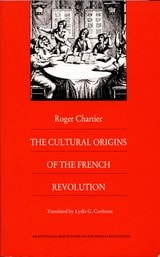
The Cultural Origins of the French Revolution
Roger Chartier
Duke University Press, 1991
Chartier has set himself two important tasks. First, while acknowledging the seminal contribution of Daniel Mornet’s Les origens intellectuelles de la Révolution française (1935), he synthesizes the half-century of scholarship that has created a sociology of culture for Revolutionary France, from education reform through widely circulated printed literature to popular expectations of government and society. Chartier goes beyond Mornet’s work, not be revising that classic text but by raising questions that would not have occurred to its author.
Chartier’s second contribution is to reexamine the conventional wisdom that there is a necessary link between the profound cultural transformation of the eighteenth century (generally characterized as the Enlightenment) and the abrupt Revolutionary rupture of 1789. The Cultural Origins of the French Revolution is a major work by one of the leading scholars in the field and is likely to set the intellectual agenda for future work on the subject.
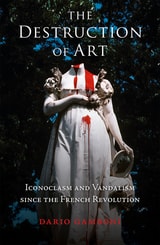
The Destruction of Art
Iconoclasm and Vandalism since the French RevolutionDario Gamboni
Reaktion Books, 2007
Last winter, a man tried to break Marcel Duchamp’s Fountain sculpture. The sculpted foot of Michelangelo’s David was damaged in 1991 by a purportedly mentally ill artist. With each incident, intellectuals must confront the unsettling dynamic between destruction and art. Renowned art historian Dario Gamboni is the first to tackle this weighty issue in depth, exploring specters of censorship, iconoclasm, and vandalism that surround such acts.
Gamboni uncovers here a disquieting phenomenon that still thrives today worldwide. As he demonstrates through analyses of incidents occurring in nineteenth- and twentieth-century America and Europe, a complex relationship exists among the evolution of modern art, destruction of artworks, and the long history of iconoclasm. From the controversial removal of Richard Serra’s Tilted Arc from New York City’s Federal Plaza to suffragette protests at London’s National Gallery, Gamboni probes the concept of artist’s rights, the power of political protest and how iconoclasm sheds light on society’s relationship to art and material culture.
Compelling and thought-provoking, The Destruction of Art forces us to rethink the ways that we interact with art and react to its power to shock or subdue.

The Long Affair
Thomas Jefferson and the French Revolution, 1785-1800Conor Cruise O'Brien
University of Chicago Press, 1996
"The book is an attack on America's long affair with Jeffersonian ideology of radical individualism: an ideology that, by confusing Jefferson with a secular prophet, will destroy the United States from within."—David C. Ward, Boston Book Review
"With his background as a politician and a diplomat, O'Brien brings a broad perspective to his effort to define Jefferson's beliefs through the prism of his attitudes toward France. . . . This is an important work that makes an essential contribution to the overall picture of Jefferson."—Booklist
"O'Brien traces the roots of Jefferson's admiration for the revolution in France but notes that Jefferson's enthusiasm for France cooled in the 1790s, when French egalitarian ideals came to threaten the slave-based Southern economy that Jefferson supported."—Library Journal
"In O'Brien's opinion, it's time that Americans face the fact that Jefferson, long seen as a champion of the 'wronged masses,' was a racist who should not be placed on a pedestal in an increasingly multicultural United States."—Boston Phoenix
"O'Brien makes a well-argued revisionist contribution to the literature on Jefferson."—Kirkus Reviews
"O'Brien is right on target . . . determined not to let the evasions and cover-ups continue."—Forrest McDonald, National Review
"The Long Affair should be read by anyone interested in Jefferson—or in a good fight."—Richard Brookhiser, New York Times Book Review
The Origins of the Welfare State
Women, Work, and the French RevolutionLisa DiCaprio
University of Illinois Press, 2005
Women workers and the revolutionary origins of the modern welfare state
In May 1790, the French National Assembly created spinning workshops (ateliers de filature) for thousands of unemployed women in Paris. These ateliers disclose new aspects of the process which transformed Old Regime charity into revolutionary welfare initiatives characterized by secularization, centralization, and entitlements based on citizenship. This study is the first to examine women and the welfare state in its formative period at a time when modern concepts of human rights were elaborated.
In The Origins of the Welfare State, Lisa DiCaprio reveals how the women working in the ateliers, municipal welfare officials, and the national government vied to define the meaning of revolutionary welfare throughout the Revolution. Presenting demands for improved wages and working conditions to a wide array of revolutionary officials, the women workers exercised their rights as "passive citizens" capaciously and shaped the meanings of work, welfare, and citizenship. Looking backward to the Old Regime and forward to the nineteenth century, this study explores the interventionist spirit that characterized liberalism in the eighteenth century and serves as a bridge to the history of entitlements in the nineteenth and twentieth centuries.

The Rise and Fall of the French Revolution
Edited by T. C. W. Blanning
University of Chicago Press, 1996
The Rise and Fall of the French Revolution is a collection of seventeen pathbreaking articles which originally appeared in the Journal of Modern History. Contributors include Keith Michael Baker, Suzanne Desan, Bill Edmonds, François Furet, Vivian R. Gruder, Paul Hanson, James N. Hood, Lynn Hunt, David Lansky, Colin Lucas, John Markoff, Mona Ozouf, Alison Patrick, Jeremy D. Popkin, William H. Sewell, Jr., Theda Skocpol, Timothy Tackett, and Dale Van Kley. In addition, a substantial introduction by the editor discusses the evolution of the history of the period and how the individual contributors have shaped the debate.
This volume not only chronicles the rise and fall of the French Revolution but also introduces the reader to the different approaches being employed by the most eminent historians working in the field. The result is a volume on the French Revolution that offers a compelling combination of information and opinion, narrative and interpretation.

The Terror of Natural Right
Republicanism, the Cult of Nature, and the French RevolutionDan Edelstein
University of Chicago Press, 2009
Natural right—the idea that there is a collection of laws and rights based not on custom or belief but that are “natural” in origin—is typically associated with liberal politics and freedom. In The Terror of Natural Right, Dan Edelstein argues that the revolutionaries used the natural right concept of the “enemy of the human race”—an individual who has transgressed the laws of nature and must be executed without judicial formalities—to authorize three-quarters of the deaths during the Terror. Edelstein further contends that the Jacobins shared a political philosophy that he calls “natural republicanism,” which assumed that the natural state of society was a republic and that natural right provided its only acceptable laws. Ultimately, he proves that what we call the Terror was in fact only one facet of the republican theory that prevailed from Louis’s trial until the fall of Robespierre.
A highly original work of historical analysis, political theory, literary criticism, and intellectual history, The Terror of Natural Right challenges prevailing assumptions of the Terror to offer a new perspective on the Revolutionary period.
University of Chicago Readings in Western Civilization, Volume 7
The Old Regime and the French RevolutionEdited by Keith M. Baker
University of Chicago Press, 1987
The University of Chicago Readings in Western Civilization series makes available to students and teachers a unique selection of primary documents, many in new translations. These readings, prepared for the highly praised Western civilization sequence at the University of Chicago, were chosen by an outstanding group of scholars whose experience teaching that course spans almost four decades. Each volume includes rarely anthologized selections as well as standard, more familiar texts; a bibliography of recommended parallel readings; and introductions providing background for the selections. Beginning with Periclean Athens and concluding with twentieth-century Europe, these source materials enable teachers and students to explore a variety of critical approaches to important events and themes in Western history.
Individual volumes provide essential background reading for courses covering specific eras and periods. The complete nine-volume series is ideal for general courses in history and Western civilization sequences.