Results by title
9 books match the query 'French and Indian War, 1754-1763'
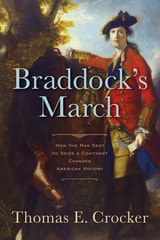
Braddock's March
How the Man Sent to Seize a Continent Changed American HistoryThomas E. Crocker
Westholme Publishing, 2009
Winner of the 2011 New York Society of Colonial Wars Distinguished Book Award
“The strength of this book lies in Crocker’s presentation of the battle and the complicated logistics involved.”—Times Literary Supplement “Braddock’s March is arguably the first truly comprehensive history devoted exclusively to the calamitous march that remade North America. . . . Braddock’s story is superb history.”—Weekly Standard “Drawing on original sources, Crocker grittily reconstructs the advance of Edward Braddock’s army on Fort Duquesne. . . . Attentive to detail, Crocker will engage colonial-history readers in this well illustrated book.”—Booklist
“Both Braddock’s epic march and subsequent destruction are brought to life by Thomas E. Crocker in Braddock’s March, his impeccably researched account of an important but largely forgotten chapter in American history. . . . It all adds up to a stirring tale.”—Washington Times
“Before we parted, the General told me he should never see me more; for he was going with a handful of men to conquer whole nations; and to do this they must cut their way through unknown woods. He produced a map of the country, saying at the same time, ‘Dear Pop, we are sent like sacrifices to the altar.’” - George Anne Bellamy on General Edward Braddock’s departure
In January 1755, Major General Edward Braddock was sent by Great Britain on a mission to drive France once and for all from the New World. Accompanied by the largest armed expeditionary force ever sent to North America, Braddock’s primary target was the Forks of the Ohio, where he planned to seize Fort Duquesne (at present-day Pittsburgh, Pennsylvania), and then march north into Canada. After landing in Alexandria, Virginia, and organizing his troops and supply chain, Braddock and his expedition began its nearly 250-mile trek, heroically cutting through uncharted wilderness, fording rivers, and scaling the Appalachian mountains, all while hauling baggage and heavy artillery. Braddock was joined on this epic mission by a young Virginia colonel, George Washington, and others who would later play major roles in the American Revolution, including Horatio Gates, Thomas Gage, and Charles Lee; among those driving the expedition’s wagons were Daniel Boone and Daniel Morgan. Having withstood the harsh frontier and finally marching upon Fort Duquesne on a hot July morning, Braddock’s exhausted column was ambushed by a combined French and Indian force. Over two-thirds of Braddock’s British and colonial troops were killed or wounded, including Braddock himself, struck by a bullet in the chest while attempting to rally his disoriented troops. George Washington miraculously escaped harm despite four bullet holes through his clothing. With this battle, North America became the greatest stake in the global war between France and Great Britain.
In Braddock’s March: How the Man Sent to Seize a Continent Changed American History, Thomas E. Crocker tells the riveting story of one of the most important events in colonial America. Not only did Braddock’s expedition have a profound impact on American political and military developments, this fateful march laid the foundation for the “National Pike,” the major road for westward expansion, launched the career of George Washington, and sowed the seeds of dissent between England and its colonies that would ultimately lead to the American Revolution.
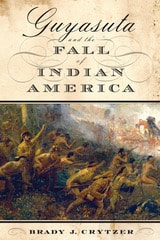
Guyasuta and the Fall of Indian America
Brady J. Crytzer
Westholme Publishing, 2013
Nearly a century before the United States declared the end of the Indian Wars, the fate of Native Americans was revealed in the battle of Fallen Timbers. In 1794, General Anthony Wayne led the first American army— the Legion of the United States—against a unified Indian force in the Ohio country. The Indians were routed and forced to vacate their lands. It was the last of a series of Indian attempts in the East to retain their sovereignty and foreshadowed what would occur across the rest of the continent. In Guyasuta and the Fall of Indian America, historian Brady J. Crytzer traces how American Indians were affected by the wars leading to American Independence through the life of one of the period’s most influential figures. Born in 1724, Guyasuta is perfectly positioned to understand the emerging political landscape of America in the tumultuous eighteenth century. As a sachem of the vaunted Iroquois Confederacy, for nearly fifty years Guyasuta dedicated his life to the preservation and survival of Indian order in a rapidly changing world, whether it was on the battlefield, in the face of powerful imperial armies, or around a campfire negotiating with his French, British, and American counterparts. Guyasuta was present at many significant events in the century, including George Washington’s expedition to Fort Le Boeuf, the Braddock disaster of 1755, Pontiac’s Rebellion and the Battle of Bushy Run in 1763, and the Battle of Oriskany during the American Revolution. Guyasuta’s involvement in the French and British wars and the American War for Independence were all motivated by a desire to retain relevance for Indian society. It was only upon the birth of the United States of America that Guyasuta finally laid his rifle down and watched as his Indian world crumbled beneath his feet. A broken man, debilitated by alcoholism, he died near Pittsburgh in 1794.
Supported by extensive research and full of compelling drama, Guyasuta and the Fall of Indian America unravels the tangled web of alliances, both white and native, and explains how the world of the American Indians could not survive alongside the emergent United States.
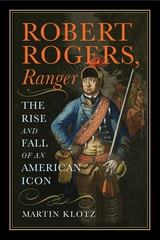
Robert Rogers, Ranger
The Rise and Fall of an American IconMartin Klotz
Westholme Publishing, 2026
Robert Rogers, Ranger: The Rise and Fall of an American Icon by Martin Klotz is a fresh look at the life of this famous, yet highly flawed man. Rogers undeniably had great personal strengths. He was brave nearly to the point of fearlessness. He was physically robust, always the one to cover the retreat, carry the wounded, or go for help when no one else could carry on. He was an intrepid explorer who wrote with eloquence about the splendors of the American frontier. He was bold and unconventional, good at thinking outside the box. He was an outstanding scout and intelligence gatherer who provided invaluable service to a British army inexperienced in woodland warfare. At the same time Rogers had enormous weaknesses that undermined his ability to lead effectively. His boldness was never tempered by judgment, and he was prone to grandiose schemes that came to nothing or, worse, to disaster. His constant self-promotion—including embellishing and lying about his battlefield successes—contributed to his popularity but damaged his reputation with peers and superiors. He succumbed to alcoholism and gambling, was profligate, especially with money—his debts were enormous—and routinely skirted the edges of the law. Rogers never found a comfortable place in America. Instead, his aristocratic patrons in London, who knew him mostly from his own self-description, gave him his most valuable opportunities, including commanding an important military and trading center on the colonial frontier and establishing the Queen’s Rangers to fight alongside Crown forces during the Revolution. But when the British cause failed in America, Rogers became an anathema on both sides of the Atlantic. A fascinating inquiry into an eighteenth-century life, Robert Rogers, Ranger presents this American legend as he lived, crossing the line between fame and misfortune.
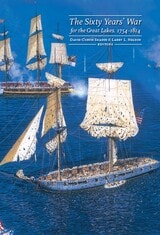
Sixty Years' War for the Great Lakes, 1754-1814
David Curtis Skaggs
Michigan State University Press, 2001
The Sixty Years' War for the Great Lakes contains twenty essays concerning not only military and naval operations, but also the political, economic, social, and cultural interactions of individuals and groups during the struggle to control the great freshwater lakes and rivers between the Ohio Valley and the Canadian Shield. Contributing scholars represent a wide variety of disciplines and institutional affiliations from the United States, Canada, and Great Britain.
Collectively, these important essays delineate the common thread, weaving together the series of wars for the North American heartland that stretched from 1754 to 1814. The war for the Great Lakes was not merely a sideshow in a broader, worldwide struggle for empire, independence, self-determination, and territory. Rather, it was a single war, a regional conflict waged to establish hegemony within the area, forcing interactions that divided the Great Lakes nationally and ethnically for the two centuries that followed.

The Journals of Jeffery Amherst, 1757-1763, Volume 1
The Daily and Personal JournalsRobert J. Andrews
Michigan State University Press, 2014

The Journals of Jeffery Amherst, 1757-1763, Volume 2
A Dictionary of People, Places, and ShipsRobert J. Andrews
Michigan State University Press, 2014
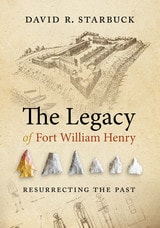
The Legacy of Fort William Henry
Resurrecting the PastDavid R. Starbuck
University Press of New England, 2014
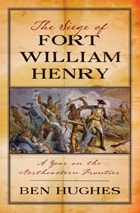
The Siege of Fort William Henry
A Year on the Northeastern FrontierBen Hughes
Westholme Publishing, 2012
Immortalized in The Last of the Mohicans, the True Story of a Pivotal Battle in the British and French War for the North American Continent
The opening years of the French and Indian War were disastrous for the British. In 1755 General Braddock’s troops were routed at the Battle of Monongahela and by the middle of 1756 Fort Oswego on Lake Ontario had fallen. Hindered by quarrelsome provincial councils, incompetent generals, and the redcoats’ inability to adapt to wilderness warfare, Britain was losing the war. In 1757 the 35th Regiment of Foot stepped into the breach. A poorly trained assortment of conscripts, old soldiers, and convicted criminals led by Lieutenant Colonel George Monro, the regiment was destined to take center stage in the most controversial event of the war. Fort William Henry on the southern shore of New York’s Lake George was a key fortification supporting British interests along the frontier with French America. Monro and his regiment occupied the fort in the spring of 1757 while Britain planned its attack on the key French fortress at Louisbourg, Nova Scotia. Learning that most of Britain’s military resources were allocated to Louisbourg, the French launched a campaign along the weakened frontier. French Commander Louis-Joseph de Montcalm and his American Indian allies laid siege to Fort William Henry; Monro could not hold out and was forced to surrender. As part of the terms, the British regiment, colonial militia, and their camp followers would be allowed safe passage to nearby Fort Edward. The French watched in horror, however, as their Indian allies attacked the British column after it left the fort, an episode that sparked outrage and changed the tactics of the war.
Seen through the eyes of participants such as Louis Antoine de Bougainville, a scholarly young aide-de-camp, Jabez Fitch, an amiable Connecticut sergeant, and Kisensik, a proud Nipissing chief whose father once met Louis XIV in the marbled halls of Versailles, The Siege of Fort William Henry: A Year on the Northeastern Frontier uses contemporary newspaper reports, official documents, private letters, and published memoirs to bring the narrative to life. From Indian councils on the banks of the Saint Lawrence River and bustling military camps in northern New York to the narrative’s bloody denouement on the shores of Lake George, the reader is immersed in the colorful, yet brutal world of eighteenth-century northeastern America.
The Snake Fence
Janet Olshewsky
QuakerPress, 2012