Results by title
74 books match the query 'Friendship' and 12 start with a
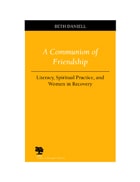
A Communion of Friendship
Literacy, Spiritual Practice, and Women in RecoveryBeth Daniell
Southern Illinois University Press, 2003
Drawing on interviews and an array of scholarly work, Beth Daniell maps out the relations of literacy and spirituality in A Communion of Friendship: Literacy, Spiritual Practice, and Women in Recovery. Daniell tells the story of a group of women in “Mountain City” who use reading and writing in their search for spiritual growth. Diverse in socioeconomic status, the Mountain City women are, or have been, married to alcoholics. In Al-Anon, they use literacy to practice the Twelve Steps of Alcoholics Anonymous in order to find spiritual solutions to their problems.
In addition, Daniell demonstrates that in the lives of these women, reading, writing, and speaking are intertwined, embedded in one another in rich and complex ways. For the women, private literate practice is of the utmost importance because it aids the development and empowerment of the self. These women engage in literate practices in order to grow spiritually and emotionally, to live more self-aware lives, to attain personal power, to find or make meaning for themselves, and to create community. By looking at the changes in the women’s reading, Daniell shows that Al-Anon doctrine, particularly its oral instruction, serves as an interpretive tool. This discussion points out the subtle but profound transformations in these women’s lives in order to call for an inclusive notion of politics.
Foregrounding the women’s voices, A Communion of Friendship addresses a number of issues important in composition studies and reading instruction. This study examines the meaning of literacy within one specific community, with implications both for pedagogy and for empirical research in composition inside and outside the academy.
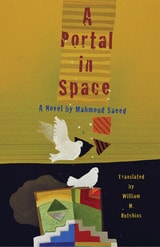
A Portal in Space
By Mahmoud Saeed, Translated by William M. Hutchins
University of Texas Press, 2015
A Portal in Space, set in Basra, Iraq, during the Iran-Iraq War (1980–1988), follows the lives of Anwar, a newly minted architect, and the other members of his affluent family as they attempt to maintain a sense of normality during the frequent bombing attacks from Iran. When Anwar joins the Iraqi army and then goes missing in action, his family struggles to cope with uncertainty over his fate. His mother falls into depression and secludes herself in the family home, while his father shifts his attention from his duties as a judge to the weekly pilgrimage to Baghdad seeking information on his son—and to Zahra, the young widow he meets there.
Emotionally engaging, A Portal in Space is a wry, wise tale of human beings striving to retain their humanity during a war that is anything but humane. Mahmoud Saeed succeeds brilliantly in bringing the sights and sounds of Iraq to life on the page—whether in a bunker on the front lines of the Iran-Iraq War or in the parlor of a fortune-teller in Baghdad. As Zahra says of the novel she is writing: “It is a normal novel that contains love, war, life, deceit, and death.”

A Small Apocalypse
StoriesLaura Chow Reeve
Northwestern University Press, 2024
In her debut short-story collection A Small Apocalypse, Laura Chow Reeve examines cultural inheritance, hybridity, queerness, and the stickiness of home with an eye for both the uncanny and the realistic: human bodies become reptilian, queer ghosts haunt their friends, a young woman learns to pickle memories, and a theater floods during an apocalyptic movie marathon. The characters in A Small Apocalypse weave in and out of its fourteen stories, confronting their sense of otherness and struggling to find new ways of being and belonging. Heavily steeped in the swampy, feral heat of Florida, these stories venture beyond the problems of constructing an identity to the frontier of characters living their truth in a world that doesn’t yet have a place for them.

Adolescent Relations with Mothers, Fathers and Friends
James Youniss and Jacqueline Smollar
University of Chicago Press, 1987
"A must for anyone interested in adolescent behavior."—Edward Z. Dager, Contemporary Sociology
Affective Communities
Anticolonial Thought, Fin-de-Siecle Radicalism, and the Politics of FriendshipLeela Gandhi
Duke University Press, 2006
Gandhi weaves together the stories of a number of South Asian and European friendships that flourished between 1878 and 1914, tracing the complex historical networks connecting figures like the English socialist and homosexual reformer Edward Carpenter and the young Indian barrister M. K. Gandhi, or the Jewish French mystic Mirra Alfassa and the Cambridge-educated Indian yogi and extremist Sri Aurobindo. In a global milieu where the battle lines of empire are reemerging in newer and more pernicious configurations, Affective Communities challenges homogeneous portrayals of “the West” and its role in relation to anticolonial struggles. Drawing on Derrida’s theory of friendship, Gandhi puts forth a powerful new model of the political: one that finds in friendship a crucial resource for anti-imperialism and transnational collaboration.

All the Tiny Beauties
A NovelJenn Scott
Acre Books, 2022
All the Tiny Beauties begins with a kitchen fire that sends the reclusive Webster Jackson to the home of his new neighbor, Colleen, who discovers him on her doorstep wearing a lacy peignoir, his house in flames. Unwilling to take responsibility for the lonely eccentric, Colleen reaches out to Webb’s estranged daughter, Debra. She also helps him find a live-in companion, a young adult reeling from the loss of her childhood friend.
Moving among perspectives and generations, we see the longings and vulnerabilities that drive and impede these characters as their stories intertwine—Webb’s first love clashing with his last; Colleen embarking on a secret affair with Debra; the older Webb and his young housemate, Hannah, forming a bond over tragedy, guilt, and his passion for baking.
Confronting the many ways they’ve failed others as well as themselves, Webb, Colleen, Hannah, and Debra slowly find ways forward and ways out. While exploring the fragile nature of our connections to one another, All the Tiny Beauties asks larger questions about the constraints society imposes that warp and wound, leading us to deny those things that make us wholly ourselves.
Ami and Amile
A Medieval Tale of Friendship, Translated from the Old FrenchSamuel N. Rosenberg and Samuel Danon
University of Michigan Press, 1996

Amigas
Letters of Friendship and ExileBy Marjorie Agosín and Emma Sepúlveda
University of Texas Press, 2001
This collection of letters chronicles a remarkable, long-term friendship between two women who, despite differences of religion and ethnicity, have followed remarkably parallel paths from their first adolescent meeting in their native Chile to their current lives in exile as writers, academics, and political activists in the United States. Spanning more than thirty years (1966-2000), Agosín's and Sepúlveda's letters speak eloquently on themes that are at once personal and political—family life and patriarchy, women's roles, the loneliness of being a religious or cultural outsider, political turmoil in Chile, and the experience of exile.
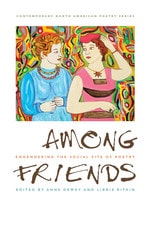
Among Friends
Engendering the Social Site of PoetryAnne Dewey and Libbie Rifkin
University of Iowa Press, 2013

An Autohistoria of Friendship with Gloria E. Anzaldúa
Three Soul Companions at the CrossroadsDavid Hatfield Sparks and Randy P. Conner
University of Illinois Press, 2027
Beginning their story in a large Noe Valley flat, Sparks and Conner trace how a collective of artists and activists shaped a shared life across lines of race, gender, and sexuality while forging a community linked through prejudice, illness, and loss. The authors mix personal stories with history and cultural memory. They also discuss Anzaldúa’s idea of spiritual mestizaje, a practice for healing and growth that joins Indigenous, African, Latino, European, and Queer traditions. Their idea of El Mundo Zurdo imagines an inclusive world that values diversity and the power of difference to create connections among human beings.
Merging spirituality with activism, An Autohistoria of Friendship with Gloria E. Anzaldúa shares a vision of a more just and caring future.
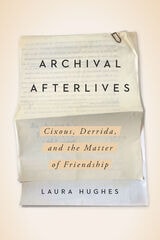
Archival Afterlives
Cixous, Derrida, and the Matter of FriendshipLaura Hughes
Northwestern University Press, 2024
A capacious analysis of a legendary intellectual friendship and the material legacies it left behind
Over the course of their decades-long friendship, Hélène Cixous and Jacques Derrida assembled overlapping archives of written experiments and exchanges that document a shared interest in their literary afterlives. In this incisive account, Laura Hughes shows how pushing against the limits of writing and of life itself means not only imagining but manifesting a community of future readers.
Archival Afterlives: Cixous, Derrida, and the Matter of Friendship examines the embodied nature of literary creation, taking letters, fragments, notes, and other ephemera as objects of critical analysis and care. Combining close readings of key texts and previously unexamined archival materials, Hughes traces critical connections between Cixous and Derrida, between the theoretical and the autobiographical, and between life writing and its limits. In putting deconstruction into dialogue with new material analyses and archive studies, Archival Afterlives positions this historical and intellectual relationship as a lens through which to reexamine the legacy of critical theory itself.

Asphodel
(Hilda Doolittle) H.D.
Duke University Press, 1992
A sequel to the author's HERmione, Asphodel takes the reader into the bohemian drawing rooms of pre-World War I London and Paris, a milieu populated by such thinly disguised versions of Ezra Pound, Richard Aldington, May Sinclair, Brigit Patmore, and Margaret Cravens; on the other side of what H.D. calls "the chasm," the novel documents the war's devastating effect on the men and women who considered themselves guardians of beauty. Against this riven backdrop, Asphodel plays out the story of Hermione Gart, a young American newly arrived in Europe and testing for the first time the limits of her sexual and artistic identities. Following Hermione through the frustrations of a literary world dominated by men, the failures of an attempted lesbian relationship and a marriage riddled with infidelity, the birth of an illegitimate child, and, finally, happiness with a female companion, Asphodel describes with moving lyricism and striking candor the emergence of a young and gifted woman from her self-exile.
Editor Robert Spoo's introduction carefully places Asphodel in the context of H.D.'s life and work. In an appendix featuring capsule biographies of the real figures behind the novel's fictional characters, Spoo provides keys to this roman à clef.