Results by title
7 books match the query 'Front'
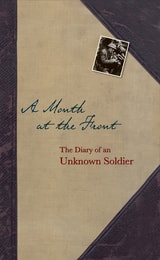
A Month at the Front
The Diary of an Unknown SoldierEdited by the Bodleian Library
Bodleian Library Publishing, 2006
A Month at the Front chronicles one month in the life of a soldier from the 12th East Surrey regiment, and the economical yet powerful narrative vividly brings to life the sights, sounds, and horrors of war. “The first night passed uneventfully, except that we were shelled”—so begins the young man in spare prose, and the quiet drama unfolds from there. Constant bombings and the sobering landscape of war—“It was nothing unusual to come across . . . a dead comrade lying waiting for burial”—are occasionally relieved by humorous events such as the discovery that a troop of advancing Germans was “nothing more than few short willow shrubs waving about in the breeze.” The young soldier describes how his comrades gradually fall one by one, until he and three remaining fellow soldiers are captured by the enemy, an event that abruptly ends the narrative.
A Month at the Front is not penned by a famous author, nor does it claim to offer any broad perspective. Rather, it is the lone voice of an unknown young man thrust into fatal circumstances.
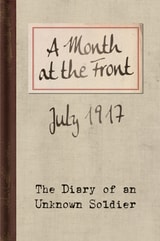
A Month at the Front
The Diary of an Unknown SoldierUnknown Soldier
Bodleian Library Publishing, 2014
Dispatches from the Front
Theological Engagements with the SecularStanley Hauerwas
Duke University Press, 1994
At once Christian theology and social criticism, this book aims to show that the two cannot be separated. In this spirit, Hauerwas mounts a forceful attack on current sentimentalities about the significance of democracy, the importance of the family, and compassion, which appears here as a literally fatal virtue. In this time of the decline of religious knowledge, when knowing a little about a religion tends to do more harm than good, Hauerwas offers direction to those who would make Christian discourse both useful and truthful. Animated by a deep commitment, his essays exhibit the difference that Christian theology can make in the shaping of lives and the world.
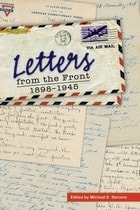
Letters from the Front, 1898-1945
Michael E. Stevens
Wisconsin Historical Society Press, 1992
This volume tells the stories of 62 men and women from Wisconsin who served in the Spanish-American War, World War I, and World War II. Letters from the Front is a vivid social history of wartime as told by those who took part in these foreign conflicts. Most of them are "ordinary" people, uprooted from farms, factories, and offices, who took part in extraordinary events. This work explores how war changed their lives and reveals the emotions they felt in uniform, in remote outposts, in combat, and in prison camps. These letters, diaries, oral histories, newspapers, and contemporary accounts provide a history of adaptation to military life; they also reflect the changes that occurred over the half-century encompassing these confilcts, an era of great technological innovation — and one in which America's vision of itself also changed.

Not in Front of the Children
'Indecency,' Censorship, and the Innocence of YouthHeins, Marjorie
Rutgers University Press, 2007
From Huckleberry Finn to Harry Potter, from Internet filters to the v-chip, censorship exercised on behalf of children and adolescents is often based on the assumption that they must be protected from “indecent” information that might harm their development—whether in art, in literature, or on a Web site. But where does this assumption come from, and is it true?
In Not in Front of the Children, Marjorie Heins explores the fascinating history of “indecency” laws and other restrictions aimed at protecting youth. From Plato’s argument for rigid censorship, through Victorian laws aimed at repressing libidinous thoughts, to contemporary battles over sex education in public schools and violence in the media, Heins guides us through what became, and remains, an ideological minefield. With fascinating examples drawn from around the globe, she suggests that the “harm to minors” argument rests on shaky foundations.
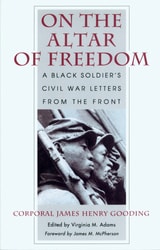
On the Altar of Freedom
A Black Soldier’s Civil War Letters from the FrontJames Henry Gooding
University of Massachusetts Press, 1991
From basic training at Camp Meigs in Readville, Massachusetts, through campaigns in Georgia, South Carolina, and Florida, Gooding faithfully records the activities of the 54th, including the legendary storming of Fort Wagner. He also voices the injustice felt by soldiers of his regiment over the issue of unequal pay, the refusal to promote deserving black enlistees to officer rank, and the deeply ingrained racism of whites in both the North and South.
Wounded and captured during the battle of Olustee, Florida, in February 1864, Gooding died later that year in Andersonville Prison.
In her introduction, Virginia M. Adams provides biographical details on Gooding's life and examines the antebellum history of New Bedford's large and articulate community of free blacks.
William S. Burroughs At the Front
Critical Reception, 1959 - 1989Jennie Skerl
Southern Illinois University Press, 1991
Jennie Skerl and Robin Lydenberg have selected twenty-five critical essays on Burroughs that reflect the historical reception of his work, both positive and negative, decade by decade, and that represent the best essays written about him.
The essays cover Burroughs’ major novels—including the cut-up and new trilogies—the censorship issue, and his work in film and painting. The chronological organization brings into critical focus the shift from moral questions raised by the novels’ content, through examinations of Burroughs’ relationship to humanism and modernism, and finally to more focused literary and linguistic issues. In their introduction, the editors survey the progress of Burroughs’ critical reception and examine the reasons for the varied and intense responses to the work and the theoretical assumptions behind those responses.
The reviewers include prominent figures such as Mary McCarthy and Marshall McLuhan as well as major academic critics such as Cary Nelson, Tony Tanner, and Ihab Hassan.