Results by title
5 books match the query 'Full employment policies'
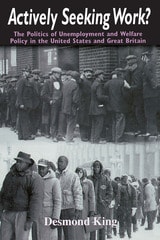
Actively Seeking Work?
The Politics of Unemployment and Welfare Policy in the United States and Great BritainDesmond King
University of Chicago Press, 1995
Why have both Great Britain and the United States been unable to create effective training and work programs for the unemployed? Desmond King contends that the answer lies in the liberal political origins of these programs. Integrating extensive, previously untapped archival and documentary materials with an analysis of the sources of political support for work-welfare programs, King shows that policymakers in both Great Britain and the United States have tried to achieve conflicting goals through these programs.
The goal of work-welfare policy in both countries has been to provide financial aid, training, and placement services for the unemployed. In order to muster support for these programs, however, work-welfare programs had to incorporate liberal requirements that they not interfere with private market forces, and that they prevent the "undeserving" from obtaining benefits. For King, the attempt to integrate these incompatible functions is the defining feature of British and American policies as well as the cause of their failure.
The goal of work-welfare policy in both countries has been to provide financial aid, training, and placement services for the unemployed. In order to muster support for these programs, however, work-welfare programs had to incorporate liberal requirements that they not interfere with private market forces, and that they prevent the "undeserving" from obtaining benefits. For King, the attempt to integrate these incompatible functions is the defining feature of British and American policies as well as the cause of their failure.
[more]
Everything for Sale
The Virtues and Limits of MarketsRobert Kuttner
University of Chicago Press, 1999
In this highly acclaimed, provocative book, Robert Kuttner disputes the laissez-faire direction of both economic theory and practice that has been gaining in prominence since the mid-1970s. Dissenting voices, Kuttner argues, have been drowned out by a stream of circular arguments and complex mathematical models that ignore real-world conditions and disregard values that can't easily be turned into commodities. With its brilliant explanation of how some sectors of the economy require a blend of market, regulation, and social outlay, and a new preface addressing the current global economic crisis, Kuttner's study will play an important role in policy-making for the twenty-first century.
"The best survey of the limits of free markets that we have. . . . A much needed plea for pragmatism: Take from free markets what is good and do not hesitate to recognize what is bad."—Jeff Madrick, Los Angeles Times
"It ought to be compulsory reading for all politicians—fortunately for them and us, it is an elegant read."—The Economist
"Demonstrating an impressive mastery of a vast range of material, Mr. Kuttner lays out the case for the market's insufficiency in field after field: employment, medicine, banking, securities, telecommunications, electric power."—Nicholas Lemann, New York Times Book Review
"A powerful empirical broadside. One by one, he lays on cases where governments have outdone markets, or at least performed well."—Michael Hirsh, Newsweek
"To understand the economic policy debates that will take place in the next few years, you can't do better than to read this book."—Suzanne Garment, Washington Post Book World
[more]

State Employment Policy in Hard Times
Michael Barker, ed.
Duke University Press, 1983
Two hundred years ago, Samuel Johnson observed that a society's level of civilization could be gauged by the manner in which it treated its poor. By that measure, the United States today is steadily losing ground. Whereas the number of officially defined poor dwindled steadily from the enactment of the Great Society programs in the mid-1960s, reaching a low of 24.5 million people in 1978, it has since risen to more than 32 million people. Although the economy continues to generate large numbers of new jobs, the basic unemployment rate continues to rise and current projections show little likelihood of unemployment rates consistently below 10 percent until some time after 1984, if then. In the years to come, the creation of an equitable and workable employment policy will be a major agenda item for politicians and policy makers at the state level, as well as for national leaders.
[more]
The Roaring Nineties
Can Full Employment Be Sustained?Alan B. Krueger
Russell Sage Foundation, 2001
The positive social benefits of low unemployment are many—it helps to reduce poverty and crime and fosters more stable families and communities. Yet conventional wisdom—born of the stagflation of the 1970s—holds that sustained low unemployment rates run the risk of triggering inflation. The last five years of the 1990s—in which unemployment plummeted and inflation remained low—called this conventional wisdom into question. The Roaring Nineties provides a thorough review of the exceptional economic performance of the late 1990s and asks whether it was due to a lucky combination of economic circumstances or whether the new economy has somehow wrought a lasting change in the inflation-safe rate of unemployment. Led by distinguished economists Alan Krueger and Robert Solow, a roster of twenty-six respected economic experts analyzes the micro- and macroeconomic factors that led to the unexpected coupling of low unemployment and low inflation. The more macroeconomically oriented chapters clearly point to a reduction in the inflation-safe rate of unemployment. Laurence Ball and Robert Moffitt see the slow adjustment of workers' wage aspirations in the wake of rising productivity as a key factor in keeping inflation at bay. And Alan Blinder and Janet Yellen credit sound monetary policy by the Federal Reserve Board with making the best of fortunate circumstances, such as lower energy costs, a strong dollar, and a booming stock market. Other chapters in The Roaring Nineties examine how the interaction between macroeconomic and labor market conditions helped sustain high employment growth and low inflation. Giuseppe Bertola, Francine Blau, and Lawrence M. Kahn demonstrate how greater flexibility in the U.S. labor market generated more jobs in this country than in Europe, but at the expense of greater earnings inequality. David Ellwood examines the burgeoning shortage of skilled workers, and suggests policies—such as tax credits for businesses that provide on-the-job-training—to address the problem. And James Hines, Hilary Hoynes, and Alan Krueger elaborate the benefits of sustained low unemployment, including budget surpluses that can finance public infrastructure and social welfare benefits—a perspective often lost in the concern over higher inflation rates. While none of these analyses promise that the good times of the 1990s will last forever, The Roaring Nineties provides a unique analysis of recent economic history, demonstrating how the nation capitalized on a lucky confluence of economic factors, helping to create the longest peacetime boom in American history. Copublished with The Century Foundation
[more]
Workforce Development Politics
Civic Capacity And Performanceedited by Robert P. Giloth, Published in association with the Annie E. Casey Foundation.
Temple University Press, 2004
If 88% of Americans believe that education and training resources should be available to the jobless and more than two-thirds of employers have identified workforce and skills shortages as top priorities, why aren't we, as a society, able to provide that training in such a way that it leads to long-term economic security? This book looks at the politics of local and regional workforce development: the ways politicians and others concerned with the workforce systems have helped or hindered that process. Contributors examine the current systems that are in place in these cities and the potential for systemic reform through case studies of Denver, Milwaukee, Philadelphia, St. Louis, and Seattle.Published in association with the Annie E. Casey Foundation.
[more]