Results by title
8 books match the query 'Galileo'
Between Copernicus and Galileo
Christoph Clavius and the Collapse of Ptolemaic CosmologyJames M. Lattis
University of Chicago Press, 1994
Though relatively unknown today, Clavius was enormously influential throughout Europe in the late sixteenth and early seventeenth centuries through his astronomy books—the standard texts used in many colleges and universities, and the tools with which Descartes, Gassendi, and Mersenne, among many others, learned their astronomy. James Lattis uses Clavius's own publications as well as archival materials to trace the central role Clavius played in integrating traditional Ptolemaic astronomy and Aristotelian natural philosophy into an orthodox cosmology. Although Clavius strongly resisted the new cosmologies of Copernicus and Tycho, Galileo's invention of the telescope ultimately eroded the Ptolemaic world view.
By tracing Clavius's views from medieval cosmology the seventeenth century, Lattis illuminates the conceptual shift from Ptolemaic to Copernican astronomy and the social, intellectual, and theological impact of the Scientific Revolution.
Between Raphael and Galileo
Mutio Oddi and the Mathematical Culture of Late Renaissance ItalyAlexander Marr
University of Chicago Press, 2011
Although largely unknown today, during his lifetime Mutio Oddi of Urbino (1569–1639) was a highly esteemed scholar, teacher, and practitioner of a wide range of disciplines related to mathematics. A prime example of the artisan-scholar so prevalent in the late Renaissance, Oddi was also accomplished in the fields of civil and military architecture and the design and retail of mathematical instruments, as well as writing and publishing.
In Between Raphael and Galileo, Alexander Marr resurrects the career and achievements of Oddi in order to examine the ways in which mathematics, material culture, and the book shaped knowledge, society, and the visual arts in late Renaissance Italy. Marr scrutinizes the extensive archive of Oddi papers, documenting Oddi’s collaboration with prominent intellectuals and officials and shedding new light on the practice of science and art during his day. What becomes clear is that Oddi, precisely because he was not spectacularly innovative and did not attain the status of a hero in modern science, is characteristic of the majority of scientific practitioners and educators active in this formative age, particularly those whose energetic popularization of mathematics laid the foundations for the Scientific Revolution. Marr also demonstrates that scientific change in this era was multivalent and contested, governed as much by friendship as by principle and determined as much by places as by purpose.
Plunging the reader into Oddi’s world, Between Raphael and Galileo is a finely wrought and meticulously researched tale of science, art, commerce, and society in the late sixteenth and early seventeenth century. It will become required reading for any scholar interested in the history of science, visual art, and print culture of the Early Modern period.
From Galileo to Gell-Mann
The Wonder that Inspired the Greatest Scientists of All Time: In Their Own WordsMarco Bersanelli
Templeton Press, 2009
Galileo, Courtier
The Practice of Science in the Culture of AbsolutismMario Biagioli
University of Chicago Press, 1993
Galileo, Courtier is a fascinating cultural and social history of science highlighting the workings of power, patronage, and credibility in the development of science.
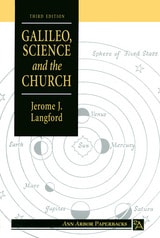
Galileo, Science and the Church
Jerome J. Langford
University of Michigan Press, 1992
The Crime of Galileo
Giorgio de Santillana
University of Chicago Press, 1955
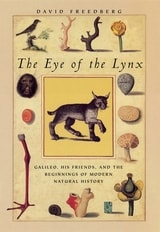
The Eye of the Lynx
Galileo, His Friends, and the Beginnings of Modern Natural HistoryDavid Freedberg
University of Chicago Press, 2003
Founded by Prince Federico Cesi in 1603, the Linceans took as their task nothing less than the documentation and classification of all of nature in pictorial form. In this first book-length study of the Linceans to appear in English, Freedberg focuses especially on their unprecedented use of drawings based on microscopic observation and other new techniques of visualization. Where previous thinkers had classified objects based mainly on similarities of external appearance, the Linceans instead turned increasingly to sectioning, dissection, and observation of internal structures. They applied their new research techniques to an incredible variety of subjects, from the objects in the heavens studied by their most famous (and infamous) member Galileo Galilei—whom they supported at the most critical moments of his career—to the flora and fauna of Mexico, bees, fossils, and the reproduction of plants and fungi. But by demonstrating the inadequacy of surface structures for ordering the world, the Linceans unwittingly planted the seeds for the demise of their own favorite method—visual description-as a mode of scientific classification.
Profusely illustrated and engagingly written, Eye of the Lynx uncovers a crucial episode in the development of visual representation and natural history. And perhaps as important, it offers readers a dazzling array of early modern drawings, from magnificently depicted birds and flowers to frogs in amber, monstrously misshapen citrus fruits, and more.
To Save the Phenomena
An Essay on the Idea of Physical Theory from Plato to GalileoPierre Duhem
University of Chicago Press, 1969
Duhem's 1908 essay questions the relation between physical theory and metaphysics and, more specifically, between astronomy and physics–an issue still of importance today. He critiques the answers given by Greek thought, Arabic science, medieval Christian scholasticism, and, finally, the astronomers of the Renaissance.