Results by title
5 books match the query 'Gardeners'
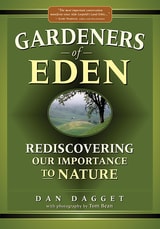
Gardeners of Eden
Rediscovering Our Importance to NatureDan Dagget
University of Nevada Press, 2005
Dagget recommends a new kind of environmentalism based on management, science, evolution, and holism, and served by humans who enrich the environment even as they benefit from it. His new environmentalism offers hopeful solutions to the current ecological crisis and a new purpose for our human energies and ideals. This book is essential reading for anyone concerned with the earth and anyone seeking a viable way for our burgeoning human population to continue to live upon it.
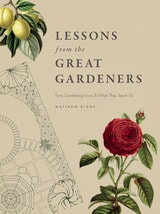
Lessons from the Great Gardeners
Forty Gardening Icons and What They Teach UsMatthew Biggs
University of Chicago Press, 2016
Entries for each gardening great highlight their iconic plants and garden designs, revealing both the gardeners’ own influences and the seeds—sometimes literal—that they sowed for gardens yet to sprout. From André Le Nôtre in seventeenth-century France, who drew on his training as an architect and hydraulic engineer to bring the topiary form to Vaux-le-Vicomte and Versailles, to the work of High Line and Lurie Garden designer Piet Oudolf, and Thomas Jefferson’s advice on creating protected garden microclimates for help growing early crops and tender fruit like figs (with peas, a Jefferson favorite), Lessons from the Great Gardeners is a resource as rich as the soil from which it springs.
Featuring lush illustrations harvested from the archives of the Royal Horticultural Society, as well as sections on a dozen international gardens that showcase the lessons of the greats, this homage to the love of good, clean dirt is sure to inspire readers to get out in the sun and dig.
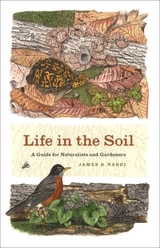
Life in the Soil
A Guide for Naturalists and GardenersJames B. Nardi
University of Chicago Press, 2007
Leonardo da Vinci once mused that “we know more about the movement of celestial bodies than about the soil underfoot,” an observation that is as apt today as it was five hundred years ago. The biological world under our toes is often unexplored and unappreciated, yet it teems with life. In one square meter of earth, there lives trillions of bacteria, millions of nematodes, hundreds of thousands of mites, thousands of insects and worms, and hundreds of snails and slugs. But because of their location and size, many of these creatures are as unfamiliar and bizarre to us as anything found at the bottom of the ocean.
Lavishly illustrated with nearly three hundred color illustrations and masterfully-rendered black and white drawings throughout, Life in the Soil invites naturalists and gardeners alike to dig in and discover the diverse community of creatures living in the dirt below us. Biologist and acclaimed natural history artist James B. Nardibegins with an introduction to soil ecosystems, revealing the unseen labors of underground organisms maintaining the rich fertility of the earth as they recycle nutrients between the living and mineral worlds. He then introduces readers to a dazzling array of creatures: wolf spiders with glowing red eyes, snails with 120 rows of teeth, and 10,000-year-old fungi, among others. Organized by taxon, Life in the Soil covers everything from slime molds and roundworms to woodlice and dung beetles, as well as vertebrates from salamanders to shrews. The book ultimately explores the crucial role of soil ecosystems in conserving the worlds above and below ground.
A unique and illustrative introduction to the many unheralded creatures that inhabit our soils and shape our environment aboveground, Life in the Soil will inform and enrich the naturalist in all of us.
Row by Row
Talking with Kentucky GardenersKatherine J. Black
Ohio University Press, 2015
For two and a half years, Katherine J. Black crisscrossed Kentucky, interviewing home vegetable gardeners from a rich variety of backgrounds. Row by Row: Talking with Kentucky Gardeners is the result, a powerful compilation of testimonies on the connections between land, people, culture, and home.
The people profiled here share a Kentucky backdrop, but their life stories, as well as their gardens, have as many colors, shapes, and tastes as heirloom tomatoes do. Black interviewed those who grow in city backyards, who carve out gardens from farmland, and who have sprawling plots in creek bottoms and former pastures. Many of the gardeners in Row by Row speak eloquently about our industrialized food system’s injuries to the land, water, and health of people. But more often they talk about what they are doing in their gardens to reverse this course.
Row by Row is as sure to appeal to historians, food studies scholars, and sustainability advocates as it is to gardeners and local food enthusiasts. These eloquent portraits, drawn from oral histories and supplemented by Deirdre Scaggs’ color photographs, form a meditation on how gardeners make sense of their lives through what they grow and how they grow it.
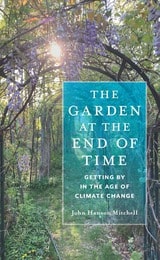
The Garden at the End of Time
Getting By in the Age of Climate ChangeJohn Hanson Mitchell
University of Massachusetts Press, 2025
John Hanson Mitchell has long written about his garden outside of Boston, and about the plants and animals with whom he shares this land. In 2022, the United Nations and others started reporting the true severity of the climate crisis as the Earth passed a point of no return. All across the globe it was the worst year on record for climate-related disasters, including extinctions, deadly floods, massive fires, and dramatic droughts, all of which have worsened since that year. Mitchell, like so many, felt overwhelmed. He looked to the story of Voltaire’s Candide, and settled on the famous aphorism from that book: “We must cultivate our garden.”
The Garden at the End of Time features Mitchell’s trademark blend of science, literature, and anecdote as he processes both the information he is reading from various sources and what it prompts him to do in his own small corner of the world. The story that unfolds is one of Mitchell diversifying his plantings; fighting what he sees as unnecessary local development; walking through and observing changes in the wild lands nearby; continuing to read the news from around the world; and meditating on other moments, real and imagined, when people sought refuge even as they did their part to improve a personally and collectively stressful situation.
Readers discover the impossibility of separating gardening from global warming, while also seeing the solace that exposure to plants can offer, in addition to their contribution to carbon consumption. With gravitas, kindness, and wit, Mitchell offers a model for maintaining a connection to nature even as it reels from manmade threats.