Results by title

10 books match the query 'Gender expression'

cover of Atomic Bombshells: How Plastics Shaped Postwar Bodies

Atomic Bombshells

How Plastics Shaped Postwar Bodies

Isabelle Held

Duke University Press, 2026

Bullet bras, bazookas, bombshells, bikinis. In Atomic Bombshells, Isabelle Held challenges the usual narratives of how war technologies enter domestic use by following plastics on their journey into women’s bodies. Held explores the effects of military-industrial science and the emergence of nylon, silicone, and plastic foams on embodied and expressive configurations of gender, sexuality, and race. She focuses on the United States between the late 1930s with the launch of nylon—whose potential was widely celebrated as the world’s first fully synthetic fiber and the ideal replacement for silk stockings—and the late 1970s, when policies began addressing the dangerous health consequences of implantable plastics. Held untangles the complex relationships between chemical companies, the US military, the Federal Drug Administration, plastic surgeons, advertising agencies, the Hollywood star system, go-go dancers, drag queens, and fashion and industrial designers. Using feminist, queer, and trans lenses, she shows that there was never just one bombshell identity. In so doing, Held complicates typical understandings of the shaping and reshaping of gender.
[more]
cover of Cisgender: Disorienting a Category

Cisgender

Disorienting a Category

Perry Zurn

Duke University Press, 2026

In Cisgender, Perry Zurn turns an incisive yet playful eye toward the “norm” against which transgender gets defined. A cisgender person is informally understood as someone who doctors called male or female at birth, became a boy or girl, and finally lived as a man or woman—without fuss. It’s this “without fuss” that anchors the cis/trans binary as it has come to be understood and belies the complex relationship all people have with gender. How did this category arise? And what else might it do? Cisgender is the first book to trace the story of how cis entered contemporary gender lexicons. Utilizing unplumbed archives and fresh interviews, Zurn offers a critical history of the term from the 1990s to the present, deftly defamiliarizing and reimagining cis at the same time. This unique examination of cisgender is a must-read for all readers invested in trans life and the futures of gender.
[more]
cover of Cistem Failure: Essays on Blackness and Cisgender

Cistem Failure

Essays on Blackness and Cisgender

Marquis Bey

Duke University Press, 2022
In Cistem Failure Marquis Bey meditates on the antagonistic relationship between blackness and cisgender. Bey asks, What does it mean to have a gender that “matches” one’s sex---that is, to be cisgender---when decades of feminist theory have destroyed the belief that there is some natural way to be a sex? Moving from the The Powerpuff Girls to the greeting “How ya mama’n’em?” to their own gender identity, Bey finds that cisgender is too flat as a category to hold the myriad ways that people who may or may not have undergone gender-affirmative interventions depart from gender alignment. At the same time, blackness, they contend, strikes at the heart of cisgender’s invariable coding as white: just as transness names a non-cis space, blackness implies a non-cis space. By showing how blackness opens up a way to subvert the hegemonic power of the gender binary, Bey makes a case for an antiracist gender abolition project that rejects cisgender as a regulatory apparatus.
[more]
cover of Emergent Genders: Living Otherwise in Tokyo's Pink Economies

Emergent Genders

Living Otherwise in Tokyo's Pink Economies

Michelle H. S. Ho

Duke University Press, 2025
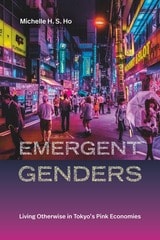
In Emergent Genders, Michelle H. S. Ho traces the genders manifesting alongside Japanese popular culture in Akihabara, an area in Tokyo renowned for the fandom and consumption of anime, manga, and games. Drawing on ethnographic fieldwork in josō and dansō cafe-and-bars, establishments where male-to-female and female-to-male crossdressing is prevalent, Ho shows how their owners, employees, and customers creatively innovate what she calls emergent genders—new practices, categories, and ways of being stemming from the simultaneous fracturing, contestations, and (re)imaginations of older forms of gender and sexual variance in Japan. Such emergent genders initiate new markets for alternative categories of expression and subjectivity to thrive in a popular cultural hub like Akihabara instead of Tokyo’s gay and lesbian neighborhood of Shinjuku Ni-chōme. By rethinking identitarian models of gender and sexuality, reconfiguring the significance of capitalism for trans studies and queer theory, and decentering theoretical frameworks incubated in a predominantly United States academic context, Ho offers new ways of examining how trans and gender nonconforming individuals may survive and flourish under capitalism.
[more]
cover of In Plenty and in Time of Need: Popular Culture and the Remapping of Barbadian Identity

In Plenty and in Time of Need

Popular Culture and the Remapping of Barbadian Identity

Lia T. Bascomb

Rutgers University Press, 2020

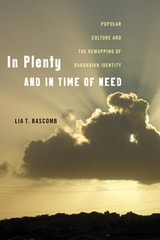
In Plenty and in Time of Need demonstrates how the unique history of Barbados has contributed to complex relations of national, gendered, and sexual identities, and how these identities are represented and interpreted on a global stage. As the most widespread manifestation of social commentary, the book uses music and performance to analyze the competing ideals and realities of the national culture. It details the histories of prominent musical artists, including the prolific Pan-Africanist calypsonian the Mighty Gabby, the world-renowned Merrymen, Soca Queen Alison Hinds, artist/activist Rupee, and international superstar Rihanna. Using these artists, the project analyzes how femininity, masculinity, and sexuality are put in service of Barbadian nationalism. By examining websites, blogs, and digital products of these artists in conversation with Barbadian tourism, the book re-examines the ways in which commodity, sexuality, gender performance, and diasporic consciousness undergird individual careers and national representations.
[more]
cover of King of Hearts: Drag Kings in the American South

King of Hearts

Drag Kings in the American South

Baker A. Rogers

Rutgers University Press, 2022

While drag subcultures have gained mainstream media attention in recent years, the main focus has been on female impersonators. Equally lively, however, is the community of drag kings: cis women, trans men, and non-binary people who perform exaggerated masculine personas onstage under such names as Adonis Black, Papi Chulo, and Oliver Clothesoff.  
 
King of Hearts shows how drag king performers are thriving in an unlikely location: Southern Bible Belt states like Tennessee, Georgia, and South Carolina. Based on observations and interviews with sixty Southern drag kings, this study reveals how they are challenging the region’s gender norms while creating a unique community with its own distinctive Southern flair. Reflecting the region’s racial diversity, it profiles not only white drag kings, but also those who are African American, multiracial, and Hispanic. 
 
Queer scholar Baker A. Rogers—who has also performed as drag king Macon Love—takes you on an insider’s tour of Southern drag king culture, exploring its history, the communal bonds that unite it, and the controversies that have divided it. King of Hearts offers a groundbreaking look at a subculture that presents a subversion of gender norms while also providing a vital lifeline for non-gender-conforming Southerners.
[more]
cover of Russian Style: Performing Gender, Power, and Putinism

Russian Style

Performing Gender, Power, and Putinism

Julie A. Cassiday

University of Wisconsin Press, 2023
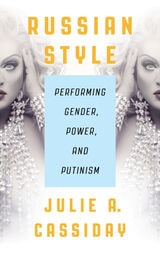
As the West liberalized its stance on sexuality and gender between 2000 and 2020, Vladimir Putin’s Russia moved in the opposite direction, remolding the performance of Russian citizenship according to a neoconservative agenda characterized by increasingly exaggerated gender roles. By connecting gendered and sexualized citizenship to developments in Russian popular culture, Julie A. Cassiday argues that heteronormativity and homophobia became a kind of politicized style under Putin’s leadership. However, the multiple modes of gender performativity simultaneously helped citizens resist and protest the state’s mandate of heteronormativity. Examining everything from memes to the Eurovision Song Contest and self-help literature, Cassiday untangles the discourse of gender to argue that drag, or travesti, became the performative trope par excellence in Putin’s Russia. Provocatively, Cassiday further argues that the exaggerated expressions of gender demanded by Putin’s regime are best understood as a form of cisgender drag. This smart and lively study provides critical, nuanced analysis of the relationship between popular culture and politics in Russia during Putin’s first two decades in power. 
[more]
cover of Transformismo: Performing Trans/Queer Cuba

Transformismo

Performing Trans/Queer Cuba

M. Myrta Leslie Santana

University of Michigan Press, 2025
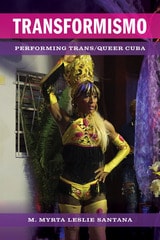
In Transformismo, M. Myrta Leslie Santana draws on years of embedded research within Cuban trans/queer communities to analyze how transformistas, or drag performers, understand their roles in the social transformation of the island. Once banned and censored in Cuba, drag performance is now a state-sponsored event. Transformismo suggests that these performances make critical interventions in Cuban trans/queer life and politics and in doing so, the volume offers critical insight into how Cuba’s postsocialist reform has exacerbated racial, sexual, and economic inequalities. Leslie Santana argues that mainstream trans/queer nightlife in Cuba is entangled with the island’s tourism economy and has shaped the aesthetics and social makeup of transformismo in coastal Havana, which largely caters to foreigners. Leslie Santana considers how Black lesbian and transgender transformistas are expanding understandings of sexual selfhood and politics on the island, particularly questioning the ways that Black women’s creativity is prominently featured in the aesthetics of tourism and trans/queer nightlife, while Black women themselves are denied social and material capital.
[more]
cover of Translocas: The Politics of Puerto Rican Drag and Trans Performance

Translocas

The Politics of Puerto Rican Drag and Trans Performance

Lawrence La Fountain-Stokes

University of Michigan Press, 2021

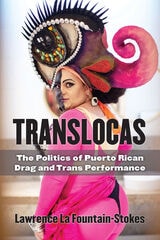
Translocas focuses on drag and transgender performance and activism in Puerto Rico and its diaspora. Arguing for its political potential, Lawrence La Fountain-Stokes explores the social and cultural disruptions caused by Latin American and Latinx “locas” (effeminate men, drag queens, transgender performers, and unruly women) and the various forms of violence to which queer individuals in Puerto Rico and the U.S. are subjected. This interdisciplinary, auto-ethnographic, queer-of-color performance studies book explores the lives and work of contemporary performers and activists including Sylvia Rivera, Nina Flowers, Freddie Mercado, Javier Cardona, Jorge Merced, Erika Lopez, Holly Woodlawn, Monica Beverly Hillz, Lady Catiria, and Barbra Herr; television programs such as RuPaul’s Drag Race; films such as Paris Is Burning, The Salt Mines, and Mala Mala; and literary works by authors such as Mayra Santos-Febres and Manuel Ramos Otero. Lawrence La Fountain-Stokes, a drag performer himself, demonstrates how each destabilizes (and sometimes reifies) dominant notions of gender and sexuality through drag and their embodied transgender expression. These performances provide a means to explore and critique issues of race, class, poverty, national identity, and migratory displacement while they posit a relationship between audiences and performers that has a ritual-like, communal dimension. The book also analyzes the murders of Jorge Steven López Mercado and Kevin Fret in Puerto Rico, and invites readers to challenge, question, and expand their knowledge about queer life, drag, trans performance, and Puerto Rican identity in the Caribbean and the diaspora. The author also pays careful attention to transgender experience, highlighting how trans activists and performers mold their bodies, promote social change, and create community in a context that oscillates between glamour and abjection.
[more]
cover of Unsettling Assumptions: Tradition, Gender, Drag

Unsettling Assumptions

Tradition, Gender, Drag

Pauline Greenhill

Utah State University Press, 2014

In Unsettling Assumptions, editors Pauline Greenhill and Diane Tye examine how tradition and gender come together to unsettle assumptions about culture and its study.

Contributors explore the intersections of traditional expressive culture and sex/gender systems to question, investigate, or upset concepts like family, ethics, and authenticity. Individual essays consider myriad topics such as Thanksgiving turkeys, rockabilly and bar fights, Chinese tales of female ghosts, selkie stories, a noisy Mennonite New Year’s celebration, the Distaff Gospels, Kentucky tobacco farmers, international adoptions, and more.

In Unsettling Assumptions, folkloric forms express but also counteract negative aspects of culture like misogyny, homophobia, and racism. But expressive culture also emerges as fundamental to our sense of belonging to a family, an occupation, or friendship group and, most notably, to identity performativity and the construction and negotiation of power.


[more]