Results by title
8 books match the query 'Genealogies'
Being Political
Genealogies of CitizenshipEngin F. Isin
University of Minnesota Press, 2002
A provocative counterhistory-and a bold new approach-to notions of citizenship.
What does it mean to be political? Every age has based its answer on citizenship, bequeathing us such indelible images as that of the Greek citizen exercising his rights and obligations in the agora, the Roman citizen conducting himself in the forum, medieval citizens receiving their charter before the guildhall. Being Political disrupts these images by approaching citizenship as otherness, presenting a powerful critique of universalistic and orientalist interpretations of the origins of citizenship and a persuasive alternative history of the present struggles over citizenship.
Who were the strangers and outsiders of citizenship? What strategies and technologies were invented for constituting those forms of otherness? Focusing on these questions, rather than on the images conveyed by history’s victors, Being Political offers a series of genealogies of citizenship as otherness. Engin F. Isin invokes the city as a "difference machine," recovering slaves, peasants, artisans, prostitutes, vagabonds, savages, flextimers, and squeegee men in the streets of the polis, civitas, metropolis, and cosmopolis. The result is a challenge to think in bolder terms about citizenship at a time when the nature of citizenship is an increasingly open question.
Bodies at War
Genealogies of Militarism in Chicana Literature and CultureBelinda Linn Rincón
University of Arizona Press, 2017
Bodies at War examines the rise of neoliberal militarism from the early 1970s to the present and its transformation of political, economic, and social relations. It charts neoliberal militarism’s impact on democratic practices, economic policies, notions of citizenship, race relations, and gender norms by focusing on how these changes affect the Chicana/o community and, more specifically, on how it shapes and is shaped by Chicana bodies. The book raises important questions about the cultural legacies of war and the gendering of violence—topics that reach across multiple disciplinary fields of inquiry, including cultural and media studies. It draws attention to the relationship between war and society, to neoliberal militarism’s destructive social impact, and to the future of Latina soldiering. Through Chicana art, activism, and writing, Rincón offers a visionary foundation for an antiwar feminist politic.
Etymologies and Genealogies
A Literary Anthropology of the French Middle AgesR. Howard Bloch
University of Chicago Press, 1983
"Bloch's Study is a genuinely interdisciplinary one, bringing together elements of history, ethnology, philology, philosophy, economics and literature, with the undoubted ambition of generating a new synthesis which will enable us to read the Middle Ages in a different light.
Stated simply, and in terms which do justice neither to the density nor the subtlety of his argument, Bloch's thesis is this: that medieval society perceived itself in terms of a vertical mode of descent from origins. This model is articulated etymologically in medieval theories of grammar and language, and is consequently reflected in historical and theological writings; it is also latent in the genealogical structure of the aristocratic family as it began to be organized in France in the twelfth century, and is made manifest in such systems of signs as heraldry and the adoption of patronymns. . . .
It is an ingenious and compelling synthesis which no medievalist, even on this side of the Atlantic, can afford to ignore." –Nicholas Mann, Times Literary Supplement
Genealogies of Joy
The Pleasure of Latinx LiteratureEdited by Leigh Johnson and Erin Murrah-Mandril; Foreword by Melina Vizcaíno-Alemán
University of Arizona Press, 2027
What does it mean to center joy in a world that insists on Latinx suffering? Genealogies of Joy: The Pleasure of Latinx Literature argues that joy is not a luxury or distraction but a radical, sustaining force woven through Latinx literature and culture. From humor and food to protest, friendship, sexuality, and aging, the essays gathered here reveal joy as an embodied, communal practice—one that refuses racialized shame and imagines liberatory futures.
Organized into three sections—Memory, Method, and Maps—the volume traces a genealogy of joy across time and space. Contributors explore how writers such as Gloria Anzaldúa, Julia de Burgos, Erika Sánchez, Javier Zamora, Myriam Gurba, Aidan Thomas, and Sandra Cisneros transform grief into resilience, invert dominant narratives, and reclaim pleasure as political praxis. Whether through irreverent laughter, queer desire, culinary memory, or vulnerable resistance, Latinx authors insist that pleasure and politics are bound together.
Engaging affect theory, Black joy scholarship, borderlands studies, and archival studies, this collection asserts that Latinx joy resists the quantification and commodification of late-stage capitalism. At once rigorous and celebratory, Genealogies of Joy invites readers to recognize joy as a human right and a vital source of connection, creativity, and collective flourishing.
Contributors
Soffía Blystra
Norma Cantú
Margaret Cantú-Sánchez
Karina Diaz
Stephanie Fetta
Elena Foulis
Eva Maria Geicht
Leigh Johnson
Mark J. Mascia
Regina Marie Mills
Erin Murrah-Mandril
Jeannine Ortega
Nancy Ríos
Rey M. Rodríguez
Rosarito Rodríguez-González
Alexandra Rodríguez Sabogal
Karen Roybal
Bianca S. Rubalcava
Suzanne Uzzilia
Natalia Villanueva-Nieves
Melina Vizcaíno-Alemán
Relative Races
Genealogies of Interracial Kinship in Nineteenth-Century AmericaBrigitte Fielder
Duke University Press, 2020
Spiritual Despots
Modern Hinduism and the Genealogies of Self-RuleJ. Barton Scott
University of Chicago Press, 2016
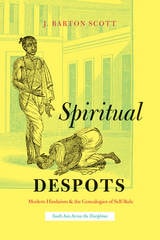
Through this alternative genealogy of the self-ruling subject, Spiritual Despots demonstrates that Hindu reform movements cannot be understood solely within the precolonial tradition, but rather need to be read alongside other movements of their period. The book’s focus moves fluidly between Britain and India—engaging thinkers such as James Mill, Keshub Chunder Sen, Max Weber, Karsandas Mulji, Helena Blavatsky, M. K. Gandhi, and others—to show how colonial Hinduism shaped major modern discourses about the self. Throughout, Scott sheds much-needed light how the rhetoric of priestcraft and practices of worldly asceticism played a crucial role in creating a new moral and political order for twentieth-century India and demonstrates the importance of viewing the emergence of secularism through the colonial encounter.
The Mantle of the Earth
Genealogies of a Geographical MetaphorVeronica della Dora
University of Chicago Press, 2021
Wayward Reproductions
Genealogies of Race and Nation in Transatlantic Modern ThoughtAlys Eve Weinbaum
Duke University Press, 2004
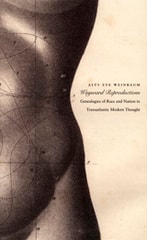
Gracefully traversing a wide range of discourses––including literature, evolutionary theory, early anthropology, Marxism, feminism, and psychoanalysis––Weinbaum traces a genealogy of the race/reproduction bind within key intellectual formations of the late nineteenth and twentieth centuries. She examines two major theorists of genealogical thinking—Friedrich Nietzsche and Michel Foucault—and unearths the unacknowledged ways their formulations link race and reproduction. She explores notions of kinship and the replication of racial difference that run through Charlotte Perkins Gilman’s work; Marxist thinking based on Friedrich Engel’s The Origin of the Family; Charles Darwin’s theory of sexual selection; and Sigmund Freud’s early studies on hysteria. She also describes W. E. B. Du Bois’s efforts to transcend ideas about the reproduction of race that underwrite citizenship and belonging within the United States. In a coda, Weinbaum brings the foregoing analysis to bear on recent genomic and biotechnological innovations.