Results by title
69 books match the query 'Genocide' and 4 start with a
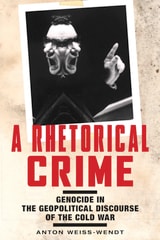
A Rhetorical Crime
Genocide in the Geopolitical Discourse of the Cold WarWeiss-Wendt, Anton
Rutgers University Press, 2018
A Rhetorical Crime shows how genocide morphed from a legal concept into a political discourse used in propaganda battles between the United States and the Soviet Union. Over the course of the Cold War era, nearly eighty countries were accused of genocide, and yet there were few real-time interventions to stop the atrocities committed by genocidal regimes like the Cambodian Khmer Rouge.
Renowned genocide scholar Anton Weiss-Wendt employs a unique comparative approach, analyzing the statements of Soviet and American politicians, historians, and legal scholars in order to deduce why their moral posturing far exceeded their humanitarian action.
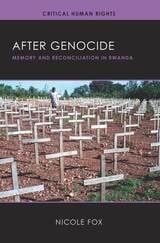
After Genocide
Memory and Reconciliation in RwandaNicole Fox
University of Wisconsin Press, 2023
In the wake of unthinkable atrocities, it is reasonable to ask how any population can move on from the experience of genocide. Simply remembering the past can, in the shadow of mass death, be retraumatizing. So how can such momentous events be memorialized in a way that is productive and even healing for survivors? Genocide memorials tell a story about the past, preserve evidence of the violence that occurred, and provide emotional support to survivors. But the goal of amplifying survivors’ voices can fade amid larger narratives entrenched in political motivations.
In After Genocide,Nicole Fox investigates the ways memorials can shape the experiences of survivors decades after mass violence has ended. She examines how memorializations can both heal and hurt, especially when they fail to represent all genders, ethnicities, and classes of those afflicted. Drawing on extensive interviews with Rwandans, Fox reveals their relationships to these spaces and uncovers those voices silenced by the dominant narrative—arguing that the erasure of such stories is an act of violence itself. The book probes the ongoing question of how to fit survivors in to the dominant narrative of healing and importantly demonstrates how memorials can shape possibilities for growth, national cohesion, reconciliation, and hope for the future.
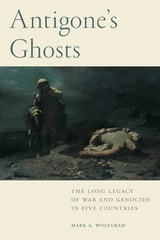
Antigone's Ghosts
The Long Legacy of War and Genocide in Five CountriesWolfgram, Mark A
Bucknell University Press, 2019
Published by Bucknell University Press. Distributed worldwide by Rutgers University Press.
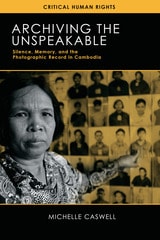
Archiving the Unspeakable
Silence, Memory, and the Photographic Record in CambodiaMichelle Caswell
University of Wisconsin Press, 2014
Winner, Waldo Gifford Leland Award, Society of American Archivists
Longlist, ICAS Book Prize, International Convention of Asia Scholars