Results by title
24 books match the query 'Geometry'
After Euclid
Jesse Norman
CSLI, 2006
Architecture and Geometry in the Age of the Baroque
George L. Hersey
University of Chicago Press, 2001
Hersey first concentrates on specific problems in geometry and architectural design. He then explores the affinities between musical chords and several types of architectural form. He turns to advances in optics, such as artificial lenses and magic lanterns, to show how architects incorporated light, a heavenly emanation, into their impressive domes. With ample illustrations and lucid, witty language, Hersey shows how abstract ideas were transformed into visual, tactile form—the epicycles of the cosmos, the sexual mystique surrounding the cube, and the imperfections of heavenly bodies. Some two centuries later, he finds that the geometric principles of the Baroque resonate, often unexpectedly, in the work of architects such as Frank Lloyd Wright and Le Corbusier. A discussion of these surprising links to the past rounds out this brilliant reexamination of some of the long-forgotten beliefs and practices that helped produce some of Europe's greatest masterpieces.
Dynamics, Geometry, Number Theory
The Impact of Margulis on Modern MathematicsEdited by David Fisher, Dmitry Kleinbock, and Gregory Soifer
University of Chicago Press, 2022
This edited collection highlights the foundations and evolution of research by widely influential Fields Medalist Gregory Margulis. Margulis is unusual in the degree to which his solutions to particular problems have opened new vistas of mathematics; his ideas were central, for example, to developments that led to the recent Fields Medals of Elon Lindenstrauss and Maryam Mirzhakhani. Dynamics, Geometry, Number Theory introduces these areas, their development, their use in current research, and the connections between them. Divided into four broad sections—“Arithmeticity, Superrigidity, Normal Subgroups”; “Discrete Subgroups”; “Expanders, Representations, Spectral Theory”; and “Homogeneous Dynamics”—the chapters have all been written by the foremost experts on each topic with a view to making them accessible both to graduate students and to experts in other parts of mathematics. This was no simple feat: Margulis’s work stands out in part because of its depth, but also because it brings together ideas from different areas of mathematics. Few can be experts in all of these fields, and this diversity of ideas can make it challenging to enter Margulis’s area of research. Dynamics, Geometry, Number Theory provides one remedy to that challenge.

Euclid and His Twentieth Century Rivals
Diagrams in the Logic of Euclidean GeometryNathaniel Miller
CSLI, 2007
Exterior Differential Systems and Euler-Lagrange Partial Differential Equations
Robert Bryant, Phillip Griffiths, and Daniel Grossman
University of Chicago Press, 2003
This timely synthesis of partial differential equations and differential geometry will be of fundamental importance to both students and experienced researchers working in geometric analysis.
Geometrical Vectors
Gabriel Weinreich
University of Chicago Press, 1998
Geometrical Vectors introduces a more sophisticated approach, which not only brings together many loose ends of the traditional treatment, but also leads directly into the practical use of vectors in general curvilinear coordinates by carefully separating those relationships which are topologically invariant from those which are not. Based on the essentially geometric nature of the subject, this approach builds consistently on students' prior knowledge and geometrical intuition.
Written in an informal and personal style, Geometrical Vectors provides a handy guide for any student of vector analysis. Clear, carefully constructed line drawings illustrate key points in the text, and problem sets as well as physical examples are provided.

Geometry and Chronometry in Philosophical Perspective
Adolf Grunbaum
University of Minnesota Press, 1968
Geometry and Chronometry in Philosophical Perspective was first published in 1968. Minnesota Archive Editions uses digital technology to make long-unavailable books once again accessible, and are published unaltered from the original University of Minnesota Press editions.
In this volume Professor Grünbaum substantially extends and comments upon his essay "Geometry, Chronometry, and Empiricism," which was first published in Volume III of the Minnesota Studies in the Philosophy of Science. Commenting on the essay when it first appeared J. J. C. Smart wrote in Mind (England): "In my opinion Adolf Grünbaum's paper ... supersedes nearly all that has been written on the logical status of physical geometry and chronometry." The full text of the essay is given here with the author's extension of it and his discussion of some of the critical comment it has evoked, particularly, a critique published by Hilary Putnam.
Adolph Grünbaum is Andrew Mellon Professor of Philosophy at the University of Pittsburgh and the current president of the Philosophy of Science Association.
Geometry and Meaning
Dominic Widdows
CSLI, 2004
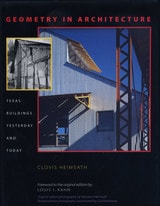
Geometry in Architecture
Texas Buildings Yesterday and TodayBy Clovis Heimsath
University of Texas Press, 2002
Pioneer Texas Buildings opened people's eyes when it was first published in 1968. At a time when "progress" meant tearing down the weathered houses, barns, churches, and stores built by the original settlers of Central Texas, this book taught people to see the beauty, simplicity, and order expressed in the unadorned geometric forms of early Texas buildings. It inspired the preservation and restoration of many of the remaining pioneer buildings, as well as the design of modern buildings that employ the same simple geometries.
This revised edition of Pioneer Texas Buildings juxtaposes the historic structures with works by twenty contemporary architects who are inspired by the pioneer tradition to show how seamlessly the basic geometries translate from one era to another. As in the first edition, sketches and brief commentary by Clovis Heimsath explain how squares, triangles, and circles take shape in the cubic, triangular, and cylindrical forms that comprise houses and other buildings. Then black-and-white photographs, the heart of the book, illustrate these geometric forms in historic and modern buildings. The book also includes two essays in which Heimsath discusses the factors that led him and his wife Maryann to document early Texas buildings and the results in historic preservation and timeless architectural designs that have followed from their efforts.

Geometry of Grief
Reflections on Mathematics, Loss, and LifeMichael Frame
University of Chicago Press, 2021
We all know the euphoria of intellectual epiphany—the thrill of sudden understanding. But coupled with that excitement is a sense of loss: a moment of epiphany can never be repeated. In Geometry of Grief, mathematician Michael Frame draws on a career’s worth of insight—including his work with a pioneer of fractal geometry Benoit Mandelbrot—and a gift for rendering the complex accessible as he delves into this twinning of understanding and loss. Grief, Frame reveals, can be a moment of possibility.
Frame investigates grief as a response to an irrevocable change in circumstance. This reframing allows us to see parallels between the loss of a loved one or a career and the loss of the elation of first understanding a tricky concept. From this foundation, Frame builds a geometric model of mental states. An object that is fractal, for example, has symmetry of magnification: magnify a picture of a mountain or a fern leaf—both fractal—and we see echoes of the original shape. Similarly, nested inside great loss are smaller losses. By manipulating this geometry, Frame shows us, we may be able to redirect our thinking in ways that help reduce our pain. Small‐scale losses, in essence, provide laboratories to learn how to meet large-scale losses.
Interweaving original illustrations, clear introductions to advanced topics in geometry, and wisdom gleaned from his own experience with illness and others’ remarkable responses to devastating loss, Frame’s poetic book is a journey through the beautiful complexities of mathematics and life. With both human sympathy and geometrical elegance, it helps us to see how a geometry of grief can open a pathway for bold action.
Geometry of Nonpositively Curved Manifolds
Patrick B. Eberlein
University of Chicago Press, 1997
self-contained treatment of differentiable spaces of nonpositive
curvature, focusing on the symmetric spaces in which every geodesic lies
in a flat Euclidean space of dimension at least two. The book builds to
a discussion of the Mostow Rigidity Theorem and its generalizations, and
concludes by exploring the relationship in nonpositively curved spaces
between geometric and algebraic properties of the fundamental group.
This introduction to the geometry of symmetric spaces of non-compact
type will serve as an excellent guide for graduate students new to the
material, and will also be a useful reference text for mathematicians
already familiar with the subject.

Geometry, Rigidity, and Group Actions
Edited by Benson Farb and David Fisher
University of Chicago Press, 2011
The study of group actions is more than a hundred years old but remains to this day a vibrant and widely studied topic in a variety of mathematic fields. A central development in the last fifty years is the phenomenon of rigidity, whereby one can classify actions of certain groups, such as lattices in semi-simple Lie groups. This provides a way to classify all possible symmetries of important spaces and all spaces admitting given symmetries. Paradigmatic results can be found in the seminal work of George Mostow, Gergory Margulis, and Robert J. Zimmer, among others.
The papers in Geometry, Rigidity, and Group Actions explore the role of group actions and rigidity in several areas of mathematics, including ergodic theory, dynamics, geometry, topology, and the algebraic properties of representation varieties. In some cases, the dynamics of the possible group actions are the principal focus of inquiry. In other cases, the dynamics of group actions are a tool for proving theorems about algebra, geometry, or topology. This volume contains surveys of some of the main directions in the field, as well as research articles on topics of current interest.
Grammar, Geometry, and Brain
Jens Erik Fenstad
CSLI, 2010
This original study considers the effects of language and meaning on the brain. Jens Erik Fenstad—an expert in the fields of recursion theory, nonstandard analysis, and natural language semantics—combines current formal semantics with a geometric structure in order to trace how common nouns, properties, natural kinds, and attractors link with brain dynamics.

Group Actions in Ergodic Theory, Geometry, and Topology
Selected PapersRobert J. Zimmer
University of Chicago Press, 2019
In addition to the selected papers themselves, this volume opens with a foreword by David Fisher, Alexander Lubotzky, and Gregory Margulis, as well as a substantial introductory essay by Zimmer recounting the course of his career in mathematics. The volume closes with an afterword by Fisher on the most recent developments around the Zimmer program.
Inversions
I. Ya. Bakel'man
University of Chicago Press, 1975
The author also discusses the theory of pencils of circles, and he uses the acquired techniques in a proof of Ptolemy's theorem. In the final chapter, the idea of a group is introduced with applications of group theory to geometry. The author demonstrates the group-theoretic basis for the distinction between Euclidean and Lobachevskian geometry.

Liberty's Grid
A Founding Father, a Mathematical Dreamland, and the Shaping of AmericaAmir Alexander
University of Chicago Press, 2024
Seen from an airplane, much of the United States appears to be a gridded land of startling uniformity. Perpendicular streets and rectangular fields, all precisely measured and perfectly aligned, turn both urban and rural America into a checkerboard landscape that stretches from horizon to horizon. In evidence throughout the country, but especially the West, the pattern is a hallmark of American life. One might consider it an administrative convenience—an easy way to divide land and lay down streets—but it is not. The colossal grid carved into the North American continent, argues historian and writer Amir Alexander, is a plan redolent with philosophical and political meaning.
In 1784 Thomas Jefferson presented Congress with an audacious scheme to reshape the territory of the young United States. All western lands, he proposed, would be inscribed with a single rectilinear grid, transforming the natural landscape into a mathematical one. Following Isaac Newton and John Locke, he viewed mathematical space as a blank slate on which anything is possible and where new Americans, acting freely, could find liberty. And if the real America, with its diverse landscapes and rich human history, did not match his vision, then it must be made to match it.
From the halls of Congress to the open prairies, and from the fight against George III to the Trail of Tears, Liberty’s Grid tells the story of the battle between grid makers and their opponents. When Congress endorsed Jefferson’s plan, it set off a struggle over American space that has not subsided. Transcendentalists, urban reformers, and conservationists saw the grid not as a place of possibility but as an artificial imposition that crushed the human spirit. Today, the ideas Jefferson associated with the grid still echo through political rhetoric about the country’s founding, and competing visions for the nation are visible from Manhattan avenues and Kansan pastures to Yosemite’s cliffs and suburbia’s cul-de-sacs. An engrossing read, Liberty’s Grid offers a powerful look at the ideological conflict written on the landscape.
Spacetime And Geometry
The Alfred Schild LecturesEdited by Richard A. Matzner and L. C. Shepley
University of Texas Press, 1982
These reports, at the forefront of relativity theory when they were written, in particular the geometrical aspects of spacetime theory, were the result of the Alfred Schild Memorial Lecture Series presented at the University of Texas at Austin beginning in 1977. Each article is a self-contained summary of an important area of contemporary gravitational physics, while the book as a whole provides an overview of a wide variety of the problems of general relativity and gravitation.
Surfaces and Superposition
Field Notes on some Geometrical ExcavationsErnest W. Adams
CSLI, 2001
This book examines the dimensionality of surfaces, how superpositions can make stable frameworks, and gives a quasi-Leibnizian account of the relative `spaces' that are defined by these frameworks. Concluding chapters deal with problems concerning the spatio-temporal frameworks of physical theories and implications for theories of visual geometry. The numerous illustrations, while surprisingly simple, are satisfyingly clear.
The Decomposition of Figures Into Smaller Parts
Vladimir Grigor'evich Boltyanskii and Izrail' Tsudikovich Gokhberg
University of Chicago Press, 1980
The Geometry of Modernism
The Vorticist Idiom in Lewis, Pound, H.D., and YeatsBy Miranda B. Hickman
University of Texas Press, 2006
Addressing both the literature and the visual arts of Anglo-American modernism, The Geometry of Modernism recovers a crucial development of modernism's early years that until now has received little sustained critical attention: the distinctive idiom composed of geometric forms and metaphors generated within the early modernist movement of Vorticism, formed in London in 1914. Focusing on the work of Wyndham Lewis, leader of the Vorticist movement, as well as Ezra Pound, H.D., and William Butler Yeats, Hickman examines the complex of motives out of which Lewis initially forged the geometric lexicon of Vorticism—and then how Pound, H.D., and Yeats later responded to it and the values that it encoded, enlisting both the geometric vocabulary and its attendant assumptions and ideals, in transmuted form, in their later modernist work.
Placing the genesis and appropriation of the geometric idiom in historical context, Hickman explores how despite its brevity as a movement, Vorticism in fact exerted considerable impact on modernist work of the years between the wars, in that its geometric idiom enabled modernist writers to articulate their responses to both personal and political crises of the 1930s and 1940s. Informed by extensive archival research as well as treatment of several of the least-known texts of the modernist milieu, The Geometry of Modernism clarifies and enriches the legacy of this vital period.
The Geometry of Visual Phonology
Linda Ann N. Uyechi
CSLI, 1996
The Philosophical Status of Diagrams
Mark Greaves
CSLI, 2001
This book explores the reasons why structured graphics have been largely ignored in contemporary formal theories of axiomatic systems. In particular, it elucidates the systematic forces in the intellectual history of mathematics which have driven the adoption of sentential representational styles over diagrammatic ones. In this book, the effects of historical forces on the evolution of diagrammatically-based systems of inference in logic and geometry are traced from antiquity to the early twentieth-century work of David Hilbert. From this exploration emerges an understanding that the present negative attitudes towards the use of diagrams in logic and geometry owe more to implicit appeals to their history and philosophical background than to any technical incompatibility with modern theories of logical systems.
Topics in Geometric Group Theory
Pierre de la Harpe
University of Chicago Press, 2000
The first five chapters present basic combinatorial and geometric group theory in a unique and refreshing way, with an emphasis on finitely generated versus finitely presented groups. In the final three chapters, de la Harpe discusses new material on the growth of groups, including a detailed treatment of the "Grigorchuk group." Most sections are followed by exercises and a list of problems and complements, enhancing the book's value for students; problems range from slightly more difficult exercises to open research problems in the field. An extensive list of references directs readers to more advanced results as well as connections with other fields.
Topics in the Foundations of General Relativity and Newtonian Gravitation Theory
David B. Malament
University of Chicago Press, 2012