Results by title
45 books match the query 'Georgian Era (1714-1837)'
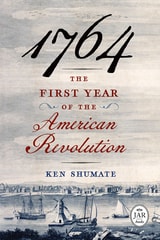
1764—The First Year of the American Revolution
Ken Shumate
Westholme Publishing, 2021
The year 1764 is of extraordinary importance to the history of the American Revolution. It was a watershed year in the relationship between Great Britain and its North American colonies.
In 1763, the British began to strictly enforce the laws of trade in order to advance a newly formulated colonial policy that included use of customs duties as a means of drawing revenue from the colonies. Americans early in 1764 protested that the laws being enforced were economically unsound and would be destructive to the trade of the colonies. Despite knowing of the American discontent, British officials moved forward with their new colonial policy. Resolutions made by the House of Commons in March 1764 not only codified a more restrictive trade policy, but revealed a plan to impose direct parliamentary taxation. A resolution to levy stamp duties brought forth a storm of American petitions and essays in late 1764 that constitute the beginning of what has become known as the Stamp Act Crisis.
In 1764: The First Year of the American Revolution, Ken Shumate presents the American arguments against the new British policy. The most prominent protests against direct parliamentary taxation were made by New York, Massachusetts, Virginia, Connecticut, and Rhode Island. Supporting the petitions were thoughtful essays by James Otis, Oxenbridge Thacher, Richard Bland, Thomas Fitch, and Stephen Hopkins. Shumate demonstrates the importance of these petitions and essays, written before the passage of the Stamp Act in 1765, as establishing the constitutional basis for the heated protests of that year and the following decade. The British interpretation of these writings as rejecting the supremacy of Parliament—even the sovereignty of Great Britain—further motivated the need for the Stamp Act as a demonstration of the fundamental right of Parliament to levy such taxes.
Adam Ferguson
David Allan
Aberdeen University Press, 2007
Adam Ferguson and the Politics of Virtue
Jack A. Hill and Michael Brown
Aberdeen University Press, 2023
Association and Enlightenment
Scottish Clubs and Societies, 1700-1830Mark C. Wallace
Bucknell University Press, 2021
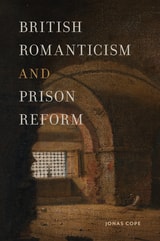
British Romanticism and Prison Reform
Jonas Cope
Bucknell University Press, 2025
In eighteenth-century Britain, criminals were routinely whipped, branded, hanged, or transported to America. Only in the last quarter of the century—with the War of American Independence and legal and sociopolitical challenges to capital punishment—did the criminal justice system change, resulting in the reformed prison, or penitentiary, meant to educate, rehabilitate, and spiritualize even hardened felons. This volume is the first to explore the relationship between historical penal reform and Romantic-era literary texts by luminaries such as Godwin, Keats, Byron, and Austen. The works examined here treat incarceration as ambiguous: prison walls oppress and reinforce the arbitrary power of legal structures but can also heighten meditation, intensify the imagination, and awaken the conscience. Jonas Cope skillfully traces the important ideological work these texts attempt: to reconcile a culture devoted to freedom with the birth of the modern prison system that presents punishment as a form of rehabilitation.
Published by Bucknell University Press. Distributed worldwide by Rutgers University Press.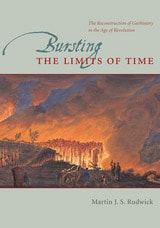
Bursting the Limits of Time
The Reconstruction of Geohistory in the Age of RevolutionMartin J. S. Rudwick
University of Chicago Press, 2005
In 1650, Archbishop James Ussher of Armagh joined the long-running theological debate on the age of the earth by famously announcing that creation had occurred on October 23, 4004 B.C. Although widely challenged during the Enlightenment, this belief in a six-thousand-year-old planet was only laid to rest during a revolution of discovery in the late eighteenth and early nineteenth centuries. In this relatively brief period, geologists reconstructed the immensely long history of the earth-and the relatively recent arrival of human life. Highlighting a discovery that radically altered existing perceptions of a human's place in the universe as much as the theories of Copernicus, Darwin, and Freud did, Bursting the Limits of Time is a herculean effort by one of the world's foremost experts on the history of geology and paleontology to sketch this historicization of the natural world in the age of revolution.
Addressing this intellectual revolution for the first time, Rudwick examines the ideas and practices of earth scientists throughout the Western world to show how the story of what we now call "deep time" was pieced together. He explores who was responsible for the discovery of the earth's history, refutes the concept of a rift between science and religion in dating the earth, and details how the study of the history of the earth helped define a new branch of science called geology. Rooting his analysis in a detailed study of primary sources, Rudwick emphasizes the lasting importance of field- and museum-based research of the eighteenth and nineteenth centuries.
Bursting the Limits of Time, the culmination of more than three decades of research, is the first detailed account of this monumental phase in the history of science.
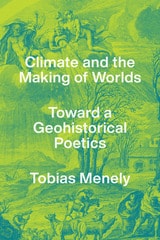
Climate and the Making of Worlds
Toward a Geohistorical PoeticsTobias Menely
University of Chicago Press, 2021
In this book, Tobias Menely develops a materialist ecocriticism, tracking the imprint of the planetary across a long literary history of poetic rewritings and critical readings which continually engage with the climate as a condition of human world making. Menely’s central archive is English poetry written between John Milton’s Paradise Lost (1667) and Charlotte Smith’s “Beachy Head” (1807)—a momentous century and a half during which Britain, emerging from a crisis intensified by the Little Ice Age, established the largest empire in world history and instigated the Industrial Revolution. Incorporating new sciences into ancient literary genres, these ambitious poems aspired to encompass what the eighteenth-century author James Thomson called the “system . . . entire.” Thus they offer a unique record of geohistory, Britain’s epochal transition from an agrarian society, buffeted by climate shocks, to a modern coal-powered nation. Climate and the Making of Worlds is a bracing and sophisticated contribution to ecocriticism, the energy humanities, and the prehistory of the Anthropocene.
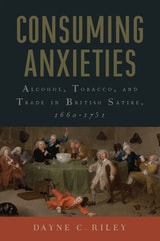
Consuming Anxieties
Alcohol, Tobacco, and Trade in British Satire, 1660-1751Dayne C. Riley
Bucknell University Press, 2024

Diet for a Large Planet
Industrial Britain, Food Systems, and World EcologyChris Otter
University of Chicago Press, 2020
We are facing a world food crisis of unparalleled proportions. Our reliance on unsustainable dietary choices and agricultural systems is causing problems both for human health and the health of our planet. Solutions from lab-grown food to vegan diets to strictly local food consumption are often discussed, but a central question remains: how did we get to this point?
In Diet for a Large Planet, Chris Otter goes back to the late eighteenth century in Britain, where the diet heavy in meat, wheat, and sugar was developing. As Britain underwent steady growth, urbanization, industrialization, and economic expansion, the nation altered its food choices, shifting away from locally produced plant-based nutrition. This new diet, rich in animal proteins and refined carbohydrates, made people taller and stronger, but it led to new types of health problems. Its production also relied on far greater acreage than Britain itself, forcing the nation to become more dependent on global resources. Otter shows how this issue expands beyond Britain, looking at the global effects of large agro-food systems that require more resources than our planet can sustain. This comprehensive history helps us understand how the British played a significant role in making red meat, white bread, and sugar the diet of choice—linked to wealth, luxury, and power—and shows how dietary choices connect to the pressing issues of climate change and food supply.
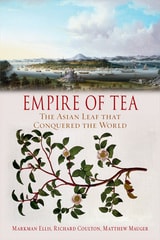
Empire of Tea
The Asian Leaf that Conquered the WorldMarkman Ellis, Richard Coulton, and Matthew Mauger
Reaktion Books, 2015
This impressively detailed book offers a rich cultural history of tea, from its ancient origins in China to its spread around the world. The authors recount tea’s arrival in London and follow its increasing salability and import via the East India Company throughout the eighteenth century, inaugurating the first regular exchange—both commercial and cultural—between China and Britain. They look at European scientists’ struggles to understand tea’s history and medicinal properties, and they recount the ways its delicate flavor and exotic preparation have enchanted poets and artists. Exploring everything from its everyday use in social settings to the political and economic controversies it has stirred—such as the Boston Tea Party and the First Opium War—they offer a multilayered look at what was ultimately an imperial industry, a collusion—and often clash—between the world’s greatest powers over control of a simple beverage that has become an enduring pastime.
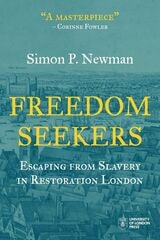
Freedom Seekers
Escaping from Slavery in Restoration LondonSimon P. Newman
University of London Press, 2021
This book brings the history of slavery in England to light, revealing the powerful untold stories of resistance by enslaved workers from Africa, South Asia, and First-Nations America forced to work in London as sailors and dockworkers, wet-nurses and washerwomen. Featuring a series of original case studies on those enslaved people who escaped captivity, this volume provides a rich source of information about slavery in eighteenth-century mainland Britain and the “freedom seekers” therein. Using maps, photographs, newspaper advertisements, and more, the book details escape routes, the networks of slaveholders, and the community of people of color across the London region.
Freedom Seekers demonstrates that not only were enslaved people present in Restoration London but that white Londoners were intimately involved in the construction of the system of racial slavery, a process traditionally regarded as happening in the colonies rather than the British Isles. Freedom Seekers is an utterly unmissable and important book that seeks to delve into Britain’s colonial past.
Haphazard Families
Romanticism, Nation, and the Prehistory of Modern AdoptionEric C. Walker
The Ohio State University Press, 2024
There are no provisions for adoption in English common law, and adoption wasn't legally formalized in England and Wales until 1926. But a century earlier, untimely adoptions navigated the new exceptionalism of childhood in Romanticism. In Haphazard Families, Eric C. Walker explores the history of the adopted child in Romantic-era England. Taking up the stories of both fictional and historical adoptees, he demonstrates how these children, diminished to nonpersons, shouldered the burden of social constructs of nation, family, gender, and class. Walker further demonstrates how Rousseau’s infamous failure to follow his own ideals of parenthood shaped British reactions in famous texts such as Frankenstein and Emma. Incorporating perspectives from Romantic scholarship and critical adoption studies and examining the stories of adopted children associated with Queen Caroline, Anna Letitia Barbauld, Jane Austen, the Wordsworth siblings, Mary Shelley, Charles and Mary Lamb, Letitia Landon, and others, Haphazard Families considers how Romantic constructions of childhood supply foundational structures of modern adoptee subjectivity.
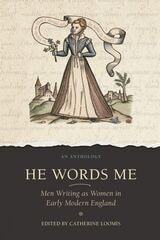
He Words Me
Men Writing as Women in Early Modern EnglandCatherine Loomis
Arizona Center for Medieval and Renaissance Studies, 2026
This anthology gives students and scholars access to a body of texts that provide a clearer understanding of what life was like for early modern women by presenting hundreds of little-known primary texts that contain details about early modern women’s work, relationships, emotional and intellectual development, friendships, and daily struggles. He Words Me brings together work from a variety of genres in which male authors adopt the voice of a female narrator and use that voice to provide intimate details about the lives of women.
These works introduce modern readers to less familiar genres, complement or contradict portrayals of women in canonical texts, and raise compelling questions about who speaks for women and when women can speak for themselves. Through these women’s voices, readers can encounter characters and experiences that will broaden their understanding of early modern English literature and culture, and of the history of women in the late sixteenth and early seventeenth centuries.
Historicizing the Enlightenment, Volume 1
Politics, Religion, Economy, and Society in BritainMichael McKeon
Bucknell University Press, 2023
Published by Bucknell University Press. Distributed worldwide by Rutgers University Press.
Historicizing the Enlightenment, Volume 2
Literature, the Arts, and the Aesthetic in BritainMichael McKeon
Bucknell University Press, 2023
Published by Bucknell University Press. Distributed worldwide by Rutgers University Press.
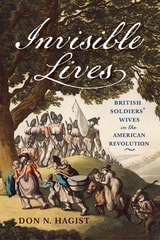
Invisible Lives
British Soldiers' Wives in the American RevolutionDon N. Hagist
Westholme Publishing, 2026
She was stabbed by her drunken husband on a storm-tossed ship in the North Atlantic. She forgave him before she died—and history never recorded her first name. Mrs. Whitlow, wife of a British soldier, is just one of the thousands of women who followed their husbands to war during the American Revolution. These women lived in the barracks and camps and endured the hardships of garrisons and campaigns in an unfamiliar and often hostile land. They faced the challenges with fortitude, proving themselves resourceful, industrious, and intrepid, but their involvement in the conflict that founded the United States has been largely lost to history. Incidents and brief mentions abound in the military writings and iconography of the era, but stories of individual lives are nearly nonexistent, which has caused this large population to be almost entirely overlooked.
Combining archival research with deeply human storytelling, Invisible Lives: British Soldiers’ Wives in the American Revolution by Don N. Hagist brings together, for the first time, the myriad glimpses of these wives to tell the larger story of how they lived, worked, suffered, and survived as women in a foreign war. Drawing on court martial proceedings, muster rolls, marriage licenses, newspaper notices, and rare surviving letters, this meticulously researched work reconstructs the lives of women who were present in every theater of the Revolutionary War. What emerges is a portrait of remarkable resilience. These women crossed oceans, survived sieges, nursed the wounded, and raised children in the chaos of an eighteenth-century war. These many moments come together to provide a more complete and invaluable picture of British soldiers’ wives and their place in the army and the surrounding society. For readers of women’s history, military history, and the American Revolution, this is an overdue and deeply moving reckoning with the lives history had left behind.
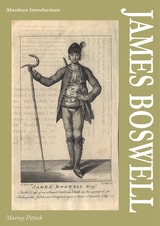
James Boswell
Murray Pittock
Aberdeen University Press, 2007
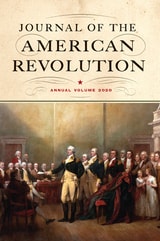
Journal of the American Revolution 2020
Annual VolumeDon N. Hagist
Westholme Publishing, 2020
The Journal of the American Revolution, Annual Volume 2020, presents the journal’s best historical research and writing over the past calendar year. The volume is designed for institutions, scholars, and enthusiasts to provide a convenient overview of the latest research and scholarship in American Revolution and Founding Era studies. The thirty-six articles in the 2020 edition include:
Bernard E. Griffiths: Trumpeter Barney of the Queen’s Rangers, Chelsea Pensioner—and Freed Slave by Todd W. Braisted
The Declaration of Independence: Did John Hancock Really Say that about his Signature?—and Other Signing Stories by J. L. Bell
Les Habitants: Collaboration and Pro-American Violence in Canada, 1774–1776 by Sebastian van Bastelaer
Misadventures in the Countryside: Escape from a British Prison Ship by Katie Turner Getty
The Revolutionary Memories of New York Loyalists: Thomas Jones and William Smith, Jr. by Cho-Chien Feng
The East India Company and Parliament’s “Fateful Decision” of 1767 by Steven Neill
Massachusetts Privateers During the Siege of Boston by Alexander Cain
The Constitution Counted Free Women and Children—And It Mattered by Andrew M. Schocket, with Kinzey M. McLaren-Czerr and Colin J. Spicer
How Magna Carta Influenced the American Revolution by Jason Yonce
Putting a Price on Loyalty: Mary Loring’s List of Losses by John Knight
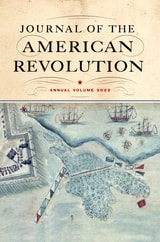
Journal of the American Revolution 2022
Annual VolumeDon N. Hagist
Westholme Publishing, 2022
The year’s best articles from the leading on-line source of new research on the Revolution and Founding eras
The Journal of the American Revolution, Annual Volume 2022, presents the journal’s best historical research and writing over the past calendar year. The volume is designed for institutions, scholars, and enthusiasts to provide a convenient overview of the latest research and scholarship in American Revolution and Founding Era studies. This year's articles are:
Massachusettensis and Novanglus: The Last Great Debate Prior to the War by James M. Smith
Wampum Belts to Canada: Stockbridge Indian Ambassadors’ Dangerous 1775 Peace Mission by Mark R. Anderson
Ethan Allen’s “Motley Parcel of Soldiery” at Montreal by Mark R. Anderson
The Devil at the Helm: A Quote That Went Astray by Don N. Hagist
Thomas Knowlton’s Revolution by David Price
Major Robert Rogers and the American Revolution by Scott M. Smith
La Petite Guerre and Indian Irregular Manner of War: Siblings, But Not Twins by Brian Gerring
George Washington and the First Mandatory Immunization by Richard J. Werther
French Adventurers, Patriots, and Pretentious Imposters in the Fight for American Independence by Arthur S. Lefkowitz
The Cherokee-American War from the Cherokee Perspective by Jordan Baker
The Numerical Strength of George Washington’s Army During the 1777 Philadelphia Campaign by Gary Ecelbarger and Michael C. Harris
A Reconsideration of Continental Army Numerical Strength at Valley Forge by Gary Ecelbarger and Michael C. Harris
American Indians at Valley Forge by Joseph Lee Boyle
The Discovery of a Letter from a Soldier of the First Rhode Island Regiment by Christian McBurney
“The Predicament We Are In”: How Paperwork Saved the Continental Army by Mike Matheny
Sir Henry Clinton’s Generalship by John Ferling
The Varick Transcripts and the Preservation of the War by Justin McHenry
“A Mere Youth”: James Monroe’s Revolutionary War by John A. Ruddima
Haitian Soldiers at the Siege of Savannah by Robert S. Davis
George Washington’s Culper Spy Ring: Separating Fact from Fiction by Bill Bleyer
Texas, Cattle, Cowboys, Ranchers, Indian Raids, and the American Revolution by George Kotlik
The Odyssey of Loyalist Colonel Samuel Bryan by Douglas R. Dorney, Jr.
“She Had Gone to the Army . . . to Her Husband”: Judith Lines’s Unremarked Life by John U. Rees
The Yorktown Tragedy: George Washington’s Slave Roundup by Gregory J. W. Urwin
Such as are Absolutely Free: Benjamin Thompson’s Black Troopers by Todd W. Braisted
The King of Sweden: Friendly Foe of the United States by Richard Werther
Shifting Indian Policy of the Articles of Confederation by John DeLee
Justice, Mercy, and Treason: John Marshall’s and Mercy Otis Warren’s Treatments of Benedict Arnold by Ray Mirante
A Chance Amiss: George Washington and the Fiasco of Spain’s Gift Diplomacy by Elisa Vargas
The Constitutional Convention Debates the Electoral College by Jason Yonce
Respected Citizen of Washington City: The Mystery of Will Costin, Freed Mount Vernon Slave by David O. Stewart
The Impeachment of Senator William Blount by Andrew A. Zellers-Frederick
Instinctive Temporary Unity: Examining Public Opinion During the Whiskey Rebellion by Jonathan Curran
“Good and Sufficient Testimony”: The Development of the Revolutionary War Pension Plan by Michael Barbieri
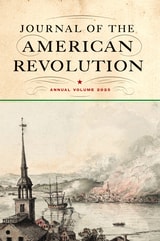
Journal of the American Revolution 2025
Annual VolumeDon N. Hagist
Westholme Publishing, 2025
The year’s best articles from the leading on-line source of new research on the Revolution and Founding eras
The Journal of the American Revolution, Annual Volume 2025, presents the journal’s best historical research and writing over the past calendar year. The volume of thirty-five articles is designed for institutions, scholars, and enthusiasts to provide a convenient overview of the latest research and scholarship in American Revolution and Founding Era studies.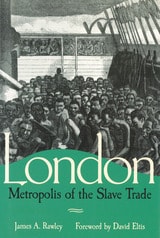
London, Metropolis of the Slave Trade
James A. Rawley & Foreword by David Eltis
University of Missouri Press, 2003
"The recognition that ordinary people could and did trade in slaves, as well as the fact that ordinary people became slaves, is, indeed, the beginning of comprehending the enormity of the forced migration of eleven million people and the attendant deaths of many more."
Rawley draws on material from the year 1700 to the American Civil War as he explores the role of London in the trade. He covers its activity as a port of departure for ships bound for Africa; its continuing large volume after the trade extended to Bristol and Liverpool; and the controversy between London’s parliamentary representatives, who defended the trade, and the abolitionist movement that was quartered there.
Sweeping in scope and thorough in its analysis, this collection of essays from a seasoned scholar will be welcomed by historians concerned with slavery and the slave trade, as well as by students just beginning their exploration of this subject.
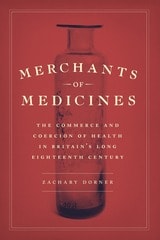
Merchants of Medicines
The Commerce and Coercion of Health in Britain’s Long Eighteenth CenturyZachary Dorner
University of Chicago Press, 2020
In Merchants of Medicines, Zachary Dorner follows the earliest industrial pharmaceuticals from their manufacture in the United Kingdom, across trade routes, and to the edges of empire, telling a story of what medicines were, what they did, and what they meant. He brings to life business, medical, and government records to evoke a vibrant early modern world of London laboratories, Caribbean estates, South Asian factories, New England timber camps, and ships at sea. In these settings, medicines were produced, distributed, and consumed in new ways to help confront challenges of distance, labor, and authority in colonial territories. Merchants of Medicines offers a new history of economic and medical development across early America, Britain, and South Asia, revealing the unsettlingly close ties among medicine, finance, warfare, and slavery that changed people’s expectations of their health and their bodies.
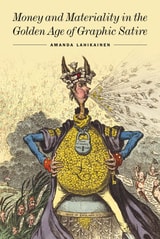
Money and Materiality in the Golden Age of Graphic Satire
Amanda Lahikainen
University of Delaware Press, 2022
This book examines the entwined and simultaneous rise of graphic satire and cultures of paper money in late eighteenth- and early nineteenth-century Britain. Asking how Britons learned to value both graphic art and money, the book makes surprising connections between two types of engraved images that grew in popularity and influence during this time. Graphic satire grew in visual risk-taking, while paper money became a more standard carrier of financial value, courting controversy as a medium, moral problem, and factor in inflation. Through analysis of satirical prints, as well as case studies of monetary satires beyond London, this book demonstrates several key ways that cultures attach value to printed paper, accepting it as social reality and institutional fact. Thus, satirical banknotes were objects that broke down the distinction between paper money and graphic satire altogether.
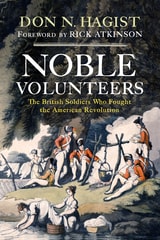
Noble Volunteers
The British Soldiers Who Fought the American RevolutionDon N. Hagist
Westholme Publishing, 2025
Winner of the 2020 American Revolution Roundtable of Philadelphia Book of the Year
Redcoats. For Americans, the word brings to mind the occupying army that attempted to crush the Revolutionary War. There was more to these soldiers than their red uniforms, but the individuals who formed the ranks are seldom described in any detail in historical literature, leaving unanswered questions. Who were these men? Why did they join the army? Where did they go when the war was over?
In Noble Volunteers: The British Soldiers Who Fought the American Revolution, Don N. Hagist brings life to these soldiers, describing the training, experiences, and outcomes of British soldiers who fought during the Revolution. Drawing on thousands of military records and other primary sources in British, American, and Canadian archives, and the writings of dozens of officers and soldiers, Noble Volunteers shows how a peacetime army responded to the onset of war, how professional soldiers adapted quickly and effectively to become tactically dominant, and what became of the thousands of career soldiers once the war was over.
In this historical tour de force, introduced by Pulitzer Prize winner Rick Atkinson, Hagist dispels long-held myths, revealing how remarkably diverse British soldiers were. They represented a variety of ages, nationalities, and socioeconomic backgrounds, and many had joined the army as a peacetime career, only to find themselves fighting a war on another continent in often brutal conditions. Against the sweeping backdrop of the war, Hagist directs his focus on the small picture, illuminating the moments in an individual soldier’s life—those hours spent nursing a fever while standing sentry in the bitter cold, or writing a letter to a wife back home. What emerges from these vignettes is the understanding that while these were “common” soldiers, each soldier was completely unique, for, as Hagist writes, “There was no ‘typical’ British soldier.”
Notorious Facts
Publicity in Romantic England, 1780–1830James Mulvihill
University of Delaware Press, 2012
Notorious Facts examines the sensationalistic confounding of persons and principles in the public life of Romantic England (1780–1830). Its purview is limited to five decades straddling the late eighteenth and early nineteenth centuries, but its trajectory, moving from a politics rendered in personal terms to a politics of personality, describes a shift still in process today. The study’s chapters draw on a motley body of literature (pamphlets, secret histories, and the like) that at first glance seems uncharacteristic of what literary historians call the English Romantic period. Viewed in the context of something called late Georgian England, these texts seem more indigenous, but if the canonical revisionism of the last few decades should teach us anything, it is that a Romanticism encompassing all romanticisms ideally excludes nothing.
In its heroic Enlightenment sense, publicity is concerned with exposing the workings of power for all to see. A good deal may be inferred about publicity in Romantic England from primary texts in which this salutary function is at once espoused and subverted. These texts—the mostly nameless or pseudonymous authors of the age’s pamphlet literature are the heroes and villains of the piece—almost invariably claim to speak from a disinterested conception of publicity while putting its methods of critical exposure to wholly self-interested purposes. This study examines well-known authors of the period like Jeremy Bentham, Samuel Taylor Coleridge, and William Hazlitt, as well as pamphleteers like John Horne Tooke, Philip Withers, and Nathaniel Jefferys. Other figures include authors of secret history like Thomas Ashe, Mary Anne Clarke, Lewis Goldsmith, and Joseph Haslewood in addition to notorious figures in their own right such as the Prince and Princess of Wales, Mrs. Fitzherbert, and the Reverend Edward Irving. Among the topics treated are treasonous libel, royal scandal, secret history, and celebrity.
Published by University of Delaware Press. Distributed worldwide by Rutgers University Press.
POLICING THE CITY
CRIME & LEGAL AUTHORITY IN LONDON, 1780-1840ANDREW T. HARRIS
The Ohio State University Press, 2004
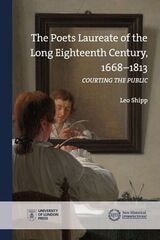
Poets Laureate in the Long Eighteenth Century, 1668-1813
Leo Shipp
University of London Press, 2022
The office of the poet laureate of Britain was a highly prominent, relevant, and respectable institution throughout the long eighteenth century. First instituted for John Dryden in 1668, the laureateship developed from an honorific into a functionary office with a settled position in court, and in 1813 was bestowed upon Robert Southey, whose tenure transformed the office. Taking an interdisciplinary approach, this book examines the office’s institutional changes and public reception, the mechanics of each laureate’s appointment, and the works produced by the laureates before and after their appointments. It argues that the laureateship played a key part in some of the most vital trends in eighteenth-century culture.
At the core of the book is a new research paradigm that Leo Shipp calls the conceptual geography of culture. It shows that Britons routinely used spatial concepts to understand culture throughout the period, which became increasingly abstract over time. As part of this, Shipp shows, the court evolved from a concrete space in London to an abstract space capable of hosting the entire British public. The laureateship was a dynamic office positioned at the interface of court and public, evolving in line with its audiences. An important intervention in eighteenth-century historiography, this book presents a nuanced understanding of eighteenth-century culture and society, in which the laureateship exemplified the enduring centrality of the court to the British conceptual geography of culture.
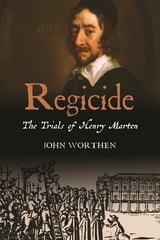
Regicide
The Trials of Henry MartenJohn Worthen
Haus Publishing, 2022
Henry Marten—soldier, member of parliament, organizer of the trial of Charles I, and signatory of the King’s death warrant—is today a neglected figure of the seventeenth century. Yet his life was both extraordinary and emblematic: he was at the fulcrum of English history during the turbulent years of the civil war, the protectorate, and the restoration. Imprisoned in the Tower of London and tried at the Old Bailey, Marten was found guilty of high treason, only to be held captive for years on the equivalent of death row. While he was in prison, his letters to his mistress Mary Ward were stolen and published in an attempt to destroy his reputation. Witty, clever, loving, sardonic, and never despairing, the letters offer a rare and extraordinary insight into the everyday life of a man in the Tower awaiting a sentence of death. The attempt to expose him as immoral revealed him instead as a tender and brave man. In John Worthen’s revelatory biography, Marten emerges from the shadows as a brilliantly clever, lively-minded man, free of the fundamentalist zeal so common in many of his republican contemporaries. Marten never abandoned his beliefs in equality, in a representative parliament under a constitution (which he had helped to write) without a monarch or a House of Lords, and in that way can be seen as a very modern man.
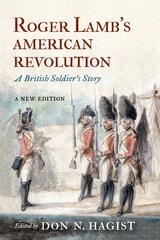
Roger Lamb's American Revolution
A British Soldier's StoryDon N. Hagist
Westholme Publishing, 2022
Of all the British soldiers who served in North America during the American Revolution, none wrote more about his experiences than Roger Lamb. He certainly had a lot to say: his service in two of the most important campaigns—the 1777 Saratoga campaign and the 1781 campaign through the Carolinas to Virginia—put him in the thick of some of the war’s most famous battles. Moreover, he was twice captured and twice escaped, making his way through hostile territory to rejoin the British army. Later in his life he wrote two books chronicling these experiences in great detail. Hundreds of British soldiers went through similar ordeals, sharing in the campaigns, the battles, the captivities, the escapes, but none recounted any aspect of these activities in the level of detail that Lamb did.
The first edition of this book, published in 2004, combined all of Roger Lamb’s first-hand recollections from his two books, An Original and Authentic Journal of Occurrences during the late American War, from its Commencement to the Year 1783 (Dublin, 1809) and Memoir of his Own Life (Dublin, 1811). Since that publication, two more important documents written by Lamb have come to light—an intelligence report written in 1782 recounting details of one of his escapes, and a “commonplace book” kept later in his life to record a vast range of memories, thoughts, and observations. Roger Lamb’s American Revolution: A British Soldier’s Story combines all of the material from these four sources pertaining to Lamb’s career as a soldier, from the time he joined the army to his departure from it, plus his recollections of childhood and post-military life. The result is the most comprehensive first-hand account by a British soldier in the American Revolution, an essential record for understanding the war in its totality.
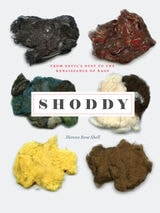
Shoddy
From Devil’s Dust to the Renaissance of RagsHanna Rose Shell
University of Chicago Press, 2020
In Shoddy: From Devil’s Dust to the Renaissance of Rags, Hanna Rose Shell takes readers on a journey to discover shoddy, from Haiti to the “shoddy towns” of West Yorkshire in England, to the United States, back in time to the British cholera epidemics and the American Civil War, and into agricultural fields, textile labs, and rag-shredding factories. Shell’s narrative is both literary and historical, drawing on an extraordinary range of sources, from court cases to military uniforms, mattress labels to medical textbooks, political cartoons to high art. Shoddy moves between genres, bringing richly drawn characters and unexpected objects to life. Along the way, shoddy becomes equally an evocative object and a portal into another world.
Almost since the time it first appeared, shoddy was both ubiquitous and controversial. In part because it was often so hard to detect, it was inherently suspicious. Public health experts worried about sanitation and disease—how could old clothes be disinfected? As well, the idea of wearing someone else’s old clothes so close to your own skin was discomforting in and of itself. Could you sleep peacefully knowing that your mattress was very likely to be stuffed with dead soldiers’ overcoats? The use of the term “virgin” wool, the idea of virginity in relation to clothes, in fact emerged as an effort by the wool industry to counter shoddy’s appeal: to make shoddy seem shoddy. Over time, shoddy would capture a host of personal, ethical, commercial, and societal failings. And yet, there was always, within shoddy, the alluring concept of regeneration, of what we today think of as conscious clothing, eco-fashion, sustainable textiles.
Shell exposes an interwoven tale of industrial espionage, political infighting, scientific inquiry, ethnic prejudices, and war profiteering. Discarded clothes may make many journeys over the course of several lifetimes. Not only in your garments, but under your rug, in your mattress pads, piano blankets, in the peculiar confetti-like stuffing in your mailing envelopes, even in the insulation in your walls. Though it began with wool, over the past century the shredding “devil” has turned to synthetics from nylon stockings to Kevlar. Shoddy is likely connected to something you are wearing right now. After reading, you will never use the word shoddy or think about your clothes, the environment, sustainability, or the intermingled world around you the same way again.
Staying Power
The History of Black People in BritainPeter Fryer
Pluto Press, 2018
Stretching back to the Roman conquest, encompassing the court of Henry VIII, and following a host of characters from the pioneering nurse and war hero Mary Seacole to the abolitionist Olaudah Equiano, Peter Fryer paints a picture of two thousand years of black presence in Britain. By rewriting black Britons into British history, showing where they influenced political traditions, social institutions, and cultural life, Staying Power presented a radical challenge to racist and nationalist agendas. This edition includes a new foreword by Gary Younge examining the book’s continued significance in shaping black British identity today, alongside the now-classic introduction by Paul Gilroy.
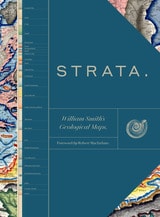
Strata
William Smith’s Geological MapsEdited by the Oxford University Museum of Natural History
University of Chicago Press, 2020
This sumptuous volume begins with an introduction by Douglas Palmer that places Smith’s work in the context of earlier, concurrent, and subsequent ideas regarding the structure and natural processes of the earth, geographical mapping, and biostratigraphical theories. The book is then organized into four parts, each beginning with four sheets from Smith’s hand-colored, 1815 strata map, accompanied by related geological cross-sections and county maps, and followed by fossil illustrations by Smith contemporary James Sowerby, all organized by strata. Essays between each section explore the aims of Smith’s work and its application in the fields of mining, agriculture, cartography and hydrology. Strata concludes with reflections on Smith’s later years as an itinerant geologist and surveyor, plagiarism by a rival, receipt of the first Wollaston Medal in recognition of his achievements, and the influence of his geological mapping and biostratigraphical theories on the sciences—all of which culminated in the establishment of the modern geological timescale.
Featuring a foreword by Robert Macfarlane, Strata is a glorious testament to the lasting geological and illustrative genius of William Smith, a collection as colossal and awe-inspiring as the layers of the Earth themselves.
Technologies of Empire
Writing, Imagination, and the Making of Imperial Networks, 1750–1820Dermot Ryan
University of Delaware Press, 2013
Published by University of Delaware Press. Distributed worldwide by Rutgers University Press.

The Corporation That Changed the World
How the East India Company Shaped the Modern MultinationalNick Robins
Pluto Press, 2012
"Elegantly written and sharply argued, Nick Robins' gripping account of the rise and fall of the English East India Company brings to life a crucial episode in the history of globalization."—Sankar Muthu, University of Chicago
The English East India Company was the mother of the modern multinational. Its trading empire encircled the globe, importing Asian luxuries such as spices, textiles, and teas. But it also conquered much of India with its private army and broke open China's markets with opium. The Company's practices shocked its contemporaries and still reverberate today, offering lessons about unfettered capitalism, corporate responsibility, and the legacy of colonialism.
The Corporation That Changed the World is the first book to reveal the Company's enduring legacy as a corporation. This expanded edition explores how the four forces of scale, technology, finance, and regulation drove its spectacular rise and fall. For decades, the Company was simply too big to fail, and stock market bubbles, famines, drug-running, and even duels between rival executives are to be found in this new account.
Table of Contents:
Introduction
Chronology
1 The Hidden Wound
2 The Imperious Company
3 Out of the Shadows
4 The Bengal Revolution
5 The Great East Indian Crash
6 Regulating the Company
7 Justice Will Be Done
8 The Toxic Exchange
10 The Unfettered Business
Epilogue
For Robins, the Company's story provides vital lessons on both the role of corporations in world history and the steps required to make global business accountable today.
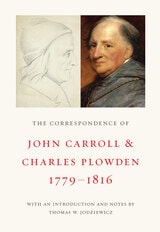
The Correspondence of John Carroll and Charles Plowden, 1779-1816
Thomas W. Jodziewicz
Catholic University of America Press, 2025
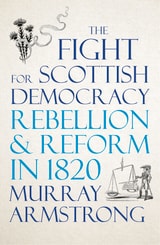
The Fight for Scottish Democracy
Rebellion and Reform in 1820Murray Armstrong
Pluto Press, 2020
This 'Radical War' was the culmination of five years of unsuccessful mass petitioning of Westminster by working people in Scotland and England. The contempt and intransigence of the Tory government forced an escalation in tactics, and on Easter Monday of 1820, the call for a general strike was answered throughout the western counties of Scotland. Their demands were threefold: the vote for all men, annual parliaments and equal constituencies. Coupled with an armed rebellion, the strike was met by the full military might of the British state; hundreds were arrested and imprisoned without trial, while hundreds more fled the country.
This Scottish general strike and insurrection is a little-known chapter of British history and yet remains an immensely important one in the long fight for democracy. In The Fight for Scottish Democracy, Murray Armstrong brings these events dramatically to life.
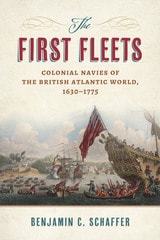
The First Fleets
Colonial Navies of the British Atlantic World, 1630–1775Benjamin C. Schaffer
University of Alabama Press, 2025
A revealing study on the little-known and misunderstood provincial navies established by North American British colonists.
In The First Fleets, Benjamin C. Schaffer reveals how, contrary to widespread beliefs, the American colonies had a long tradition of independent naval defense decades before the Revolution. He demonstrates that Anglo-American governments established and maintained significant provincial naval forces and that the history of provincial navies illuminates broader aspects of colonial history and the colonies’ ultimate break with the British Crown.
Based on meticulous research, Schaffer recounts the sea-borne threats that American colonies faced from the French, Spanish, pirates, and others. He reviews colonial governance and the relationships between colonial governments and Great Britain. Highlighting Britain’s scant naval power in North America, Schaffer demonstrates how the vulnerable coastal colonies undertook their own self-defense.
Schaffer’s readable study offers many fascinating episodes from colonial history. Establishing a navy was controversial in pacifist-minded, Quaker-dominated Pennsylvania. South Carolina deployed its scout-boat navy to pursue enslaved Africans who fled colonial capture. The first paper money issued in North America was an initiative to pay for a naval expedition against French Quebec in 1690. These and other episodes show the intimate connection between these little-known provincial navies and the major sociopolitical developments of their day.
The First Fleets will be of great interest to historians and readers of early American history, particularly colonial maritime and naval activities. Readers interested in the political and military dynamics of pre-Revolutionary America, as well as enthusiasts of naval history and maritime trade, will find The First Fleets both a valuable resource and an engrossing narrative.
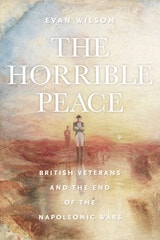
The Horrible Peace
British Veterans and the End of the Napoleonic WarsEvan Wilson
University of Massachusetts Press, 2023
Few battles in world history provide a cleaner dividing line than Waterloo: before, there was Napoleon; after, there was the Pax Britannica. While Waterloo marked France’s defeat and Britain’s ascendance as an imperial power, the war was far from over for many soldiers and sailors, who were forced to contend with the lasting effects of battlefield trauma, the realities of an impossibly tight labor market, and growing social unrest. The Horrible Peace details a story of distress and discontent, of victory complicated by volcanism, and of the challenges facing Britain at the beginning of its victorious century.
Examining the process of demobilization and its consequences for British society, Evan Wilson draws on archival research and veterans’ memoirs to tell the story of this period through the experiences of veterans who struggled to reintegrate and soldiers and sailors who remained in service as Britain attempted to defend and expand the empire. Veterans were indeed central to Britain’s experience of peace, as they took to the streets to protest the government’s indifference to widespread unemployment and misery. The fighting did not stop at Waterloo.
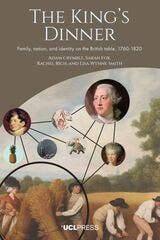
The King’s Dinner
Family, Nation, and Identity on the British table, 1760–1820Adam Crymble, Sarah Fox, Rachel Rich, and Lisa Smith
University College London, 2026
Expanding previous notions of the monarchy and Britishness, this volume examines British identity in the late eighteenth century through the lens of the kitchen.
Drawing on a large dataset of two royal household kitchen ledgers, this book studies the role and influence of food in understanding British identity in the late eighteenth century. Analyzing trade routes, migration, agricultural changes, recipes, and flavors, it argues that Britishness was more complex and multicultural than previously recognized. By situating national identity at the dinner table, the authors show how Britishness was an embodied identity that combined regional, national, and global elements. Combining digital humanities and data science approaches with social and cultural history, The King's Dinner also proposes a new way of understanding the monarchy's position within rather than above the cultural habitus of their subjects.
The Rise of Common-Sense Conservatism
The American Right and the Reinvention of the Scottish EnlightenmentAntti Lepistö
University of Chicago Press, 2021
In considering the luminaries of American neoconservative thought—among them Irving Kristol, Gertrude Himmelfarb, James Q. Wilson, and Francis Fukuyama—Lepistö argues that the centrality of their conception of the common man accounts for the enduring power and influence of their thought. Intriguingly, Lepistö locates the roots of this conception in the eighteenth-century Scottish Enlightenment, revealing how leading neoconservatives weaponized the ideas of Adam Smith, Thomas Reid, and David Hume to denounce postwar liberal elites, educational authorities, and social reformers. Their reconfiguration of Scottish Enlightenment ideas ultimately gave rise to a defining force in modern conservative politics: the common sense of the common man. Whether twenty-first-century politicians who invoke the grievances of “the people” are conscious of this unusual lineage or not, Lepistö explains both the persistence of the trope and the complicity of some conservative thinkers with the Trump regime.
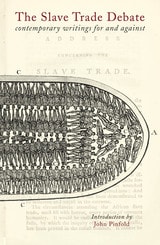
The Slave Trade Debate
Contemporary Writings For and AgainstEdited by the Bodleian Library
Bodleian Library Publishing, 2007
More than fifty years before the question of slavery launched the United States into the bloody turmoil of the American Civil War, Britain wrestled passionately with the same issues. A flood of pamphlets published by both abolitionists and slavery proponents fueled the debate, and they are now collected here in this fascinating volume in commemoration of the Abolition of the Slave Trade Act, 1807.
Written during the 1780s and 1790s, the pamphlets confront the issues surrounding slavery, such as the Rights of Man, the economic health of the British colonies, poverty in England, and, most prominently, the economic and moral condition of the African slaves. The authors on both sides of the debate—including such prominent figures as the eventual King William IV, Sir John Gladstone (father of the future Prime Minister William Gladstone), and the leading abolitionist William Wilberforce—draw upon biblical scriptures to justify their positions, providing illuminating insights into the theological debates of the time as well. Also included in the volume are an excerpt of abolitionist James Ramsay’s journal and an informative introduction that places the writings in their historical and social contexts. The Slave Trade Debate is an essential resource for scholars of transatlantic slavery and British history.
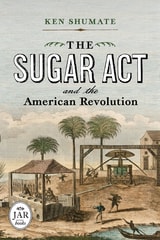
The Sugar Act and the American Revolution
Ken Shumate
Westholme Publishing, 2022
The Sugar Act and the American Revolution by Ken Shumate is the only book-length treatment of this first great challenge of the revolutionary era. For each of the three incarnations of the act, the author provides a clause-by-clause description, including the British reasoning behind the duties and trade restrictions, and a summary of the resulting American grievance. Following the explanation of each act are chapters describing the protests of American merchants and popular leaders, and the British response to those protests. As a consequence of further parliamentary acts of taxation, the story ends with the demand in 1774 by the First Continental Congress for Parliament to repeal the Sugar Act as being “essentially necessary in order to restore harmony between Great Britain and the American colonies.”
Tiger Duff
India, Madeira and Empire in Eighteenth-Century ScotlandAlistair Mutch
Aberdeen University Press, 2017
Town
Prints & Drawings of Britain before 1800Bernard Nurse
Bodleian Library Publishing, 2020
Wordsworth's Fun
Matthew Bevis
University of Chicago Press, 2019
Wordsworth’s Fun explores the writer’s debts to the ludic and the ludicrous in classical tradition; his reworkings of Ariosto, Erasmus, and Cervantes; his engagement with forms of English poetic humor; and his love of comic prose. Combining close reading with cultural analysis, Bevis travels many untrodden ways, studying Wordsworth’s interest in laughing gas, pantomime, the figure of the fool, and the value of play. Intrepid, immersive, and entertaining, Wordsworth’s Fun sheds fresh light on how one poet’s strange humor helped to shape modern literary experiment.