Results by title
212 books match the query 'German' and 15 start with a

A History of German Jewish Bible Translation
Abigail Gillman
University of Chicago Press, 2018
This book is the first in English to offer a close analysis of German Jewish translations as part of a larger cultural project. Looking at four distinct waves of translations, Abigail Gillman juxtaposes translations within each that sought to achieve similar goals through differing means. As she details the history of successive translations, we gain new insight into the opportunities and problems the Bible posed for different generations and gain a new perspective on modern German Jewish history.
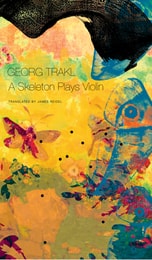
A Skeleton Plays Violin
Book Three of Our TraklGeorg Trakl
Seagull Books, 2017
A Skeleton Plays Violin comprises the final volume in a trilogy of works by Trakl published by Seagull Books. This selection gathers Trakl’s early, middle, and late work, none of it published in book form during his lifetime. The work here ranges widely, from his haunting prose pieces to his darkly beautiful poems documenting the first bloody weeks of World War I on the Eastern Front.
Book Three of Our Trakl—the series that began with Trakl’s first book Poems and his posthumously published Sebastian Dreaming—also includes translations of unpublished poems and significant variants. Interpolated throughout this comprehensive and chronological selection is a biographical essay that provides more information about Trakl’s gifted and troubled life, especially as it relates to his poetry, as well as the necessary context of his relationship with his favorite sibling, his sister Grete, whose role as a muse to her brother is still highly controversial. Trakl’s life was mysterious and fascinating, a fact reflected in his work. A Skeleton Plays Violin should not be missed.
Ab Initio Language Teaching in British Higher Education
The Case of GermanEdited by Ulrike Bavendiek, Silke Mentchen, Christian Mossmann, and Dagmar Paulus
University College London, 2022
As entries for UK school exams in modern foreign languages decrease, this book serves the urgent need for research and guidance on ab initio learning and teaching in higher education. Drawing extensively on the expertise of teachers of German in universities across the UK, the volume offers an overview of recent trends, new pedagogical approaches, and practical guidance for teaching languages at the beginners’ level in the higher education classroom that will be useful for teachers of both German and other languages.
The first chapters assess the role of ab initio provision within the wider context of modern language departments and language centers. They are followed by sections on teaching methods and approaches in the ab initio classroom, including the use of music, textbook evaluation, effective use of flipped classrooms, and the contribution of language apps. Finally, the book focuses on the learner in the ab initio context and explores issues around autonomy and learner strengths.
Absinthe
World Literature in Translation: Volume 27: Through German: Contemporary Literature in TranslationLauren Beck
Michigan Publishing Services, 2021
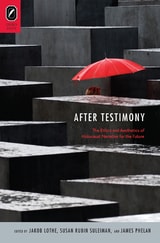
After Testimony
The Ethics and Aesthetics of Holocaust Narrative for the FutureEdited by Jakob Lothe, Susan Rubin Suleiman, and James Phelan
The Ohio State University Press, 2012
After Testimony: The Ethics and Aesthetics of Holocaust Narrative for the Future collects sixteen essays written with the awareness that we are on the verge of a historical shift in our relation to the Third Reich’s programmatic genocide. Soon there will be no living survivors of the Holocaust, and therefore people not directly connected to the event must assume the full responsibility for representing it. The contributors believe that this shift has broad consequences for narratives of the Holocaust. By virtue of being “after” the accounts of survivors, storytellers must find their own ways of coming to terms with the historical reality that those testimonies have tried to communicate. The ethical and aesthetic dimensions of these stories will be especially crucial to their effectiveness. Guided by these principles and employing the tools of contemporary narrative theory, the contributors analyze a wide range of Holocaust narratives—fictional and nonfictional, literary and filmic—for the dual purpose of offering fresh insights and identifying issues and strategies likely to be significant in the future. In addition to the editors, the contributors are Daphna Erdinast-Vulcan, Sidra DeKoven Ezrahi, Anniken Greve, Jeremy Hawthorn, Marianne Hirsch, Irene Kacandes, Phillipe Mesnard, J. Hillis Miller, Michael Rothberg, Beatrice Sandberg, Anette H. Storeide, Anne Thelle, and Janet Walker.
Albrecht Dürer and the Epistolary Mode of Address
Shira Brisman
University of Chicago Press, 2016
In the early modern period, before the establishment of a reliable postal system, letters faced risks of interception and delay. During the Reformation, the printing press threatened to expose intimate exchanges and blur the line between public and private life. Exploring the complex travel patterns of sixteenth-century missives, Brisman explains how these issues of sending and receiving informed Dürer’s artistic practices. His success, she contends, was due in large part to his development of pictorial strategies—an epistolary mode of address—marked by a direct, intimate appeal to the viewer, an appeal that also acknowledged the distance and delay that defers the message before it can reach its recipient. As images, often in the form of prints, coursed through an open market, and artists lost direct control over the sale and reception of their work, Germany’s chief printmaker navigated the new terrain by creating in his images a balance between legibility and concealment, intimacy and public address.
An Aesthetics of Narrative Performance
Transnational Theater, Literature, and Film in Contemporary GermanyClaudia Breger
The Ohio State University Press, 2012
An Emotional State
The Politics of Emotion in Postwar West German CultureAnna M. Parkinson
University of Michigan Press, 2015
One of the book’s major contributions is that it offers an analytical distinction between emotion and affect, finding a compelling way to talk about affect and emotion that is informed by affect theory but that integrates psychoanalysis. The study draws on the psychoanalytic writings of Freud, Margarete and Alexander Mitscherlich, and André Green, while engaging with interdisciplinary theorists of affect including Barbara Rosenwein, Lauren Berlant, Ann Cvetkovich, and Eve Kosofsky Sedgwick among many others.
Archaeologies of Modernity
Avant-Garde BildungRainer Rumold
Northwestern University Press, 2015
Archaeologies of Modernity explores the shift from the powerful tradition of literary forms of Bildung—the education of the individual as the self—to the visual forms of “Bildung” (from Bild) that characterize German modernism and the European avant-garde. Interrelated chapters examine the work of Franz Kafka, Jean/Hans Arp, Walter Benjamin, and Carl Einstein, and of artists such as Oskar Kokoschka or Kurt Schwitters, in the light of the surge of an autoformation (Bildung) of verbal and visual images at the core of expressionist and surrealist aesthetics and the art that followed. In this first scholarly focus on modernist avant-garde Bildung in its entwinement of conceptual modernity with forms of the archaic, Rumold resituates the significance of the poet and art theorist Einstein and his work on the language of primitivism and the visual imagination. Archaeologies of Modernity is a major reconsideration of the conception of the modernist project and will be of interest to scholars across the disciplines.
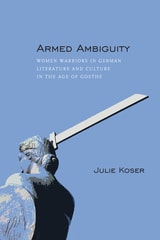
Armed Ambiguity
Women Warriors in German Literature and Culture in the Age of GoetheJulie Koser
Northwestern University Press, 2016
Armed Ambiguity is a fascinating examination of the tropes of the woman warrior constructed by print culture—including press reports, novels, dramatic works, and lyrical texts—during the decades-long conflict in Europe around 1800.
In it, Julie Koser sheds new light on how women’s bodies became a battleground for competing social, cultural, and political agendas in one of the most pivotal periods of modern history. She traces the women warriors in this work as reflections of the social and political climate in German-speaking lands, and she reveals how literary texts and cultural artifacts that highlight women’s armed insurrection perpetuated the false dichotomy of "public" versus "private" spheres along a gendered fault line. Koser illuminates how reactionary visions of "ideal femininity" competed with subversive fantasies of new femininities in the ideological battle being waged over the restructuring of German society.
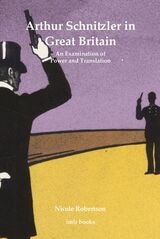
Arthur Schnitzler in Great Britain
An Examination of Power and TranslationNicole Robertson
University of London Press, 2022
The “amoral voice” of fin-de-siècle Vienna, Arthur Schnitzler (1862–1931) was one of the major figures of European modernist literature. Throughout his lifetime and after his death, his writing enjoyed substantial domestic and international success, yet the arrival of his dramatic works in Great Britain was plagued by false starts, short runs, and inconsistencies. Only with Tom Stoppard’s adaptations of Das weite Land and Liebelei, as Undiscovered Country and Dalliance respectively, were Schnitzler’s plays finally produced at the National Theatre.
This fascinating book studies the history of Schnitzler’s reception in Great Britain to unearth evidence of power in transcultural and translingual migrations. Surveying the field from the end of the nineteenth century to the present day, Nicole Robertson’s analysis of published translations, critical reviews, correspondence, and unpublished drafts provides expansive insight into the process of translating from page to stage. This book presents exhaustive and detailed scholarship on a fascinating, if far from smooth, journey, raising fundamental questions about the nature of authorship.
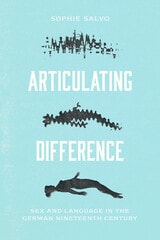
Articulating Difference
Sex and Language in the German Nineteenth CenturySophie Salvo
University of Chicago Press, 2024
Drawing on a wide range of texts, from understudied ethnographic and scientific works to canonical literature and philosophy, Sophie Salvo uncovers the prehistory of the inextricability of gender and language. Taking German discourses on language as her focus, she argues that we are not the inventors but, rather, the inheritors and adapters of the notion that gender and language are interrelated. Particularly during the long nineteenth century, ideas about sexual differences shaped how language was understood, classified, and analyzed. As Salvo explains, philosophers asserted the patriarchal origins of language, linguists investigated “women’s languages” and grammatical gender, and literary Modernists imagined “feminine” sign systems, and in doing so they not only deemed sex-based divisions to be necessary categories of language but also produced a plethora of gendered tropes and fictions, which they used both to support their claims and delimit their disciplines.
Articulating Difference charts new territory, revealing how gendered conceptions of language make possible the misogynistic logic of exclusion that underlies arguments claiming, for example, that women cannot be great orators or writers. While Salvo focuses on how male scholars aligned language study with masculinity, she also uncovers how women responded, highlighting the contributions of understudied nineteenth-century works on language that women wrote even as they were excluded from academic opportunities.
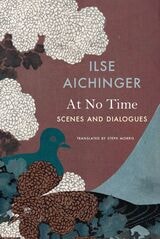
At No Time
Scenes and DialoguesIlse Aichinger
Seagull Books, 2023
A member of the Gruppe 47 writers’ group which sought to renew German-language literature after World War II, Ilse Aichinger (1921–2016) achieved great acclaim as a writer of fiction, poetry, prose, and radio drama. The vignettes in At No Time each begin in recognizable situations, often set in Vienna or other Austrian cities, but immediately swerve into bizarre encounters, supernatural or fantastical situations. Precisely drawn yet disturbingly skewed, they are both naturalistic and disjointed, like the finest surrealist paintings. Created to be experienced on the page or on the radio rather than the stage, they echo the magic realism of her short stories. Even though they frequently take a dark turn, they remain full of humor, agility, and poetic freedom.
At the Limit of the Obscene
German Realism and the Disgrace of MatterErica Weitzman
Northwestern University Press, 2021
As German-language literature turned in the mid-nineteenth century to the depiction of the profane, sensual world, a corresponding anxiety emerged about the terms of that depiction—with consequences not only for realist poetics but also for the conception of the material world itself. At the Limit of the Obscene examines the roots and repercussions of this anxiety in German realist and postrealist literature. Through analyses of works by Adalbert Stifter, Gustav Freytag, Theodor Fontane, Arno Holz, Gottfried Benn, and Franz Kafka, Erica Weitzman shows how German realism’s conflicted representations of the material world lead to an idea of the obscene as an excess of sensual appearance beyond human meaning: the obverse of the anthropocentric worldview that German realism both propagates and pushes to its crisis. At the Limit of the Obscene thus brings to light the troubled and troubling ontology underlying German realism, at the same time demonstrating how its works continue to shape our ideas about representability, alterity, and the relationship of human beings to the non-human well into the present day.
as mornings and mossgreen I. Step to the window
Friederike Mayröcker
Seagull Books, 2023
Austrian poet Friederike Mayröcker is widely considered one of the most important European poets of the twentieth and twenty-first centuries. The last book of hers to be published during her lifetime, as mornings and moosgreen I. Step to the window is an elliptical and, if at times cryptic, deeply personal, playful, and highly poetic collection of experiences, memories, dreams, desires, fears, visions, observations, and peregrinations through landscapes both real and imagined. The volume bears witness to her unique late lyrical style of pyrotechnical cut-up. Among many others, her beloved Derrida, Duchamp, Hölderlin, and Jean-Paul all appear, almost like guides, as Mayröcker bravely makes her way through infirmity, old age, and loneliness, prolonging her time as a prolific writer as much as possible.