Results by title
8 books match the query 'Ghetto'
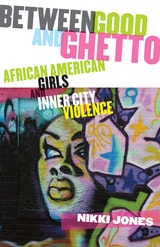
Between Good and Ghetto
African American Girls and Inner-City ViolenceNikki Jones
Rutgers University Press, 2009
Drawing on personal encounters, traditions of urban ethnography, Black feminist thought, gender studies, and feminist criminology, Nikki Jones gives readers a richly descriptive and compassionate account of how African American girls negotiate schools and neighborhoods governed by the so-called "code of the street"ùthe form of street justice that governs violence in distressed urban areas. She reveals the multiple strategies they use to navigate interpersonal and gender-specific violence and how they reconcile the gendered dilemmas of their adolescence. Illuminating struggles for survival within this group, Between Good and Ghetto encourages others to move African American girls toward the center of discussions of "the crisis" in poor, urban neighborhoods.
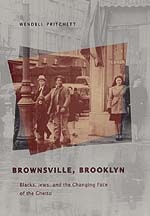
Brownsville, Brooklyn
Blacks, Jews, and the Changing Face of the GhettoWendell E. Pritchett
University of Chicago Press, 2001
The story of these two different, but in many ways similar, Brownsvilles is compellingly told in this probing new work. Focusing on the interaction of Brownsville residents with New York's political and institutional elites, Wendell Pritchett shows how the profound economic and social changes of post-World War II America affected the area. He covers a number of pivotal episodes in Brownsville's history as well: the rise and fall of interracial organizations, the struggles to deal with deteriorating housing, and the battles over local schools that culminated in the famous 1968 Teachers Strike. Far from just a cautionary tale of failed policies and institutional neglect, the story of Brownsville's transformation, he finds, is one of mutual struggle and frustrated cooperation among whites, blacks, and Latinos.
Ultimately, Brownsville, Brooklyn reminds us how working-class neighborhoods have played, and continue to play, a central role in American history. It is a story that needs to be read by all those concerned with the many challenges facing America's cities today.
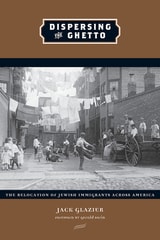
Dispersing the Ghetto
The Relocation of Jewish Immigrants Across AmericaJack Glazier
Michigan State University Press, 2005
In the early 20th century, the population of New York City’s Lower East Side swelled with vast numbers of eastern European Jewish immigrants. The tenements, whose inhabitants faced poverty and frequent unemployment, provoked the hostile attention of immigration restrictionists, many of whom disdained Jews, racial minorities, and foreigners as inferior. Accordingly, they aimed to stifle the growth of dense ethnic settlements by curtailing immigration.
Dispersing the Ghetto is the first book to describe in detail an important but little-known chapter in American immigration history, that of the Industrial Removal Office (IRO), founded in 1901. Established American Jews—arrivals from the German states only a generation before—felt vulnerable. They feared their security was at risk owing to the rising tide of Russian Jews on the east coast. German American Jews believed they too might become the objects of anti-Semitic scorn, which would be disastrous for German and Russian Jews alike if it were allowed to shape public policy. As a defensive measure to undercut the immigration restrictionist movement, American Jews of German origin established the Industrial Removal Office to promote the relocation of the immigrants to the towns and cities of the nation’s interior. Until the onset of World War I, the IRO directed the resettlement of Jewish immigrants from New York and other port cities to hundreds of communities nationwide.
Drawing on a variety of sources, including the IRO archive, first-person accounts of resettlement, local records, and the Jewish press, Glazier recounts the operation of the IRO and the complex relationship between two sets of Jewish immigrants.
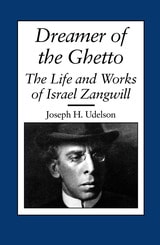
Dreamer of the Ghetto
The Life and Works of Israel ZangwillJoseph H. Udelson
University of Alabama Press, 1990
"An impressive achievement. . . . Udelson provides a trenchant analysis of Zangwill's works set within a historical context, i.e., Jewish emancipation and the dilemma of how one might remain fully Jewish while becoming fully modern, that helps to illuminate Zangwill's life as well as his writings."
—Jewish Book News
"By carefully following the threads of Zangwill's own divided self through the labyrinths of his life and writings, Udelson convinces us not only of the author's startling political prescience, but that he embodies attitudes now shared by almost all secular Jews as a result of events Zangwill did not witness—Nazism and the founding of Israel."
—Shofar
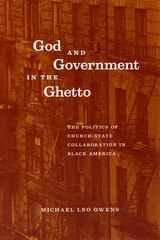
God and Government in the Ghetto
The Politics of Church-State Collaboration in Black AmericaMichael Leo Owens
University of Chicago Press, 2007
But as Michael Leo Owens demonstrates in God and Government in the Ghetto, this alliance also serves as a means for black clergy to reaffirm their political leadership and reposition moral authority in black civil society. Drawing on both survey data and fieldwork in New York City, Owens reveals that African American churches can use these newly forged connections with public agencies to influence policy and government responsiveness in a way that reaches beyond traditional electoral or protest politics. The churches and neighborhoods, Owens argues, can see a real benefit from that influence—but it may come at the expense of less involvement at the grassroots.
Anyone with a stake in the changing strategies employed by churches as they fight for social justice will find God and Government in the Ghetto compelling reading.
Harlem
The Unmaking of a GhettoCamilo José Vergara
University of Chicago Press, 2013
Photographer Camilo José Vergara has been chronicling the neighborhood for forty-three years, and Harlem: The Unmaking of a Ghetto is an unprecedented record of urban change. Vergara began his documentation of Harlem in the tradition of such masters as Helen Levitt and Aaron Siskind, and he later turned his focus on the neighborhood’s urban fabric, both the buildings that compose it and the life and culture embedded in them. By repeatedly returning to the same locations over the course of decades, Vergara is able to show us a community that is constantly changing—some areas declining, as longtime businesses give way to empty storefronts, graffiti, and garbage, while other areas gentrify, with corporate chain stores coming in to compete with the mom-and-pops. He also captures the ever-present street life of this densely populated neighborhood, from stoop gatherings to graffiti murals memorializing dead rappers to impersonators honoring Michael Jackson in front of the Apollo, as well as the growth of tourism and racial integration.
Woven throughout the images is Vergara’s own account of his project and his experience of living and working in Harlem. Taken together, his unforgettable words and images tell the story of how Harlem and its residents navigated the segregation, dereliction and slow recovery of the closing years of the twentieth century and the boom and racial integration of the twenty-first century. A deeply personal investigation, Harlem will take its place with the best portrayals of urban life.

Society for the Prevention of Cruelty to Animals
A Humorous – Insofar as That Is Possible – Novella from the GhettoJ. R. Pick
Karolinum Press, 2018
Tony suffers from tuberculosis, and, lying in his hospital bed one day, he decides to set up an animal welfare organization. Even though no animals are permitted in the camp, he is determined to find just one creature he can care for and protect—and his determination is contagious. A group of older boys, including Tony’s best friend, Ernie, aid him in his quest. Soon they’re joined by Tony’s mother—and her coterie of boyfriends. Eventually, they find Tony his pet: a mouse, which he names and carefully guards in a box hidden beneath his bed. But in the fall of 1944, the transports to Auschwitz begin.
As moving as it is irreverent, Pick’s novella draws on the two years he spent imprisoned in Terezín in his late teens. With cutting black humor, he shines a light on both the absurdities and injustices of the Nazi-run Jewish ghetto, using his literary artistry to portray in stunning shorthand an experience of the Holocaust that pure histories could never convey.
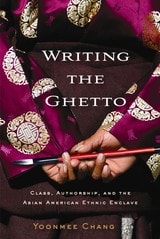
Writing the Ghetto
Class, Authorship, and the Asian American Ethnic EnclaveChang, Yoonmee
Rutgers University Press, 2010
Yoonmee Chang examines the class structure of Chinatowns, Koreatowns, Little Tokyos, and Little Indias, arguing that ghettoization in these spaces is disguised. She maintains that Asian American literature both contributes to and challenges this masking through its marginalization by what she calls the "ethnographic imperative." Chang discusses texts from the late nineteenth century to the present, including those of Sui Sin Far, Winnifred Eaton, Monica Sone, Fae Myenne Ng, Chang-rae Lee, S. Mitra Kalita, and Nam Le. These texts are situated in the contexts of the Chinese Exclusion Era, Japanese American internment during World War II, the globalization of Chinatown in the late twentieth century, the Vietnam War, the 1992 Los Angeles riots, and the contemporary emergence of the "ethnoburb."