Results by title
8 books match the query 'Gibb, Andrew'
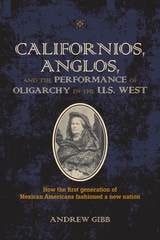
Californios, Anglos, and the Performance of Oligarchy in the U.S. West
Andrew Gibb
Southern Illinois University Press, 2018
This interdisciplinary study draws on performance studies, theatre historiography, and New Western History to identify how the unique power relations of historical California were constituted and perpetuated through public performances—not only traditional theatrical productions but also social events such as elite weddings and community dances—and historical events like the U.S. seizure of the city of Monterey, the feting of Commodore Stockton in San Francisco, and the Bear Flag Revolt.
Theatre History Studies 2015, Vol. 34
Elizabeth Reitz Mullenix
University of Alabama Press, 2015
The five essays are arranged chronologically, starting with Alan Sikes’s discussion of the Abydos Passion Play. Sikes challenges the long-held interpretation of that ritualized annual reenactment of the death, dismemberment, and return to life of Egyptian god-king Osiris as the world’s first recorded dramatic production. In analyzing the “Passion Play”—Sikes argues the term is not apt—he applies semiotic theory using "sign and referent" to revise general concepts of mimesis, and in so doing clarifies the fundamental answer to the question, “What is theatre?”
In a pair of essays, Andrew Gibb and Nicole Berkin both explore theatre during America’s antebellum period. Gibb examines minstrelsy in antebellum California, exploding narrow definitions of minstrelsy as a primarily Eastern phenomenon and one reflecting a stark interaction of two races. Following the story of Jewish African Caribbean immigrant William Alexander Leidesdorff, Gibb demonstrates that national forms are always affected by their local productions and audiences. Berkin’s essay focuses on the struggles over cultural power that took place between popular entertainers and theatre managers. She examines how both parties used touring strategically to engage with antebellum notions of deception and fraud.
The last two essays, by Megan Geigner and Heide Nees, present findings from performance studies which, by examining a wide array of dramatic and performative texts, expands the interdisciplinary foundations of theatre history studies. This fascinating collection is rounded out by an expanded selection of insightful reviews of recent literature in the area.
Theatre History Studies 2018, Vol. 37
Sara Freeman
University of Alabama Press, 2018
THEATRE HISTORY STUDIES, VOLUME 37
STEFAN AQUILINA
Meyerhold and The Revolution: A Reading through Henri Lefebvre’s Theories on “Everyday Life”
VIVIAN APPLER
“Shuffled Together under the Name of a Farce”: Finding Nature in Aphra Behn’s The Emperor of the Moon
KRISTI GOOD
Kate Soffel’s Life of Crime: A Gendered Journey from Warden’s Wife to Criminal Actress
PETER A. CAMPBELL
Staging Ajax’s Suicide: A Historiography
BRIAN E. G. COOK
Rousing Experiences: Theatre, Politics, and Change
MEGAN LEWIS
Until You See the Whites of Their Eyes: Brett Bailey’s Exhibit B and the Consequences of Staging the Colonial Gaze
PATRICIA GABORIK
Taking the Theatre to the People: Performance Sponsorship and Regulation in Mussolini’s Italy
ILINCA TODORUT AND ANTHONY SORGE
To Image and to Imagine: Walid Raad, Rabih Mouré, and the Arab Spring
SHULAMITH LEV-ALADGEM
Where Has the Political Theatre in Israel Gone? Rethinking the Concept of Political Theatre Today
CHRISTINE WOODWORTH
“Equal Rights By All Means!”: Beatrice Forbes-Robertson’s 1910 Suffrage Matinee and the Onstage Junction of the US And UK Franchise Movements
LURANA DONNELS O’MALLEY
“Why I Wrote the Phyllis Wheatley Pageant-Play”: Mary Church Terrell’s Bicentennial Activism
JULIET GUZZETTA
The Lasting Theatre of Dario Fo and Franca Rame
ASHLEY E. LUCAS
Chavez Ravine: Culture Clash and the Political Project of Rewriting History
NOE MONTEZ
The Heavy Lifting: Resisting the Obama Presidency’s Neoliberalist Conceptions of the American Dream in Kristoffer Diaz’s The Elaborate Entrance of Chad Deity
Theatre History Studies 2019, Vol. 38
Edited by Sara Freeman
University of Alabama Press, 2019
THEATRE HISTORY STUDIES, VOLUME 38
PART I: Studies in Theatre History
ELIZABETH COEN
Hanswurst’s Public: Defending the Comic in the Theatres of Eighteenth-Century Vienna
BRIDGET MCFARLAND
“This Affair of a Theatre”: The Boston Theatre Controversy and the Americanization of the Stage
RYAN TVEDT
From Moscow to Simferopol: How the Russian Cubo-Futurists Accessed the Provinces
DANIELLA VINITSKI MOONEY
So Long Ago I Can’t Remember: GAle GAtes et al. and the 1990s Immersive Theatre
Part II: The Site-Based Theatre Audience Experience: Dramaturgy and Ethics
—EDITED BY PENELOPE COLE AND RAND HARMON
PENELOPE COLE
Site-Based Theatre: The Beginning
PENELOPE COLE
Becoming the Mob: Mike Brookes and Mike Pearson’s Coriolan/us
SEAN BARTLEY
A Walk in the Park: David Levine’s Private Moment and Ethical Participation in Site-Based Performance
DAVID BISAHA
“I Want You to Feel Uncomfortable”: Adapting Participation in A 24-Decade History of Popular Music at San Francisco’s Curran Theatre
COLLEEN RUA
Navigating Neverland and Wonderland: Audience as Spect-Character
GUILLERMO AVILES-RODRIGUEZ, PENELOPE COLE, RAND HARMON, AND ERIN B. MEE
Ethics and Site-Based Theatre: A Curated Discussion
PART III: The Robert A. Schanke Award-Winning Essay from the 1038 Mid-America Theatre Conference
MICHELLE GRANSHAW
Inventing the Tramp: The Early Tramp Comic on the Variety Stage
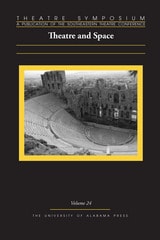
Theatre Symposium, Vol. 24
Theatre and SpaceEdited by Becky K. Becker
University of Alabama Press, 2016
Exploring the dynamic intersections of performance and place.
At a time when so many options exist for access to theatrical entertainments, it is no surprise that theatre practitioners and scholars are often preoccupied with the role of the audience. While space undoubtedly impacts the rehearsal and production processes, its greater significance seems to rest in the impact a specific location has on the audience.
This volume provides diverse viewpoints on theatre and space, as well as its relationship to the audience. Sebastian Trainor and Samuel T. Shanks offer contemporary perspectives on two ancient theatre spaces, while Lisa Marie Bowler describes the Globe Theatre, a replica of the original, as embodying a kind of absence despite its rich link to the past. Focusing on distinctly different periods and settings, both Andrew Gibb and Christine Woodworth describe a politics of space in which specific players gain prestige and power. Chase Bringardner identifies the audience as playing an important role in creating a space for parody in a historic Nashville venue, while Arnab Banerji describes an exhausting process for members of the Bengali group theatre who must continually move from space to space. Finally, Alicia Corts discusses virtual performance spaces and the degree to which participants are able to control their online identities within virtual performances. Bookending these eight essays are Marvin Carlson’s keynote presentation “Whose Space Is It Anyway?” and his closing remarks for the symposium, both of which allude to, and richly explicate, the ultimate arbiters of theatrical space: the audience.
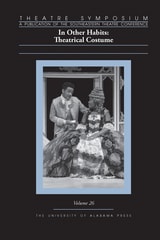
Theatre Symposium, Vol. 26
In Other Habits: Theatrical CostumeSarah McCarroll
University of Alabama Press, 2018
Stage costumes reveal character. They tell audiences who the character is or how a character functions within the world of the play, among other things. Theatrical costuming, however, along with other forms of theatre design, has often been considered merely a craft, rather than part of the deeply systemic creation of meaning onstage. In what ways do our clothes shape and reveal our habits of behavior? How do stage costumes work to reveal one kind of habit via the manipulation of another? How might theatre practitioners learn to most effectively exploit this dynamic? Theatre Symposium, Volume 26 analyzes the ways in which meaning is conveyed through costuming for the stage and explores the underlying assumptions embedded in theatrical practice and costume production.
THEATRE SYMPOSIUM, VOLUME 26
MICHELE MAJER
Plus que Reine: The Napoleonic Revival in Belle Epoque Theatre and Fashion
CAITLIN QUINN
Creating a Realistic Rendering Pedagogy: The Fashion Illustration Problem
ALY RENEE AMIDEI
Where'd I Put My Character?: The Costume Character Body and Essential Costuming for the Ensemble Actor
KYLA KAZUSCHYK
Embracing the Chaos: Creating Costumes for Devised Work
DAVID S. THOMPSON
Dressing the Image: Costumes in Printed Theatrical Advertising
LEAH LOWE
Costuming the Audience: Gentility, Consumption, and the Lady’s Theatre Hat in Gilded Age America
JORGE SANDOVAL
The RuPaul Effect: The Exploration of the Costuming Rituals of Drag Culture in Social Media and the Theatrical Performativity of the Male Body in the Ambit of the Everyday
GREGORY S. CARR
A Brand New Day on Broadway: The Genius of Geoffrey Holder’s Artistry and His Intentional Evocation of the African Diaspora
ANDREW GIBB
On the [Historical] Sublime: J. R. Planché’s King John and the Romantic Ideal of the Past
Theatre Symposium, Vol. 28
Theatre and CitizenshipEdited by Andrew Gibb
University of Alabama Press, 2020
A collection of essays whose authors reach beyond simple definitions of citizenship as determined by documents and legal rights
The scholarly conference from which this publication emerged was circulated in the waning months of 2018, following a summer of urgent and emotional debate surrounding new US immigration policies regarding immigrant family separations, arguments fueled on one side by fears about the loss of social cohesion, and on the other by photographs of incarcerated children. Given the then-prevailing political atmosphere, editor Andrew Gibb anticipated that a good number of submissions might draw connections between the patterns, policies, and histories of immigration on the one hand, and theatrical or otherwise performance-centered expressions of citizenship, whether inclusive or exclusionary, on the other. In retrospect, what could have been foreseen is that theatre scholars, educators, and professionals would interpret recent events against a wider and more complex backdrop. The ultimate result of that initial call is this volume, a collection of essays whose authors reach beyond simple definitions of citizenship as determined by documents and legal rights, and who engage in larger conversations about what citizenship can mean, and how such meanings are expressed through theatre and performance.
Interestingly, while none of the authors published herein take up immigration as a central issue, they all make use of some combination of three particular analytical frameworks, all of which happen to be pertinent to the current immigrant experience and attempts to regulate it: bodies, institutions, and technologies.
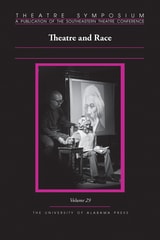
Theatre Symposium, Vol. 29
Theatre and RaceEdited by Andrew Gibb
University of Alabama Press, 2022
Essays whose composition and editing were undertaken almost entirely within the transformed cultural and professional landscape of 2020
A few weeks prior to the submission deadline for this volume of Theatre Symposium, the murder of George Floyd by officers of the Minneapolis Police Department sparked a movement for racial justice that reverberated at every level of US society. At predominantly and historically white academic institutions (including Theatre Symposium and its parent organization, the Southeastern Theatre Conference) leaders were compelled, as perhaps never before, to account for the role of systematic racism in the foundation and perpetuation of their organizations. While the present volume’s theme of “Theatre and Race” was announced in the waning days of 2019, the composition and editing of the issue’s essays were undertaken almost entirely within the transformed cultural and professional landscape of 2020. Throughout its twenty-nine years of publication, Theatre Symposium’s pages have included many excellent essays whose authors have deployed theories of race as an analytical framework, and (less often) treated BIPOC-centered art and artists as subject. The intent of the current editors in conceiving this issue was to center such subjects and theorizations, a goal that has since taken on a more widely recognized urgency.
Taken together, these twelve essays represent a wide range of scholarly responses to the theme of “theatre and race.” The fact that there is so much to say on the topic, from so many different perspectives, is a sign of how profoundly theatre practices have been—and continue to be—shaped by racial discourses and their material manifestations.