Results by title
2 books match the query 'Gila River (N.M. and Ariz.)'
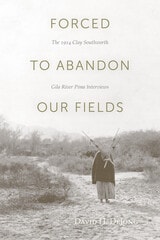
Forced to Abandon Our Fields
The 1914 Clay Southworth Gila River Pima InterviewsDavid H. DeJong
University of Utah Press, 2011
During the nineteenth century, upstream diversions from the Gila River decreased the arable land on the Gila River Indian Reservation to only a few thousand acres. As a result the Pima Indians, primarily an agricultural people, fell into poverty. Many Pima farmers and leaders lamented this suffering and in 1914 the United States Indian Irrigation Service assigned a 33-year-old engineer named Clay “Charles” Southworth to oversee the Gila River adjudication. As part of that process, Southworth interviewed 34 Pima elders, thus putting a face on the depth of hardships facing many Indians in the late nineteenth century.
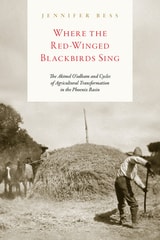
Where the Red-Winged Blackbirds Sing
The Akimel O'odham and Cycles of Agricultural Transformation in the Phoenix BasinJennifer Bess
University Press of Colorado, 2021
Author Jennifer Bess examines the Akimel O’odham’s worldview, which links their origins with a responsibility to farm the Gila River Valley and to honor their history of adaptation and obligations as “world-builders”—co-creators of an evermore life-sustaining environment and participants in flexible networks of economic exchange. Bess considers this worldview in context of the Huhugam–Akimel O’odham agricultural economy over more than a thousand years. Drawing directly on Akimel O’odham traditional ecological knowledge, innovations, and interpretive strategies in archives and interviews, Bess shows how the Akimel O’odham engaged in agricultural economy for the sake of their lifeways, collective identity, enduring future, and actualization of the values modeled in their sacred stories.
Where the Red-Winged Blackbirds Sing highlights the values of adaptation, innovation, and co-creation fundamental to Akimel O’odham lifeways and chronicles the contributions the Akimel O’odham have made to American history and to the history of agriculture. The book will be of interest to scholars of Indigenous, American Southwestern, and agricultural history.