Results by title
2 books match the query 'Global Modernity'
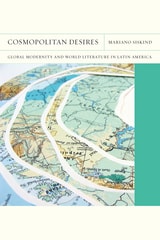
Cosmopolitan Desires
Global Modernity and World Literature in Latin AmericaMariano Siskind
Northwestern University Press, 2014
Mariano Siskind’s groundbreaking debut book redefines the scope of world literature, particularly regarding the place of Latin America in its imaginaries and mappings. In Siskind’s formulation, world literature is a modernizing discursive strategy, a way in which cultures negotiate their aspirations to participate in global networks of cultural exchange, and an original tool to reorganize literary history. Working with novels, poems, essays, travel narratives, and historical documents, Siskind reads the way Latin American literary modernity was produced as a global relation, from the rise of planetary novels in the 1870s and the cosmopolitan imaginaries of modernism at the turn of the twentieth century, to the global spread of magical realism. With its unusual breadth of reference and firm but unobtrusive grounding in philosophy, literary theory, and psychoanalysis, Cosmopolitan Desires will have a major impact in the fields of Latin American studies and comparative literature.

Thinking through Art
Aesthetic Agency and Global Modernity, Volume 25Daniel T. O’Hara and Alan Singer, eds.
Duke University Press, 0
Included in this volume are considerations of the relation between theories of art and the avant-garde; art’s relation to cognition; the aesthetic as history; the aesthetic as a unique access to modernity; and its impact on problems of identity formation, ideology, and resistances to the institutional powers inherent in dominant social formations.
Contributors. Charles Altieri, Peter Burger, David Carroll, Anthony J. Cascardi, Howard Caygill, Allen Dunn, Eric Gans, Agnes Heller, Ronald A. T. Judy, Marie-Rose Logan, Daniel T. O’Hara, Donald E. Pease, Alan Singer