Results by title
8 books match the query 'Glossary'

A Glossary of John Dryden’s Critical Terms
H. James Jensen
University of Minnesota Press, 1969
A Glossary of John Dryden's Critical Terms was first published in 1969. Minnesota Archive Editions uses digital technology to make long-unavailable books once again accessible, and are published unaltered from the original University of Minnesota Press editions.
Although John Dryden is, as Samuel Johnson described him, the father of modern criticism, his critical writings are difficult for twentieth-century readers to understand and appreciate. Part of the problem lies in the fact that many of the critical terms which Dryden used have changed or expanded in meaning since his time. By providing a series of glosses of seventeenth-century critical terms, this volume clarifies and illuminates Dryden's work for modern readers and scholars.
Professor Jensen has catalogued every important word that Dryden used in discussing critical matters, whether about art, literature, or music. In addition to covering all of Dryden's works, the glossary encompasses works of other important seventeenth century critics, among them, John Milton, Ben Johnson, and Thomas Rymer.
The structure of the glossary is simple: under each word there is a general definition and, if needed, an essay on the word's origin, history, and general usage. Then the various particular meanings of the word are given, and under each definition are listed the critics, the works, the editions, and the page numbers where the word is used with that particular meaning. Selected quotations abound, substantiating the text.
The book will be useful for students and teachers in seventeenth and eighteenth-century literature courses and for scholars doing advanced research. Students will gain an understanding of the development of critical though by reading the essays in the Glossary. Modern scholars of Restoration literature will find new ideas here as well as confirmation of some older conjectures about Dryden.
A Glossary of Words and Phrases in the Oral Performing and Dramatic Literatures of the Jin, Yuan, and Ming
Dale R. Johnson
University of Michigan Press, 2002
Autobiographical Reflections, Revised Edition with Glossary
Eric Voegelin, edited with an introduction by Ellis Sandoz
University of Missouri Press, 2011
Codex Chimalpopoca
The Text in Nahuatl with a Glossary and Grammatical NotesJohn Bierhorst
University of Arizona Press, 2011
Glossary of Hausa Music and Its Social Contexts
David W. Ames and Anthony V. King
Northwestern University Press, 1971
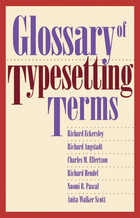
Glossary of Typesetting Terms
Richard Eckersley, Richard Angstadt, Charles M. Ellertson, and Richard Hendel
University of Chicago Press, 1994
Prepared by a team of leading professionals—a designer, an editor, compositors, and production managers—this glossary will be valuable to anyone who works in publishing or printing for its definitions of typographical terms and concise treatment of typographical style.
The glossary adds important details to discussions of typography that are covered more generally in editorial style guides such as The Chicago Manual of Style. It is indispensable to anyone who prepares text for a living, including those who implement their own typesetting decisions with the aid of word-processing and page-layout software.
This manual furnishes a common technical vocabulary for specialists and nonspecialists alike. More than 900 entries provide up-to-date meanings for traditional terms like kerning,bleed, and thumbnail and definitions of new phrases like global search and replace,H & J (hyphenation and justification), and idiot file that have been developed to describe the role of computer technology in typesetting.
Eight appendixes offer additional guidance. The house style sheets of a major typesetter provide a sample checklist of items that affect the way in which words are composed into professional-quality type. Other appendixes cover families of type, the parts of a book, diagrams of the parts of a letter, coding and marking a manuscript in the precise language of typesetters, writing specifications for tables, proofreaders’ marks, and special characters.
No other reference book makes the vocabulary and practices of contemporary typesetting so accessible.
Intermediate Technical Japanese, Volume 2
GlossaryJames L. Davis
University of Wisconsin Press, 2002
Learn how to read and translate technical manuals, research publications, and reference works. This two-volume set is designed to help the intermediate-level learner of Japanese build a technical vocabulary, reinforce understanding of frequently used grammatical patterns, improve reading comprehension, and practice translating technical passages. The glossary in volume 2 clarifies words and phrases that often puzzle beginning readers.
The sample readings on technical topics are drawn from a broad range of specialties, from mathematics and computer science to electronics and polymer science. The initial grammar lesson and the first nine field-specific lessons constitute the common core to be used by all instructors or students. Topics of interest from the remaining thirty-one field-specific lessons may be selected to produce a customized course of study. Intermediate Technical Japanese is designed to fulfill a typical two-semester sequence.
Volume 1 contains:
o information about 600 key kanji
o explanations of 100 important grammatical patterns
o more than 700 scientific or technical essays
o an index of the grammatical patterns.
Volume 2 contains:
o a complete glossary
The PhDictionary
A Glossary of Things You Don't Know (but Should) about Doctoral and Faculty LifeHerb Childress
University of Chicago Press, 2016
With more than two decades as a doctoral student, college teacher, and administrator, Herb Childress has tripped over almost every possible misunderstood term, run up against every arcane practice, and developed strategies to deal with them all. He combines current data and personal stories into memorable definitions of 150 key phrases and concepts graduate students will need to know (or pretend to know) as they navigate their academic careers. From ABD to white paper—and with buyout, FERPA, gray literature, and soft money in between—each entry contains a helpful definition and plenty of relevant advice. Wry and knowledgeable, Childress is the perfect guide for anyone hoping to scale the ivory tower.