Results by title
13 books match the query 'Good & Evil'
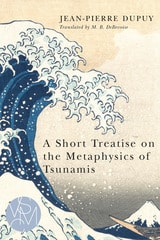
A Short Treatise on the Metaphysics of Tsunamis
Jean-Pierre Dupuy
Michigan State University Press, 2015
Jean-Pierre Dupuy asks whether, from Lisbon to Sumatra, mankind has really learned nothing about evil. When moral crimes are unbearably great, he argues, our ability to judge evil is gravely impaired, and the temptation to regard human atrocity as an attack on the natural order of the world becomes irresistible. This impulse also suggests a kind of metaphysical ruse that makes it possible to convert evil into fate, only a fate that human beings may choose to avoid. Postponing an apocalyptic future will depend on embracing this paradox and regarding the future itself in a radically new way.
The American edition of Dupuy’s classic essay, first published in 2005, also includes a postscript on the 2011 nuclear accident that occurred in Japan, again as the result of a tsunami.
Dostoevsky and the Affirmation of Life
Predrag Cicovacki
St. Augustine's Press, 2008
Economy and the Future
A Crisis of FaithJean-Pierre Dupuy
Michigan State University Press, 2014
For René Girard
Essays in Friendship and in TruthSandor Goodhart
Michigan State University Press, 2009
In his explorations of the relations between the sacred and violence, René Girard has hit upon the origin of culture—the way culture began, the way it continues to organize itself. The way communities of human beings structure themselves in a manner that is different from that of other species on the planet.
Like Albert Einstein, Sigmund Freud, Émile Durkheim, Martin Buber, or others who have changed the way we think in the humanities or in the human sciences, Girard has put forth a set of ideas that have altered our perceptions of the world in which we function. We will never be able to think the same way again about mimetic desire, about the scapegoat mechanism, and about the role of Jewish and Christian scripture in explaining sacrifice, violence, and the crises from which our culture has been born.
The contributions fall into roughly four areas of interpretive work: religion and religious study; literary study; the philosophy of social science; and psychological studies.
The essays presented here are offered as "essays" in the older French sense of attempts (essayer) or trials of ideas, as indeed Girard has tried out ideas with us. With a conscious echo of Montaigne, then, this hommage volume is titled Essays in Friendship and in Truth.
Human Goodness
Tuan, Yi-Fu
University of Wisconsin Press, 2008
Human Goodness
Yi-Fu Tuan
University of Wisconsin Press, 2008
In his many best-selling books, Yi-Fu Tuan seizes big, metaphysical issues and considers them in uniquely accessible ways. Human Goodness is evidence of this talent and is both as simple, and as epic, as it sounds.
Genuinely good people and their actions, Tuan contends, are far from boring, naive, and trite; they are complex, varied, and enormously exciting. In a refreshing antidote to skeptical times, he writes of ordinary human courtesies, as simple as busing your dishes after eating, that make society functional and livable. And he writes of extraordinary courage and inventiveness under the weight of adversity and evil. He considers the impact of communal goodness over time, and his sketches of six very different individuals—Confucius, Socrates, Wolfgang Amadeus Mozart, John Keats, Dr. Albert Schweitzer, and Simone Weil—confirm that there are human lives that can encourage and lead us to our better selves.
In the Eyes of God
A Study on the Culture of SufferingBy Fernando Escalante Gonzalbo
University of Texas Press, 2006
"Every culture needs to appropriate the universal truth of human suffering," says Fernando Escalante, ". . . to give its own meaning to this suffering, so that human existence is bearable." Originally published in Spanish as La mirada de Dios: Estudios sobre la cultura del sufrimiento, this book is a remarkable study of the evolution of the culture of suffering and the different elements that constitute it, beginning with a reading of Rousseau and ending with the appearance of the Shoah in the Western consciousness—"The memory endures, and this constitutes a fundamental transition for the Western conscience: we have witnessed."
Drawing on writings from the Greeks to Cervantes, Voltaire to Nietzsche, and Freud to William James, Escalante combines his considerable knowledge of politics and political theory with a vast array of literary examples to arrive at an intellectual understanding of the history and meaning of suffering. His investigation encompasses the rise of popular politics, the role of messianism in modern nationalism, and the contemporary implications of the Shoah.
This book will appeal to a wide audience: students of political theory, humanism, and philosophy, as well as the general reader interested in a glimpse into the mind of a highly original Latin American thinker.
Mimetic Theory and Its Shadow
Girard, Milbank, and Ontological ViolenceScott Cowdell
Michigan State University Press, 2023
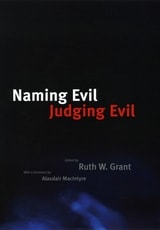
Naming Evil, Judging Evil
Edited by Ruth W. Grant
University of Chicago Press, 2006
Is it more dangerous to call something evil or not to? This fundamental question deeply divides those who fear that the term oversimplifies grave problems and those who worry that, to effectively address such issues as terrorism and genocide, we must first acknowledge them as evil. Recognizing that the way we approach this dilemma can significantly affect both the harm we suffer and the suffering we inflict, a distinguished group of contributors engages in the debate with this series of timely and original essays.
Drawing on Western conceptions of evil from the Middle Ages to the present, these pieces demonstrate that, while it may not be possible to definitively settle moral questions, we are still able—and in fact are obligated—to make moral arguments and judgments. Using a wide variety of approaches, the authors raise tough questions: Why is so much evil perpetrated in the name of good? Could evil ever be eradicated? How can liberal democratic politics help us strike a balance between the need to pass judgment and the need to remain tolerant? Their insightful answers exemplify how the sometimes rarefied worlds of political theory, philosophy, theology, and history can illuminate pressing contemporary concerns.
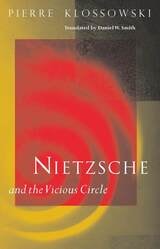
Nietzsche and the Vicious Circle
Pierre Klossowski
University of Chicago Press, 1997
Long recognized as a masterpiece of Nietzsche scholarship, Nietzsche and the Vicious Circle is made available here for the first time in English. Taking a structuralist approach to the relation between Nietzsche's thought and his life, Klossowski emphasizes the centrality of the notion of Eternal Return (a cyclical notion of time and history) for understanding Nietzsche's propensities for self-denial, self-reputation, and self-consumption.
Nietzsche's ideas did not stem from personal pathology, according to Klossowski. Rather, he made a pathological use of his best ideas, anchoring them in his own fluctuating bodily and mental conditions. Thus Nietzsche's belief that questions of truth and morality are at base questions of power and fitness resonates dynamically and intellectually with his alternating lucidity and delirium.
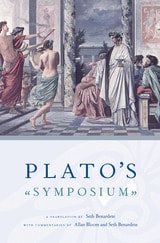
Plato's Symposium
A Translation by Seth Benardete with Commentaries by Allan Bloom and Seth BenardetePlato
University of Chicago Press, 2001
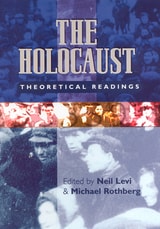
The Holocaust
Theoretical ReadingsLevi, Neil
Rutgers University Press, 2003
This agenda-setting reader brings together both classic and new writings to demonstrate how concerns arising from the Nazi genocide shaped contemporary literary and cultural theory. Wide in its thematic scope, it covers such vital questions as:
- Authenticity and experience
- Memory and trauma
- Historiography and the philosophy of history
- Fascism and Nazi anti-Semitism
- Representation and identity formation
- Race, gender, and genocide
- Implications of the Holocaust for theories of the unconscious, ethics, politics, and aesthetics
The readings, which are fully contextualized by a general introduction, section introductions, and bibliographical notes, represent the work of many influential writers and theorists, including Theodor Adorno, Giorgio Agamben, Hannah Arendt, Jean Baudrillard, Zygmunt Bauman, Walter Benjamin, Cathy Caruth, Jacques Derrida, Shoshana Felman, Saul Friedlander, Paul Gilroy, Lawrence Langer, Emmanuel Levinas, Primo Levi, Jean-François Lyotard, Hayden White, and James E. Young. This multidisciplinary anthology will be welcomed by students and scholars of the Holocaust.
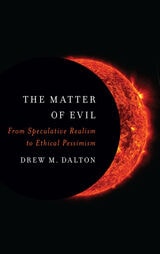
The Matter of Evil
From Speculative Realism to Ethical PessimismDrew M. Dalton
Northwestern University Press, 2024
In this radical reconsideration of ethical reasoning in contemporary European philosophy, Drew M. Dalton makes the case for an absolutely grounded account of ethical normativity developed from a scientifically informed and purely materialistic metaphysics. Expanding on speculative realist arguments, Dalton argues that the limits placed on the nature of ethical judgments by Kant’s critique can be overcome through a moral evaluation of the laws of nature—specifically, the entropic principle that undergirds the laws of physics, chemistry, and biology. In order to extract a moral meaning from this simple material fact, Dalton scrutinizes the presumptions of classical accounts and traditional understandings of good and evil within the history of Western philosophy and ultimately asserts that ethical normativity can be reestablished absolutely without reverting to dogmatism.
By overturning our assumptions about the nature and value of reality, The Matter of Evil: From Speculative Realism to Ethical Pessimism presents a provocative new model of ethical responsibility that is both logically justifiable and scientifically sound. Dalton argues for “ethical pessimism,” a position previously marginalized in the West, as a means to cultivate an account of ethical responsibility and political activism that takes seriously the unbecoming of being and the moral horror of existence.