Results by title
11 books match the query 'Gospel music'
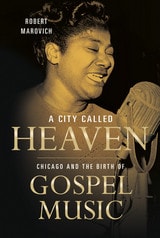
A City Called Heaven
Chicago and the Birth of Gospel MusicRobert Marovich
University of Illinois Press, 2015
A City Called Heaven celebrates a sound too mighty and too joyous for even church walls to hold.
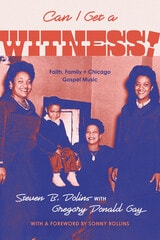
Can I Get a Witness!
Faith, Family, and Chicago Gospel MusicSteven B. Dolins with Gregory Donald Gay
University of Chicago Press, 2026
The remarkable story of pastor Donald Gay and his family’s lasting contributions to gospel music and Chicago culture.
When the preacher Gregory Donald Gay joined his sisters onstage at Carnegie Hall in 1950, on a sold-out bill they shared with Mahalia Jackson and the Clara Ward Singers, he became a participant in a landmark moment: the first concert in the venue to feature entirely gospel music. He was just five years old.
The Gay Sisters—Evelyn, Geraldine, and Mildred—were key figures in gospel’s Golden Age, and their youngest brother had a front-row seat. Evelyn and Geraldine each innovated singular approaches to gospel piano, while Mildred sang. Together, they toured and performed on a series of influential gospel recordings from 1948 to 1973, playing the Apollo Theatre and crossing paths with musical luminaries like Sister Rosetta Tharpe, Sam Cooke, Pops Staples, and Dizzy Gillespie. But despite a hit record and prodigious talent, the Gay Sisters faded from the limelight. In the ensuing years, they weathered personal trials while their mother, Fannie, devoted her attention to another family undertaking: starting a church.
Can I Get a Witness! is a call-and-response between Steven B. Dolins, founder of The Sirens Records, and Donald Gay, who vividly describes his boyhood in Chicago’s Woodlawn neighborhood, his family’s remarkable place in gospel history, his mother’s work as a faith leader, and his own calling as a pastor. The book spotlights the rich contributions of a family remembered not only for the songs they recorded but also for their unwavering kindness to others, a legacy that the legendary Sonny Rollins recounts in a moving foreword.
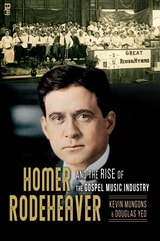
Homer Rodeheaver and the Rise of the Gospel Music Industry
Kevin Mungons and Douglas Yeo
University of Illinois Press, 2021
Homer Rodeheaver merged evangelical hymns and African American spirituals with popular music to create a potent gospel style. Kevin Mungons and Douglas Yeo examine his enormous influence on gospel music against the backdrop of Christian music history and Rodeheaver's impact as a cultural and business figure. Rodeheaver rose to fame as the trombone-playing song leader for evangelist Billy Sunday. As revivalism declined after World War I, Rodeheaver leveraged his place in America's newborn celebrity culture to start the first gospel record label and launch a nationwide radio program. His groundbreaking combination of hymnal publishing and recording technology helped define the early Christian music industry. In his later years, he influenced figures like Billy Graham and witnessed the music's split into southern gospel and black gospel.
Clear-eyed and revealing, Homer Rodeheaver and the Rise of the Gospel Music Industry is an overdue consideration of a pioneering figure in American music.
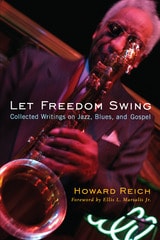
Let Freedom Swing
Collected Writings on Jazz, Blues, and GospelHoward Reich
Northwestern University Press, 2010
Each section of Let Freedom Swing composes a suite, focusing on either a person, place, or scene. Reich gives new life to the standards with his profiles and elegies for such giants as Gershwin, Ellington, and Sinatra. A profile of Louis Armstrong brings out the often angry side of Satchmo but also reveals a more remarkable musician and human being.
His open-mindedness makes Reich a particularly astute observer of the experimental and new, from Ornette Coleman to Chicago experimentalist Ken Vandermark. And his observations about street music open our ears to the songs of everyday life. Reich’s fearlessness is evident in his writing about daunting subjects, such as the New Orleans music scene after Katrina, the lost legacy of jazz in Panama, and the complicated legacy of "race music" in America.
Howard Reich combines a deep enthusiasm for music, a breadth of knowledge, and an ability to share his world with his readers, and Let Freedom Swing is essential reading for anyone interested in the continuing vitality of jazz, gospel, blues, and American music in general.
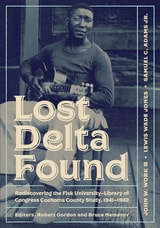
Lost Delta Found
Rediscovering the Fisk University-Library of Congress Coahoma County Study, 1941-1942John W. Work
Vanderbilt University Press, 2005
This remarkable book recovers three invaluable perspectives, long thought to have been lost, on the culture and music of the Mississippi Delta.
In 1941 and ’42 African American schol-ars from Fisk University—among them the noted composer and musicologist John W. Work III, sociologist Lewis Wade Jones, and graduate student Samuel C. Adams Jr.—joined folklorist Alan Lomax of the Library of Congress on research trips to Coahoma County, Mississippi. Their mission was “to document adequately the cultural and social backgrounds for music in the community.” Among the fruits of the project were the earliest recordings by the legendary blues singer and guitarist Muddy Waters.
The hallmark of the study was to have been a joint publication of its findings by Fisk and the Library of Congress. While this publication was never completed, Lost Delta Found is composed of the writings, interviews, notes, and musical transcriptions produced by Work, Jones, and Adams in the Coahoma County study. Their work captures, with compelling immediacy, a place, a people, a way of life, and a set of rich musical traditions as they existed in the 1940s.
Illustrated with photos and more than 160 musical transcriptions.
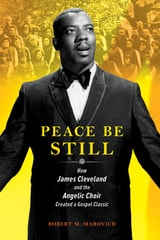
Peace Be Still
How James Cleveland and the Angelic Choir Created a Gospel ClassicRobert M. Marovich
University of Illinois Press, 2021
In September of 1963, Reverend Lawrence Roberts and the Angelic Choir of the First Baptist Church of Nutley, New Jersey, teamed with rising gospel star James Cleveland to record Peace Be Still. The LP and its haunting title track became a phenomenon. Robert M. Marovich draws on extensive oral interviews and archival research to chart the history of Peace Be Still and the people who created it. Emerging from an established gospel music milieu, Peace Be Still spent several years as the bestselling gospel album of all time. As such, it forged a template for live recordings of services that transformed the gospel music business and Black worship. Marovich also delves into the music's connection to fans and churchgoers, its enormous popularity then and now, and the influence of the Civil Rights Movement on the music's message and reception.
The first in-depth history of a foundational recording, Peace Be Still shines a spotlight on the people and times that created a gospel music touchstone.
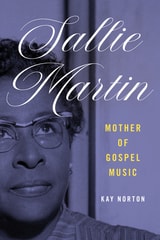
Sallie Martin, Mother of Gospel Music
Kay Norton
University of Illinois Press, 2026
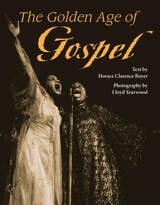
The Golden Age of Gospel
Text by Horace Clarence BoyerPhotography by Lloyd Yearwood
University of Illinois Press, 1995
Skillfully blending music history and social context, Boyer traces the development of gospel from its earliest beginnings through the Golden Age (1945-55) and into the 1960s when gospel entered the concert hall. He introduces dozens of the genre's most gifted contributors, from Thomas A. Dorsey and Mahalia Jackson to the Soul Stirrers and Aretha Franklin, evoking their distinctive styles and distinguishing among the characteristic sounds of gospel music in Chicago, Philadelphia, Detroit, St. Louis, and other locations.
Capturing the essence of a thrilling performance tradition, The Golden Age of Gospel clearly establishes gospel's importance as an authentic American art form and a musical statement of profound belief.
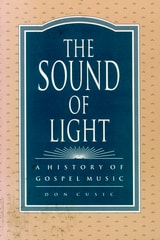
The Sound of Light
A History of Gospel MusicDon Cusic
University of Wisconsin Press, 1990
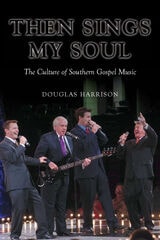
Then Sings My Soul
The Culture of Southern Gospel MusicDouglas Harrison
University of Illinois Press, 2012
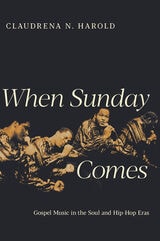
When Sunday Comes
Gospel Music in the Soul and Hip-Hop ErasClaudrena N. Harold
University of Illinois Press, 2020
Weaving insightful analysis into a collective biography of gospel icons, When Sunday Comes explores the music's essential place as an outlet for African Americans to express their spiritual and cultural selves.