Results by title
46 books match the query 'Gothic & Romance'
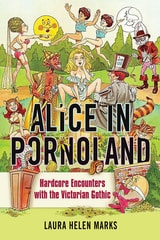
Alice in Pornoland
Hardcore Encounters with the Victorian GothicLaura Helen Marks
University of Illinois Press, 2018
Laura Helen Marks investigates the contradictions and seesawing gender dynamics in Victorian-inspired adult films and looks at why pornographers persist in drawing substance and meaning from the era's Gothic tales. She focuses on the particular Victorianness that pornography prefers, and the mythologies of the Victorian era that fuel today's pornographic fantasies. In turn, she exposes what porning the Victorians shows us about pornography as a genre.
A bold foray into theory and other forbidden places, Alice in Pornoland reveals how modern-day Victorian Gothic pornography constantly emphasizes, navigates, transgresses, and renegotiates issues of gender, sexuality, and race.
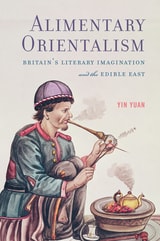
Alimentary Orientalism
Britain’s Literary Imagination and the Edible EastYin Yuan
Bucknell University Press, 2023
American Gothic
New Interventions in a National NarrativeRobert K. Martin
University of Iowa Press, 1998
In America as in Britain, the rise of the Gothic represented the other—the fearful shadows cast upon Enlightenment philosophies of common sense, democratic positivism, and optimistic futurity. Many critics have recognized the centrality of these shadows to American culture and self-identification. American Gothic, however, remaps the field by offering a series of revisionist essays associated with a common theme: the range and variety of Gothic manifestations in high and popular art from the roots of American culture to the present.
The thirteen essayists approach the persistence of the Gothic in American culture by providing a composite of interventions that focus on specific issues—the histories of gender and race, the cultures of cities and scandals and sensations—in order to advance distinct theoretical paradigms. Each essay sustains a connection between a particular theoretical field and a central problem in the Gothic tradition.
Drawing widely on contemporary theory—particularly revisionist views of Freud such as those offered by Lacan and Kristeva—this volume ranges from the well-known Gothic horrors of Edgar Allan Poe and Nathaniel Hawthorne to the popular fantasies of Stephen King and the postmodern visions of Kathy Acker. Special attention is paid to the issues of slavery and race in both black and white texts, including those by Ralph Ellison and William Faulkner. In the view of the editors and contributors, the Gothic is not so much a historical category as a mode of thought haunted by history, a part of suburban life and the lifeblood of films such as The Exorcist and Fatal Attraction.
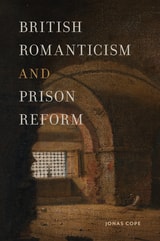
British Romanticism and Prison Reform
Jonas Cope
Bucknell University Press, 2025
In eighteenth-century Britain, criminals were routinely whipped, branded, hanged, or transported to America. Only in the last quarter of the century—with the War of American Independence and legal and sociopolitical challenges to capital punishment—did the criminal justice system change, resulting in the reformed prison, or penitentiary, meant to educate, rehabilitate, and spiritualize even hardened felons. This volume is the first to explore the relationship between historical penal reform and Romantic-era literary texts by luminaries such as Godwin, Keats, Byron, and Austen. The works examined here treat incarceration as ambiguous: prison walls oppress and reinforce the arbitrary power of legal structures but can also heighten meditation, intensify the imagination, and awaken the conscience. Jonas Cope skillfully traces the important ideological work these texts attempt: to reconcile a culture devoted to freedom with the birth of the modern prison system that presents punishment as a form of rehabilitation.
Published by Bucknell University Press. Distributed worldwide by Rutgers University Press.
CONTESTED CASTLE
GOTHIC NOVELS AND THE SUBVERSION OF DOMEKate Ferguson Ellis
University of Illinois Press, 1989
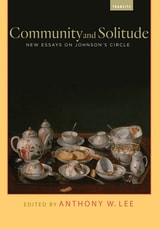
Community and Solitude
New Essays on Johnson’s CircleLee, Anthony W
Bucknell University Press, 2019
Contributors: Christopher Catanese, James Caudle, Marilyn Francus, Christine Jackson-Holzberg, Claudia Thomas Kairoff, Elizabeth Lambert, Anthony W. Lee, James E. May, John Radner, and Lance Wilcox.
Published by Bucknell University Press. Distributed worldwide by Rutgers University Press.
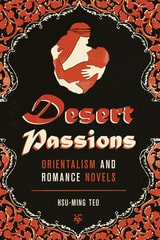
Desert Passions
Orientalism and Romance NovelsBy Hsu-Ming Teo
University of Texas Press, 2012
The Sheik—E. M. Hull’s best-selling novel that became a wildly popular film starring Rudolph Valentino—kindled “sheik fever” across the Western world in the 1920s. A craze for all things romantically “Oriental” swept through fashion, film, and literature, spawning imitations and parodies without number. While that fervor has largely subsided, tales of passion between Western women and Arab men continue to enthrall readers of today’s mass-market romance novels. In this groundbreaking cultural history, Hsu-Ming Teo traces the literary lineage of these desert romances and historical bodice rippers from the twelfth to the twenty-first century and explores the gendered cultural and political purposes that they have served at various historical moments.
Drawing on “high” literature, erotica, and popular romance fiction and films, Teo examines the changing meanings of Orientalist tropes such as crusades and conversion, abduction by Barbary pirates, sexual slavery, the fear of renegades, the Oriental despot and his harem, the figure of the powerful Western concubine, and fantasies of escape from the harem. She analyzes the impact of imperialism, decolonization, sexual liberation, feminism, and American involvement in the Middle East on women’s Orientalist fiction. Teo suggests that the rise of female-authored romance novels dramatically transformed the nature of Orientalism because it feminized the discourse; made white women central as producers, consumers, and imagined actors; and revised, reversed, or collapsed the binaries inherent in traditional analyses of Orientalism.
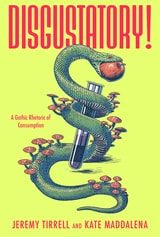
Disgustatory!
A Gothic Rhetoric of ConsumptionJeremy Tirrell and Kate Maddalena
University of Alabama Press, 2026
A critical exploration of how Gothic tropes infiltrate wellness discourse, revealing the rhetorical forces behind our cultural obsession with food, health, and bodily control.
Disgustatory! A Gothic Rhetoric of Consumption unearths the darkness behind modern obsessions with food, health, and bodily optimization. In this provocative and richly interdisciplinary work, Jeremy Tirrell and Kate Maddalena argue that contemporary discourses around food, medicine, and the body are steeped in Gothic rhetoric—where the promise of purity and control is shadowed by monstrosity, abjection, and the uncanny.
From Soylent and nootropics to probiotics and lab-grown meat, Tirrell and Maddalena show how wellness discourse is haunted by Gothic tropes: body horror, hybridity, and existential dread. Wellness culture, they argue, is not merely pseudoscience or fraud but a complex, persuasive rhetoric that blurs science and myth, purity and decay, medicine and mysticism.
Disgustatory! offers a fresh framework: a “Gothic rhetoric of consumption” that explains why we are drawn to weird diets, digital detoxes, and miracle cures. Through case studies of strange substances and stranger practices—Reddit fasting rituals, magic dirt supplements, fecal transplants— Tirrell and Maddalena reveal how fear, fascination, and the fantasy of bodily control animate our health choices. Each chapter explores a rhetorical element—quantification, hybridity, abjection, optimization, and regulation—to show how food becomes a site of cultural anxiety and existential longing. This book will appeal to rhetoricians, scholars of science and technology studies, cultural theorists, and anyone interested in the strange intersections of health, horror, and persuasion.
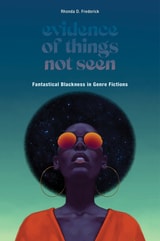
Evidence of Things Not Seen
Fantastical Blackness in Genre FictionsRhonda D. Frederick
Rutgers University Press, 2022
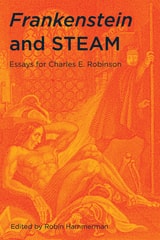
Frankenstein and STEAM
Essays for Charles E. RobinsonRobin Hammerman
University of Delaware Press, 2022
Charles E. Robinson, Professor Emeritus of English at The University of Delaware, definitively transformed study of the novel Frankenstein with his foundational volume The Frankenstein Notebooks and, in nineteenth century studies more broadly, brought heightened attention to the nuances of writing and editing. Frankenstein and STEAM consolidates the generative legacy of his later work on the novel's broad relation to topics in science, technology, engineering, arts, and mathematics (STEAM). Seven chapters written by leading and emerging scholars pay homage to Robinson's later perspectives of the novel and a concluding postscript contains remembrances by his colleagues and students. This volume not only makes explicit the question of what it means to be human, a question Robinson invited students and colleagues to examine throughout his career, but it also illustrates the depth of the field and diversity of those who have been inspired by Robinson's work. Frankenstein and STEAM offers direction for continuing scholarship on the intersections of literature, science, and technology.
Published by the University of Delaware Press. Distributed worldwide by Rutgers University Press.
Gender and the Gothic in the Fiction of Edith Wharton
Kathy A. Fedorko
University of Alabama Press, 1995
Revealing the Gothic foundations of Edith Wharton's vision of gender and identity.
Gender and the Gothic in the Fiction of Edith Wharton is an innovative study that provides fresh insights into Wharton’s male characters while at the same time showing how Wharton’s imagining of a fe/male self evolves throughout her career. Using feminist archetypal theory and theory of the female Gothic, Kathy A. Fedorko shows how Wharton, in sixteen short stories and six major novels written during four distinct periods of her life, adopts and adapts Gothic elements to explore the nature of feminine and masculine ways of knowing and being and to dramatize the tension between them.
Edith Wharton’s contradictory views of women and men—her attitudes toward the feminine and the masculine—reflect a complicated interweaving of family and social environment, historical time, and individual psychology. Studies of Wharton have exhibited this same kind of contradiction, with some seeing her as disparaging men and the masculine and others depicting her as disparaging women and the feminine. The use of Gothic elements in her fiction provided Wharton, who was often considered the consummate realist, with a way to dramatize the conflict between feminine and masculine selves as she experienced them and to evolve an alternative to the dualism.
Fedorko’s work is unique in its careful consideration of Wharton’s sixteen Gothic works, which are seldom discussed. Further, the revelation of how these Gothic stories are reflected in her major realistic novels. In the novels with Gothic texts, Wharton draws multiple parallels between male and female protagonists, indicating the commonalities between women and men and the potential for a female self. Eventually, in her last completed novel and her last short story, Wharton imagines human beings who are comfortable with both gender selves.
Gothic Geoculture
Nineteenth-Century Representations of Cuba in the Transamerican ImaginaryIvonne M. García
The Ohio State University Press, 2019
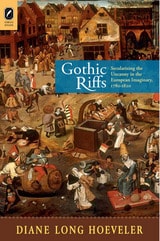
Gothic Riffs
Secularizing the Uncanny in the European Imaginary, 1780–1820Diane Long Hoeveler
The Ohio State University Press, 2010
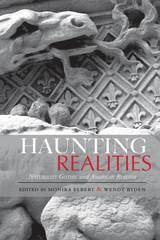
Haunting Realities
Naturalist Gothic and American RealismEdited by Monika Elbert and Wendy Ryden
University of Alabama Press, 2017
An innovative collection of essays examining the sometimes paradoxical alignment of Realism and Naturalism with the Gothic in American literature to highlight their shared qualities
Following the golden age of British Gothic in the late eighteenth century, the American Gothic’s pinnacle is often recognized as having taken place during the decades of American Romanticism. However, Haunting Realities explores the period of American Realism—the end of the nineteenth century—to discover evidence of fertile ground for another age of Gothic proliferation.
At first glance, “Naturalist Gothic” seems to be a contradiction in terms. While the Gothic is known for its sensational effects, with its emphasis on horror and the supernatural, the doctrines of late nineteenth-century Naturalism attempted to move away from the aesthetics of sentimentality and stressed sobering, mechanistic views of reality steeped in scientific thought and the determinism of market values and biology. Nonetheless, what binds Gothicism and Naturalism together is a vision of shared pessimism and the perception of a fearful, lingering presence that ominously haunts an impending modernity. Indeed, it seems that in many Naturalist works reality is so horrific that it can only be depicted through Gothic tropes that prefigure the alienation and despair of modernism.
In recent years, research on the Gothic has flourished, yet there has been no extensive study of the links between the Gothic and Naturalism, particularly those which stem from the early American Realist tradition. Haunting Realities is a timely volume that addresses this gap and is an important addition to scholarly work on both the Gothic and Naturalism in the American literary tradition.
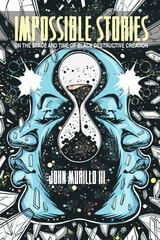
Impossible Stories
On the Space and Time of Black Destructive CreationJohn Murillo III
The Ohio State University Press, 2021
Taking as his lens the fragment—fragmented bodies, fragments of memories, fragments of texts—Murillo theorizes new directions for Black identity and cultural production. Combining a critical engagement of physics and metaphysics with innovative readings of Gayl Jones’s Corregidora, Octavia Butler’s Kindred, Toni Morrison’s Beloved, Kiese Laymon’s Long Division, Dionne Brand’s A Map to the Door of No Return, and Paul Beatty’s The Sellout, he offers new ways to think about anti-Black racism and practice Black creativity. Ultimately, in his equally creative and analytical responses to depictions of Black people left out of history and barred from spaces, Murillo argues that through Afro-pessimism, Black people can fight the anti-Black cosmos.
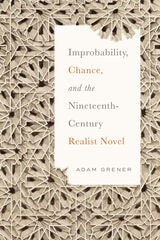
Improbability, Chance, and the Nineteenth-Century Realist Novel
Adam Grener
The Ohio State University Press, 2020
Contemporary thinking about probability came to recognize the variability and even randomness of the world while also discovering how patterns and order reemerge at scale. Reading chance as a tension between randomness and order, Grener shows how novels by Jane Austen, Sir Walter Scott, Charles Dickens, Anthony Trollope, and Thomas Hardy resist the demands of probabilistic representation and develop strategies for capturing cultural particularity and historical transformation. These authors served their visions of realism by tactically embracing improbability in the form of coincidences, fatalism, supernaturalism, and luck. Understanding this strategy helps us to appreciate how realist novels work to historicize the social worlds and experiences they represent and asks us to rethink the very foundation of realism.
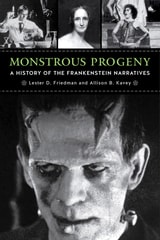
Monstrous Progeny
A History of the Frankenstein NarrativesFriedman, Lester D
Rutgers University Press, 2016
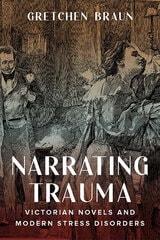
Narrating Trauma
Victorian Novels and Modern Stress DisordersGretchen Braun
The Ohio State University Press, 2022
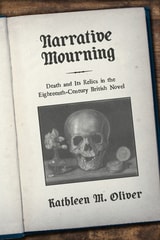
Narrative Mourning
Death and Its Relics in the Eighteenth-Century British NovelKathleen M. Oliver
Bucknell University Press, 2020
Published by Bucknell University Press. Distributed worldwide by Rutgers University Press.
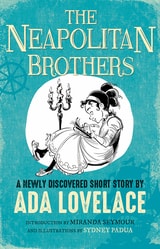
Neapolitan Brothers, The
A Newly Discovered Short StoryAda Lovelace
Bodleian Library Publishing, 2020
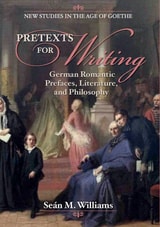
Pretexts for Writing
German Romantic Prefaces, Literature, and PhilosophyWilliams, Seán M
Bucknell University Press, 2019
Published by Bucknell University Press. Distributed worldwide by Rutgers University Press.
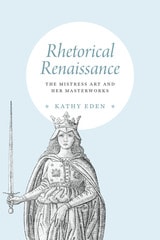
Rhetorical Renaissance
The Mistress Art and Her MasterworksKathy Eden
University of Chicago Press, 2022
Kathy Eden explores the intersection of early modern literary theory and practice. She considers the rebirth of the rhetorical art—resulting from the rediscovery of complete manuscripts of high-profile ancient texts about rhetoric by Plato, Aristotle, Cicero, Quintilian, and Tacitus, all unavailable before the early fifteenth century—and the impact of this art on early modern European literary production. This profound influence of key principles and practices on the most widely taught early modern literary texts remains largely and surprisingly unexplored.
Devoting four chapters to these practices—on status, refutation, similitude, and style—Eden connects the architecture of the most widely read classical rhetorical manuals to the structures of such major Renaissance works as Petrarch’s Secret, Castiglione’s Book of the Courtier, Erasmus’s Antibarbarians and Ciceronianus, and Montaigne’s Essays. Eden concludes by showing how these rhetorical practices were understood to work together to form a literary masterwork, with important implications for how we read these texts today.
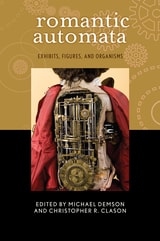
Romantic Automata
Exhibitions, Figures, OrganismsMichael Demson
Bucknell University Press, 2020
Recent scholarship in post-humanism, post-colonialism, disability studies, post-modern feminism, eco-criticism, and radical Orientalism has significantly affected the critical discourse on this topic. In engaging with the work and thought of Coleridge, Poe, Hoffmann, Mary Shelley, and other Romantic luminaries, the contributors to this collection open new methodological approaches to understanding human interaction with technology that strives to simulate, supplement, or supplant organic life.
Published by Bucknell University Press. Distributed worldwide by Rutgers University Press.
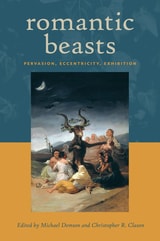
Romantic Beasts
Pervasion, Eccentricity, ExhibitionMichael Demson
Bucknell University Press, 2025
Published by Bucknell University Press. Distributed worldwide by Rutgers University Press.
Shelley and Synesthesia
Glenn O'Malley
Northwestern University Press, 1964

Southern Neogothic
Literary and Cinematic Reckonings from the 1970s to the PresentLee Rozelle
University of Alabama Press, 2026
In Southern Neogothic, Lee Rozelle moves beyond familiar debates that have long dominated studies of the American South, proposing a new framework for understanding how contemporary writers, filmmakers, and artists have transformed the genre’s signature tropes to engage pressing cultural, political, and environmental concerns. Rather than revisiting narratives centered on white grievance, Confederate memory, or Lost Cause mythology, Rozelle examines works that expand Southern Gothic’s reach, connecting regional traditions to global audiences and contemporary struggles over identity, power, and belonging. By demonstrating how contemporary artists have reinvented one of America’s most enduring literary modes, Rozelle offers a fresh and timely account of the genre’s continuing cultural relevance.
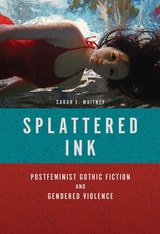
Splattered Ink
Postfeminist Gothic Fiction and Gendered ViolenceSarah E Whitney
University of Illinois Press, 2016
Sarah E. Whitney explores the genre's challenge to postfeminist assumptions of women's equality and empowerment. The authors she examines--Patricia Cornwell, Jodi Picoult, Susanna Moore, Sapphire, and Alice Sebold--construct narratives around socially invisible and physically broken protagonists who directly experience consequences of women's ongoing disempowerment. Their works ask readers to inhabit women's suffering and to face the uncomfortable, all-too-denied fact that today's women must navigate lives fraught with risk. Whitney's analysis places the authors within a female gothic tradition that has long given voice to women's fears of their own powerlessness. But she also reveals the paradox that allows the genre to powerfully critique postfeminism's often sunshiney outlook while uneasily coexisting within the same universe.
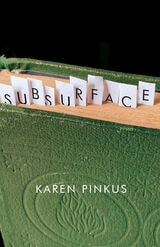
Subsurface
Karen Pinkus
University of Minnesota Press, 2023
A bold new consideration of climate change between narratives of the Earth’s layers and policy of the present
Long seen as a realm of mystery and possibility, the subsurface beneath our feet has taken on all-too-real import in the era of climate change. Can reading narratives of the past that take imaginative leaps under the surface better attune us to our present knowledge of a warming planet?
In Subsurface, Karen Pinkus looks below the surface of texts by Edgar Allan Poe, Arthur Conan Doyle, George Sand, E. T. A. Hoffmann, and Jules Verne to find the buried origins of capitalist fantasies in which humans take what they want from the earth. Putting such texts into conversation with narrative theory, critical theory, geology, and climate policy, she shows that the subsurface has been, in our past, a place of myth and stories of male voyages down to gain knowledge—but it is also now the realm of fossil fuels. How do these two modes intertwine?
A highly original take on evocative terms such as extraction, burial, fossils, deep time, and speculative futurity, Subsurface questions the certainty of comfortable narrative arcs. It asks us to read literature with and against the figure of the geological column, with and against fossil fuels and the emissions warming our planet. As we see our former selves move into the distance, what new modes of imagination might we summon?
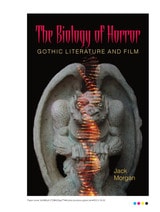
The Biology of Horror
Gothic Literature and FilmJack Morgan
Southern Illinois University Press, 2002
Unearthing the fearful flesh and sinful skins at the heart of gothic horror, Jack Morgan rends the genre’s biological core from its oft-discussed psychological elements and argues for a more transhistorical conception of the gothic, one negatively related to comedy. The Biology of Horror: Gothic Literature and Film dissects popular examples from the gothic literary and cinematic canon, exposing the inverted comic paradigm within each text.
Morgan’s study begins with an extensive treatment of comedy as theoretically conceived by Suzanne Langer, C. L. Barber, and Mikhail Bakhtin. Then, Morgan analyzes the physical and mythological nature of horror in inverted comic terms, identifying a biologically grounded mythos of horror. Motifs such as sinister loci, languishment, masquerade, and subversion of sensual perception are contextualized here as embedded in an organic reality, resonating with biological motives and consequences. Morgan also devotes a chapter to the migration of the gothic tradition into American horror, emphasizing the body as horror’s essential place in American gothic.
The bulk of Morgan’s study is applied to popular gothic literature and films ranging from high gothic classics like Matthew Lewis’s The Monk, Ann Radcliffe’s The Mysteries of Udolpho, Charles Maturin’s Melmoth the Wanderer, and Mary Shelley’s Frankenstein, to later literary works such as Poe’s macabre tales, Melville’s “Benito Cereno,” J.S. Le Fanu’s Uncle Silas, H.P. Lovecraft’s “The Shadow over Innsmouth,” Shirley Jackson’s The Haunting of Hillhouse, Stephen King’s Salem’s Lot, and Clive Barker’s The Damnation Game. Considered films include Nosferatu, Invasion of the Body Snatchers, Friday the 13th, Halloween, Night of the Living Dead, Angel Heart, The Stand, and The Shining.
Morganconcludes his physical examination of the Gothic reality with a consideration born of Julia Kristeva’s theoretical rubric which addresses horror’s existential and cultural significance, its lasting fascination, and its uncanny positive—and often therapeutic—direction in literature and film.

The Centenary Edition of the Works of Nathaniel Hawthorne
VOL. IV, THE MARBLE FAUNNathaniel Hawthorne
The Ohio State University Press, 1969
Hawthorne's 'International Novel' dramatizes the confrontation of the Old World and the New and the uncertain relationship between the 'authentic' and the 'fake' in life as in art. The author's evocative descriptions of classic sites made The Marble Faun a favorite guidebook to Rome for Victorian tourists, but this richly ambiguous symbolic romance is also the story of a murder, and a parable of the Fall of Man. As the characters find their civilized existence disrupted by the awful consequences of impulse, Hawthorne leads his readers to question the value of Art and Culture and addresses the great evolutionary debate which was beginning to shake Victorian society.
The Dangerous Lover
Gothic Villains, Byronism, and the Nineteenth-Century Seduction NarrativeDeborah Lutz
The Ohio State University Press, 2006
The dangerous lover has haunted our culture for over two hundred years; English, American, and European literature is permeated with his erotic presence. The Dangerous Lover takes seriously the ubiquity of the brooding romantic hero—his dark past, his remorseful and rebellious exile from comfortable everyday living. Deborah Lutz traces the recent history of this figure, through the melancholy iconoclasm of the Romantics, the lost soul redeemed by love of the Brontës, and the tormented individualism of twentieth-century love narratives. Arguing for this character’s central influence not only in literature but also in the history of ideas, this book places the dangerous lover firmly within the philosophy of Martin Heidegger, the Modernism of Georg Lukács, and Roland Barthes’s theories on love and longing. Working with canonical authors such as Ann Radcliffe, Charles Maturin, Lord Byron, Charles Dickens, George Eliot, and Oscar Wilde, and also with non-canonical texts such as contemporary romance, The Dangerous Lover combines a lyrical, essayistic style with a depth of inquiry that raises questions about the mysteries of desire, death, and eroticism.
The Dangerous Lover is the first book-length study of this pervasive literary hero; it also challenges the tendency of sophisticated philosophical readings of popular narratives and culture to focus on male-coded genres. In its conjunction of high and low literary forms, this volume explores new historical and cultural framings for female-coded popular narratives.
The Essential Guide to Werewolf Literature
Brian J. Frost
University of Wisconsin Press, 2003
Frost’s analysis encompasses fanciful medieval beliefs, popular works by Victorian authors, scholarly treatises and medical papers, and short stories from pulp magazines of the 1930s and 1940s. Revealing the complex nature of the werewolf phenomenon and its tremendous and continuing influence, The Essential Guide to Werewolf Literature is destined to become a standard reference on the subject.
The Global Wordsworth
Romanticism Out of PlaceBergren, Katherine
Bucknell University Press, 2019
Published by Bucknell University Press. Distributed worldwide by Rutgers University Press.
The Gothic World of Anne Rice
Edited by Gary Hoppenstand and Ray B. Browne
University of Wisconsin Press, 1996
This anthology argues for the serious study of the literary oeuvre of Anne Rice, a major figure in today’s popular literature. The essays assert that Rice expands the conventions of the horror genre’s formula to examine important social issues. Like a handful of authors working in this genre, Rice manipulates its otherwise predictable narrative structures so that a larger, more interesting cultural mythology can be developed. Rice searches for philosophical truth, examining themes of good and evil, the influence on people and society of both nature and nurture, and the conflict and dependence of humanism and science.
The Gothic World of Stephen King
Landscape of NightmaresEdited by Gary Hoppenstand and Ray B. Browne
University of Wisconsin Press, 1987
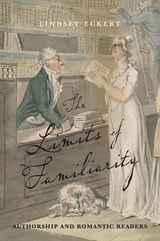
The Limits of Familiarity
Authorship and Romantic ReadersLindsey Eckert
Bucknell University Press, 2022
What did Wordsworth wear, and where did he walk? Who was Byron’s new mistress, and how did his marriage fare? Answers—sometimes accurate, sometimes not—were tantalizingly at the ready in the Romantic era, when confessional poetry, romans à clef, personal essays, and gossip columns offered readers exceptional access to well-known authors. But at what point did familiarity become overfamiliarity? Widely recognized as a social virtue, familiarity—a feeling of emotional closeness or comforting predictability—could also be dangerous, vulgar, or boring. In The Limits of Familiarity, Eckert persuasively argues that such concerns shaped literary production in the Romantic period. Bringing together reception studies, celebrity studies, and literary history to reveal how anxieties about familiarity shaped both Romanticism and conceptions of authorship, this book encourages us to reflect in our own fraught historical moment on the distinction between telling all and telling all too much.
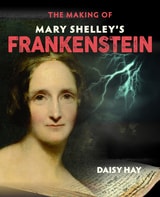
The Making of Mary Shelley's Frankenstein
Daisy Hay
Bodleian Library Publishing, 2018
In the two hundred years since its first publication, the story of Frankenstein’s creation during stormy days and nights at Byron’s Villa Diodati on Lake Geneva has become literary legend. In this compelling and innovative book, Daisy Hay stitches together the objects and manuscripts of the novel’s turbulent genesis in order to bring its story back to life.
Frankenstein was inspired by the extraordinary people surrounding the eighteen-year-old author and by the places and historical dramas that formed the backdrop of her youth. Featuring manuscripts, portraits, illustrations, and artifacts, The Making of Mary Shelley’s “Frankenstein” explores the novel’s time and place, the people who inspired its characters, the relics of its long afterlife, and the notebooks in which it was created. Hay strips Frankenstein back to its constituent parts to reveal an uneven novel written by a young woman deeply engaged in the process of working out what she thought about the pressing issues of her time: from science, politics, religion, and slavery to maternity, the imagination, creativity, and community. Richly illustrated throughout, this is an astute and intricate biography of the novel for all those fascinated by its essential, brilliant chaos.

The Monster with a Thousand Faces
Guises of the Vampire in Myth and LiteratureBrian J. Frost
University of Wisconsin Press, 1989
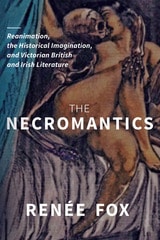
The Necromantics
Reanimation, the Historical Imagination, and Victorian British and Irish LiteratureRenée Fox
The Ohio State University Press, 2023
Winner, 2025 Sonya Rudikoff Award for the best first book in Victorian Studies
Honorable Mention, 2023 North American Victorian Studies Association First Book Prize
Honorable Mention, American Council for Irish Studies Donald Murphy Prize for Distinguished First Book
The Necromantics dwells on the literal afterlives of history. Reading the reanimated corpses—monstrous, metaphorical, and occasionally electrified—that Mary Shelley, Robert Browning, Charles Dickens, W. B. Yeats, Bram Stoker, and others bring to life, Renée Fox argues that these undead figures embody the present’s desire to remake the past in its own image. Fox positions “necromantic literature” at a nineteenth-century intersection between sentimental historiography, medical electricity, imperial gothic monsters, and the Irish Literary Revival, contending that these unghostly bodies resist critical assumptions about the always-haunting power of history.
By considering Irish Revival texts within the broader scope of nineteenth-century necromantic works, The Necromantics challenges Victorian studies’ tendency to merge Irish and English national traditions into a single British whole, as well as Irish studies’ postcolonial efforts to cordon off a distinct Irish canon. Fox thus forges new connections between conflicting political, formal, and historical traditions. In doing so, she proposes necromantic literature as a model for a contemporary reparative reading practice that can reanimate nineteenth-century texts with new aesthetic affinities, demonstrating that any effective act of reading will always be an effort of reanimation.
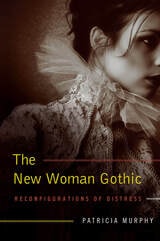
The New Woman Gothic
Reconfigurations of DistressPatricia Murphy
University of Missouri Press, 2026
The controversial and compelling figure of the New Woman in late Victorian fiction has garnered extensive scholarly attention, but rarely has she been investigated through the fascinating lens of the Gothic. Yet the presence of sinister Gothic elements is so widespread in the generally realisitic British novels that the term "New Woman Gothic" readily comes to mind. Drawing from and reworking Gothic conventions of Romantic and later literature, the New Woman version is marshaled during this tumultuous cultural moment of gender anxieties either to defend or revile the complex individual who sought improvements in educational, marital, and professional realms.
The White Trash Menace and Hemispheric Fiction
Ramón E. Soto-Crespo
The Ohio State University Press, 2020
Tragic Encounters
Pushkin and European RomanticismMaksim Hanukai
University of Wisconsin Press, 2023
Many of Pushkin’s works move seamlessly between the closed world of traditional tragedy and the open world of Romantic tragic drama, and yet they follow neither the cathartic program prescribed by Aristotle nor the redemptive mythologies of the Romantics. Instead, the idiosyncratic and artistically mercurial Pushkin seized upon the newly unstable tragic mode to develop multiple, overlapping tragic visions. Providing new, innovative readings of such masterpieces as The Gypsies, Boris Godunov, The Little Tragedies, and The Bronze Horseman, Hanukai sheds light on an unexplored aspect of Pushkin’s work, while also challenging reigning theories about the fate of tragedy in the Romantic period.
Transmedia Adaptation in the Nineteenth Century
Lissette Lopez Szwydky
The Ohio State University Press, 2020
In Transmedia Adaptation in the Nineteenth Century, Lissette Lopez Szwydky convincingly historicizes the practice of adaptation, drawing on multiple disciplines to illustrate narrative mobility across time, culture, and geography. Case studies from stage plays, literature, painting, illustration, chapbooks, and toy theaters position adaptation as a central force in literary history that ensures continued cultural relevance, accessibility, and survival. The history of these forms helps to inform and put into context our contemporary obsessions with popular media. Finally, in upending a traditional understanding of canon by arguing that adaptation creates canon and not the other way around, Szwydky provides crucial bridges between nineteenth-century literary scholarship, adaptation studies, and media studies, thus identifying new stakes for all.
Transmedia Creatures
Frankenstein’s AfterlivesSaggini, Francesca
Bucknell University Press, 2018
Published by Bucknell University Press. Distributed worldwide by Rutgers University Press.
Unnatural Narrative
Theory, History, and PracticeBrian Richardson
The Ohio State University Press, 2015
Applying these theoretical insights, Richardson also provides a compelling alternative view of the history of narrative. He traces a genealogy of unnatural narratives from ancient Greek and Sanskrit works through medieval and renaissance fiction to eighteenth-century and romantic fiction. The study continues through the twentieth century, discussing the unnatural elements of Ulysses and other early twentieth-century texts, and engages with contemporary fiction by offering an alternative account of postmodernism. Unnatural Narrative makes an essential intervention in narrative theory and an important contribution to the history of the novel.
Vampires, Mummies and Liberals
Bram Stoker and the Politics of Popular FictionDavid Glover
Duke University Press, 1996
Glover’s efforts reveal a writer who was more wide-ranging and politically engaged than his current reputation suggests. An Irish Protestant and nationalist, Stoker nonetheless drew his political inspiration from English liberalism at a time of impending crisis, and the tradition’s contradictions and uncertainties haunt his work. At the heart of Stoker’s writing Glover exposes a preoccupation with those sciences and pseudo-sciences—from physiognomy and phrenology to eugenics and sexology—that seemed to cast doubt on the liberal faith in progress. He argues that Dracula should be read as a text torn between the stances of the colonizer and the colonized, unable to accept or reject the racialized images of backwardness that dogged debates about Irish nationhood. As it tracks the phantasmatic form given to questions of character and individuality, race and production, sexuality and gender, across the body of Stoker’s writing, Vampires, Mummies, and Liberals draws a fascinating portrait of an extraordinary transitional figure.
Combining psychoanalysis and cultural theory with detailed historical research, this book will be of interest to scholars of Victorian and Irish fiction and to those concerned with cultural studies and popular culture.