Results by title
56 books match the query 'Government, Resistance to' and 4 start with a
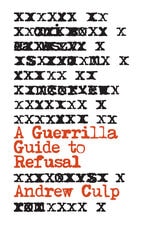
A Guerrilla Guide to Refusal
Andrew Culp
University of Minnesota Press, 2022
A field guide to a nonfascist life at the end of the world as we know it
A Guerrilla Guide to Refusal is an unexpected approach to philosophy from a guerrilla-logic point of view. Harnessing critical theory to creatively reimagine counterinsurgency, guerrilla warfare, and interventions beyond the political mainstream, it takes us on a journey through anarchist infowar, queer outlaws, and black insurgency—through a subterranean network of communiques, military documents, contemporary art, political slogans, adversarial blogs, and captive media. In doing so, it provides powerful new insight into contemporary political movements that pose no demands, refuse labels, and offer no solutions.
Written to both inspire and provoke, A Guerrilla Guide to Refusal urges us to think through the refusal to participate in politics as usual. Author Andrew Culp demonstrates how evasion can combatively deny the existing order its power. Focusing on punk cinema, anarchist pamphlets, feminist art projects, hacker manifestos, and guerrilla manuals, he foregrounds invisibility as a novel force of disruption. He draws on concepts of criminality, fugitivity, and anonymity to bring a more nuanced understanding of how power makes things—and people—visible.
The book’s unique format is that of a theoretical manual, comprising freestanding segments instead of blueprints. Poised to reach beyond the academy into activist circles, this potent theory-in-action intervention forces us to reconsider the terrain upon which our struggles against patriarchy, anti-Blackness, capitalism, and the state operate.
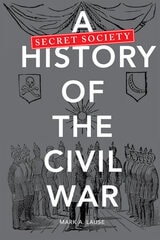
A Secret Society History of the Civil War
Mark A. Lause
University of Illinois Press, 2014
Antebellum secret societies ranged politically from those with progressive or even revolutionary agendas to those that pursued conservative or oppressive goals. This book shows how, in the years leading up to the Civil War, these clandestine organizations exacerbated existing sectional tensions in the United States. Lause's research indicates that the pervasive influence of secret societies may have played a part in key events such as the Freesoil movement, the beginning of the Republican party, John Brown's raid on Harpers Ferry, Lincoln's election, and the Southern secession process of 1860-1861.
This exceptional study encompasses both white and African American secret society involvement, revealing the black fraternal experience in antebellum America as well as the clandestine operations that provided assistance to escaped slaves via the Underground Railroad. Unraveling these pervasive and extensive networks of power and influence, A Secret Society History of the Civil War demonstrates that antebellum secret societies played a greater role in affecting Civil War-era politics than has been previously acknowledged.
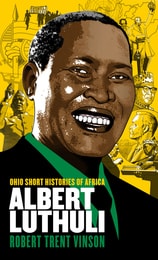
Albert Luthuli
Robert Trent Vinson
Ohio University Press, 2018
In an excellent addition to the Ohio Short Histories of Africa series, Robert Trent Vinson recovers the important but largely forgotten story of Albert Luthuli, Africa’s first Nobel Peace Prize winner and president of the African National Congress from 1952 to 1967. One of the most respected African leaders, Luthuli linked South African antiapartheid politics with other movements, becoming South Africa’s leading advocate of Mahatma Gandhi’s nonviolent civil disobedience techniques. He also framed apartheid as a crime against humanity and thus linked South African antiapartheid struggles with international human rights campaigns.
Unlike previous studies, this book places Luthuli and the South African antiapartheid struggle in new global contexts, and aspects of Luthuli’s leadership that were not previously publicly known: Vinson is the first to use new archival evidence, numerous oral interviews, and personal memoirs to reveal that Luthuli privately supported sabotage as an additional strategy to end apartheid. This multifaceted portrait will be indispensable to students of African history and politics and nonviolence movements worldwide.
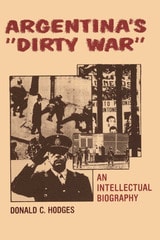
Argentina's "Dirty War"
An Intellectual BiographyBy Donald C. Hodges
University of Texas Press, 1991
Argentines ask how their ultracivilized country, reputedly the most European in Latin America, could have relapsed into near-barbarism in the 1970s. This enlightening study seeks to answer that question by reviewing the underlying political events and intellectual foundations of the "dirty war" (1975–1978) and overlapping Military Process (1976–1982). It examines the ideologies and actions of the main protagonists—the armed forces, guerrillas, and organized labor—over time and traces them to their roots.
In the most comprehensive treatment of the subject to date, Hodges examines primary materials never seen by other researchers, including clandestinely published guerrilla documents, and interviews important actors in Argentina's political drama. His wide-ranging scholarship traces the origins of the national security and national salvation doctrines to the Spanish Inquisition, sixteenth-century witch hunts, and nineteenth-century reactions to the modernizing ideologies of liberalism, democracy, socialism, and communism.
Hodges posits that the "dirty war," Military Process, and revolutionary war to which they responded represented the culmination of social tensions that arose in 1930 with the launching of the Military Era by Argentina's first successful twentieth-century coup. He offers the disquieting hypothesis that as long as the "Argentine Question" remains unsettled the military may intervene again, the resistance movement will remain strong, and violence may continue even under a democratic government.