Results by title
11 books match the query 'Government information'
A Thousand Paper Cuts
US Empire and the Bureaucratic Life of WarAnjali Nath
Duke University Press, 2025
Dark Matters
On the Surveillance of BlacknessSimone Browne
Duke University Press, 2015

Feminist Surveillance Studies
Rachel E. Dubrofsky and Soshana Amielle Magnet, eds.
Duke University Press, 2015
Contributors. Seantel Anaïs, Mark Andrejevic, Paisley Currah, Sayantani DasGupta, Shamita Das Dasgupta, Rachel E. Dubrofsky, Rachel Hall, Lisa Jean Moore, Yasmin Jiwani, Ummni Khan, Shoshana Amielle Magnet, Kelli Moore, Lisa Nakamura, Dorothy Roberts, Andrea Smith, Kevin Walby, Megan M. Wood, Laura Hyun Yi Kang
Fundamentals of Government Information
Mining, Finding, Evaluating, and Using Government ResourcesCassandra J. Hartnett
American Library Association, 2016
Law, Liberty, and the Pursuit of Terrorism
Roger Douglas
University of Michigan Press, 2014
Roger Douglas compares responses to terrorism by five liberal democracies—the United States, the United Kingdom, Canada, Australia, and New Zealand—over the past 15 years. He examines each nation’s development and implementation of counterterrorism law, specifically in the areas of information-gathering, the definition of terrorist offenses, due process for the accused, detention, and torture and other forms of coercive questioning.
Douglas finds that terrorist attacks elicit pressures for quick responses, often allowing national governments to accrue additional powers. But emergencies are neither a necessary nor a sufficient condition for such laws, which may persist even after fears have eased. He argues that responses are influenced by both institutional interests and prior beliefs, and complicated when the exigencies of office and beliefs point in different directions. He also argues that citizens are wary of government’s impingement on civil liberties and that courts exercise their capacity to restrain the legislative and executive branches. Douglas concludes that the worst antiterror excesses have taken place outside of the law rather than within, and that the legacy of 9/11 includes both laws that expand government powers and judicial decisions that limit those very powers.
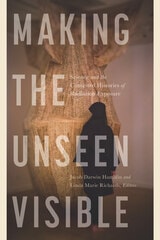
Making the Unseen Visible
Science and the Contested Histories of Radiation ExposureJacob Darwin Hamblin
Oregon State University Press, 2023
From 2017 to 2020, Jacob Hamblin and Linda Richards ran the Oregon State University Downwinders Project, sponsored by the National Science Foundation, to support research and scholarship on the Hanford downwinders cases. Additionally, each summer the project team sponsored a workshop that brought a variety of stakeholders together to explore the science, history, and lived experiences of nuclear exposure. These workshops took a broad view of nuclear exposure, beyond Hanford, beyond the United States, and beyond academia. Community members and activists presented their testimonies and creative work alongside scholars studying exposure worldwide.
Making the Unseen Visible collects the best work arising from the project and its workshops. Scholarly research chapters and reflective essays cover topics and experiences ranging from colonial nuclear testing in North Africa, to Hiroshima survivor stories, to uranium mining in the Navajo Nation, to battles over public memory around Hanford. Scholarship on nuclear topics has largely happened on a case study basis, focusing on individual disasters or locations. Making the Unseen Visible brings a variety of current community and scholarly work together to create a clearer, larger web uniting nuclear humanities research across time and geography.
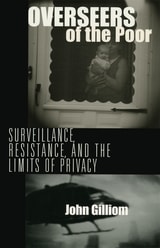
Overseers of the Poor
Surveillance, Resistance, and the Limits of PrivacyJohn Gilliom
University of Chicago Press, 2001
This powerful book lets us in on the conversations of low-income mothers from Appalachian Ohio as they talk about the welfare bureaucracy and its remarkably advanced surveillance system. In their struggle to care for their families, these women are monitored and assessed through a vast network of supercomputers, caseworkers, fraud control agents, and even grocers and neighbors.
In-depth interviews show that these women focus less on the right to privacy than on a critique of surveillance that lays bare the personal and political conflicts with which they live. And, while they have little interest in conventional forms of politics, we see widespread patterns of everyday resistance as they subvert the surveillance regime when they feel it prevents them from being good parents. Ultimately, Overseers of the Poor demonstrates the need to reconceive not just our understanding of the surveillance-privacy debate but also the broader realms of language, participation, and the politics of rights.
We all know that our lives are being watched more than ever before. As we struggle to understand and confront this new order, Gilliom argues, we need to spend less time talking about privacy rights, legislatures, and courts of law and more time talking about power, domination, and the ongoing struggles of everyday people.
The Arkansas Freedom of Information Act
John J. Watkins
University of Arkansas Press, 2017
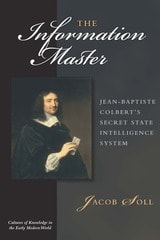
The Information Master
Jean-Baptiste Colbert's Secret State Intelligence SystemJacob Soll
University of Michigan Press, 2011
"Colbert has long been celebrated as Louis XIV's minister of finance, trade, and industry. More recently, he has been viewed as his minister of culture and propaganda. In this lively and persuasive book, Jake Soll has given us a third Colbert, the information manager."
---Peter Burke, University of Cambridge
"Jacob Soll gives us a road map drawn from the French state under Colbert. With a stunning attention to detail Colbert used knowledge in the service of enhancing
royal power. Jacob Soll's scholarship is impeccable and his story long
overdue and compelling."
---Margaret Jacob, University of California, Los Angeles
"Nowadays we all know that information is the key to power, and that the masters of information rule the world. Jacob Soll teaches us that Jean-Baptiste Colbert had grasped this principle three and a half centuries ago, and used it to construct a new kind of state. This imaginative, erudite, and powerfully written book re-creates the history of libraries and archives in early modern Europe, and ties them in a novel and convincing way to the new statecraft of Europe's absolute monarchs."
---Anthony Grafton, Princeton University
"Brilliantly researched, superbly told, and timely, Soll's story is crucial for the history of the modern state."
---Keith Baker, Stanford University
When Louis XIV asked his minister Jean-Baptiste Colbert---the man who was to oversee the building of Versailles and the Royal Academy of Sciences, as well as the navy, the Paris police force, and French industry---to build a large-scale administrative government, Colbert created an unprecedented information system for political power. In The Information Master, Jacob Soll shows how the legacy of Colbert's encyclopedic tradition lies at the very center of the rise of the modern state and was a precursor to industrial intelligence and Internet search engines.
Soll's innovative look at Colbert's rise to power argues that his practice of collecting knowledge originated from techniques of church scholarship and from Renaissance Italy, where merchants recognized the power to be gained from merging scholarship, finance, and library science. With his connection of interdisciplinary approaches---regarding accounting, state administration, archives, libraries, merchant techniques, ecclesiastical culture, policing, and humanist pedagogy---Soll has written an innovative book that will redefine not only the history of the reign of Louis XIV and information science but also the study of political and economic history.
Jacob Soll is Associate Professor of History at Rutgers University and the author of Publishing The Prince: History, Reading, and the Birth of Political Criticism (University of Michigan Press, 2005), and winner of the 2005 Jacques Barzun Prize from the American Philosophical Society and a 2009 Guggenheim Fellowship. Soll edited a special issue of Journal of the History of Ideas titled "The Uses of Historical Evidence in Early Modern Europe"; has cofounded the online journal Republics of Letters; and is editor, along with Anthony Grafton and Ann Blair, of the series Cultures of Knowledge in the Early Modern World.
The Politics of Attention
How Government Prioritizes ProblemsBryan D. Jones and Frank R. Baumgartner
University of Chicago Press, 2005
Analyzing fifty years of data, Jones and Baumgartner's book is the first study of American politics based on a new information-processing perspective. The authors bring together the allocation of attention and the operation of governing institutions into a single model that traces public policies, public and media attention to them, and governmental decisions across multiple institutions.
The Politics of Attention offers a groundbreaking approach to American politics based on the responses of policymakers to the flow of information. It asks how the system solves, or fails to solve, problems rather than looking to how individual preferences are realized through political action.
The Politics of Lists
Bureaucracy and Genocide under the Khmer RougeJames A. Tyner
West Virginia University Press, 2018
2019 Julian Minghi Distinguished Book Award winner
Scholars from a number of disciplines have, especially since the advent of the war on terror, developed critical perspectives on a cluster of related topics in contemporary life: militarization, surveillance, policing, biopolitics (the relation between state power and physical bodies), and the like. James A. Tyner, a geographer who has contributed to this literature with several highly regarded books, here turns to the bureaucratic roots of genocide, building on insight from Hannah Arendt, Zygmunt Bauman, and others to better understand the Khmer Rouge and its implications for the broader study of life, death, and power.
The Politics of Lists analyzes thousands of newly available Cambodian documents both as sources of information and as objects worthy of study in and of themselves. How, Tyner asks, is recordkeeping implicated in the creation of political authority? What is the relationship between violence and bureaucracy? How can documents, as an anonymous technology capable of conveying great force, be understood in relation to newer technologies like drones? What does data create and what does it destroy? Through a theoretically informed, empirically grounded study of the Khmer Rouge security apparatus, Tyner shows that lists and telegrams have often proved as deadly as bullet and bombs.