Results by title
4 books match the query 'Graban, Tarez Samra'
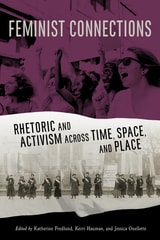
Feminist Connections
Rhetoric and Activism across Time, Space, and PlaceEdited by Katherine Fredlund, Kerri Hauman, and Jessica Ouellette
University of Alabama Press, 2020
Tracing the rhetoric of feminist activism across generations, cultures, and movements.
In 1917, Alice Paul and other suffragists famously picketed in front of the White House while holding banners with short, pithy sayings such as “Mr. President: How long must women wait for Liberty?” Their juxtaposition of this short phrase with the image of the White House (a symbol of liberty and justice) relies on the same rhetorical tactics as memes, a genre contemporary feminists use frequently to make arguments about reproductive rights, Black Lives Matter, sex-positivity, and more. Many such connections between feminists of different spaces, places, and eras have yet to be considered, let alone understood. Feminist Connections: Rhetoric and Activism across Time, Space, and Place reconsiders feminist rhetorical strategies as linked, intergenerational, and surprisingly consistent despite the emergence of new forms of media and intersectional considerations.
Contributors to this volume highlight continuities in feminist rhetorical practices that are often invisible to scholars, obscured by time, new media, and wildly different cultural, political, and social contexts. Thus, this collection takes a nonchronological approach to the study of feminist rhetoric, grouping chapters by rhetorical practice rather than time, content, or choice of media.
By connecting historical, contemporary, and future trajectories, this collection develops three feminist rhetorical frameworks: revisionary rhetorics, circulatory rhetorics, and response rhetorics. A theorization of these frameworks explains how feminist rhetorical practices (past and present) rely on similar but diverse methods to create change and fight oppression. Identifying these strategies not only helps us rethink feminist rhetoric from an academic perspective but also allows us to enact feminist activist rhetorics beyond the academy during a time in which feminist scholarship cannot afford to remain behind its hallowed yet insular walls.
Teaching through the Archives
Text, Collaboration, and ActivismEdited by Tarez Samra Graban and Wendy Hayden
Southern Illinois University Press, 2022
Disruptive pedagogies for archival research
In a cultural moment when institutional repositories carry valuable secrets to the present and past, this collection argues for the critical, intellectual, and social value of archival instruction. Graban and Hayden and 37 other contributors examine how undergraduate and graduate courses in rhetoric, history, community literacy, and professional writing can successfully engage students in archival research in its many forms, and successfully model mutually beneficial relationships between archivists, instructors, and community organizations.
Combining new and established voices from related fields, each of the book’s three sections includes a range of form-disrupting pedagogies. Section I focuses on how approaching the archive primarily as text fosters habits of mind essential for creating and using archives, for critiquing or inventing knowledge-making practices, and for being good stewards of private and public collections. Section II argues for conducting archival projects as collaboration through experiential learning and for developing a preservationist consciousness through disciplined research. Section III details praxis for revealing, critiquing, and intervening in historic racial omissions and gaps in the archives in which we all work.
Ultimately, contributors explore archives as sites of activism while also raising important questions that persist in rhetoric and composition scholarship, such as how to decolonize research methodologies, how to conduct teaching and research that promote social justice, and how to shift archival consciousness toward more engaged notions of democracy. This collection highlights innovative classroom and curricular course models for teaching with and through the archives in rhetoric and composition and beyond.
Unsettling Archival Research
Engaging Critical, Communal, and Digital ArchivesEdited by Gesa E. Kirsch, Romeo García, Caitlin Burns Allen, and Walker P. Smith
Southern Illinois University Press, 2023
A collection of accessible, interdisciplinary essays that explore archival practices to unsettle traditional archival theories and methodologies.
What would it mean to unsettle the archives? How can we better see the wounded and wounding places and histories that produce absence and silence in the name of progress and knowledge? Unsettling Archival Research sets out to answer these urgent questions and more, with essays that chart a more just path for archival work.
Unsettling Archival Research is one of the first publications in rhetoric and writing studies dedicated to scholarship that unsettles disciplinary knowledge of archival research by drawing on decolonial, Indigenous, antiracist, queer, and community perspectives. Written by established and emerging scholars, essays critique not only the practices, ideologies, and conventions of archiving, but also offer new tactics for engaging critical, communal, and digital archiving within and against systems of power. Contributors reflect on efforts to unsettle and counteract racist, colonial histories, confront the potentials and pitfalls of common archival methodologies, and chart a path for the future of archival research otherwise. Unsettling Archival Research intervenes in a critical issue: whether the discipline’s assumptions about the archives serve or fail the communities they aim to represent and what can be done to center missing voices and perspectives. The aim is to explore the ethos and praxis of bearing witness in unsettling ways, carried out as a project of queering and/or decolonizing the archives.
Unsettling Archival Research takes seriously the rhetorical force of place and wrestles honestly with histories that still haunt our nation, including the legacies of slavery, colonial violence, and systemic racism.
Women's Irony
Rewriting Feminist Rhetorical HistoriesTarez Samra Graban
Southern Illinois University Press, 2015
In Women’s Irony: Rewriting Feminist Rhetorical Histories, author Tarez Samra Graban synthesizes three decades of feminist scholarship in rhetoric, linguistics, and philosophy to present irony as a critical paradigm for feminist rhetorical historiography that is not linked to humor, lying, or intention. Using irony as a form of ideological disruption, this innovative approach allows scholars to challenge simplistic narratives of who harmed, and who was harmed, throughout rhetorical history.
Three case studies of women’s political discourse between 1600 and 1900—examining the work of Anne Askew, Anne Hutchinson, and Helen M. Gougar—demonstrate how reading historical texts ironically complicates the theoretical relationships between women and agency, language and history, and archival location and memory. Interwoven throughout are shorter case studies from twentieth-century performances, revealing irony’s consciousness-raising potential for the present and the future.
Ultimately, Women’s Irony suggests alternative ways to question women’s histories and consider how contemporary feminist discourse might be better historicized. Graban challenges critical methods in rhetoric, asking scholars in rhetoric and its related disciplines—composition, communication, and English studies—to rethink how they produce historical knowledge and use archives to recover women’s performances in political situations.