Results by title
9 books match the query 'Greek poetry, Hellenistic'
A Companion to Apollonius of Rhodes
Ruth Scodel
University of Michigan Press, 2025
A Companion to Apollonius of Rhodes aims to help contemporary readers appreciate what is most characteristic of Apollonius’ epic—its fascination with ritual and myth, gods who act without the direction of Zeus, frequent distanced narration, the portrayal of characters in situations where there are no good choices. It includes thorough analyses of the poem’s relationship to contemporary art with illustrations and treats familiar topics, such as Jason’s leadership, with nuance. Contributors include Benjamin Acosta-Hughes, Annemarie Ambühl, Anja Bettenworth, Keyne Cheshire, Christopher Chinn, James Clauss, Adele Teresa Cozzoli, Kristopher Fletcher, Alexander Hollmann, Regina Höschele, Niklas Holzberg, Alison Keith, Adolf Köhnken†, Anatole Mori, William H. Race, Norman Sandridge, Selina Stewart, Stefanie Stürner, and Graham Zanker.
Echoing Hylas
A Study in Hellenistic and Roman MetapoeticsMark Heerink
University of Wisconsin Press, 2015
In Echoing Hylas, Mark Heerink argues that the story of Hylas—a famous episode of the Argonauts' voyage—was used by poets throughout classical antiquity to reflect symbolically on the position of their poetry in the literary tradition. Certain elements of the story, including the characters of Hylas and Hercules themselves, functioned as metaphors of the art of poetry. In the Hellenistic age, for example, the poet Theocritus employed Hylas as an emblem of his innovative
bucolic verse, contrasting the boy with Hercules, who symbolized an older, heroic-epic tradition. The Roman poet Propertius further developed and transformed Theocritus's metapoetical allegory by turning Heracles into an elegiac lover in pursuit of an unattainable object of affection. In this way, the myth of Hylas became the subject of a dialogue among poets across time, from the Hellenistic age to the Flavian era. Each poet, Heerink demonstrates, used elements of the myth to claim his own place in a developing literary tradition.
With this innovative diachronic approach, Heerink opens a new dimension of ancient metapoetics and offers many insights into the works of Apollonius of Rhodes, Theocritus, Virgil, Ovid, Valerius Flaccus, and Statius.
Hellenistic Aesthetic
Barbara Hughes Fowler
University of Wisconsin Press, 1989
“Fowler’s . . . own insights are apparent throughout, and they seem to distill the personal appreciation and understanding of a scholar who has devoted much of her career to both contemplating and enjoying Hellenistic poetry. . . . [This book] would make an excellent background text for courses in later Greek and Roman art, and it can be read with profit by anyone interested in exploring the character of Hellenistic culture.”—J. J. Pollitt, American Journal of Archaeology
“Outstanding is the range of examples discussed both in poetry and art. Theocritus, Callimachus, Appolonius, the epigrammatists, and others—that is, the major figures of the time—are considered at length and in several different contexts. Passages are quoted in the original Greek, translated, and analyzed. Fowler’s sensitivity to poetic forms, evident in her other published writings, is again evident here. In addition, however, the philosophical context is not overlooked. . . . Also highly commendable are the liberal references to works of art. Sculpture in the round and in relief, portraits, terracotta figurines, original paintings (grave stelai) and Campanian murals, mosaics, gold and silver vessels, and jewelry are introduced at various points. Every work of art discussed is illustrated in astonishingly clear photographs, which are interspersed in the body of the text.”—Christine Mitchell Havelock
“The Hellenistic Aesthetic provides classicists with their first thorough discussion of the aesthetic unity found in Hellenistic art and literature. . . . Fowler examines parallels both in subject matter and in artistic approach among a diverse group of literary genres and artistic forms. In twelve chapters, The Hellenistic Aesthetic surveys Alexandrian epigrams, pastorals, epics, sculptural groups, mosaics, paintings, and jewelry to supply a convincing, and frequently unexpected, picture of a unified aesthetic vision.”—Jeffrey Buller, Classical Outlook
Hellenistic Poetry
A SelectionDavid Sider, Editor
University of Michigan Press, 2017
The text of each poem is presented, together with basic help on obscure vocabulary, morphology, dialect, meter, syntax, and similar philological issues. The modern commentators also offer guidance on a poem’s literary significance and a brief introduction to the scholarship.
Among the 44 named and anonymous poets represented here are Apollonius of Rhodes, Archimedes, Aristotle, Callimachus, Cercidas, Corinna, Eratosthenes, Erinna, Ezekiel, Hermesianax, Herodas, Lycophron, and Phanocles.
Contributors to the volume in addition to David Sider include: Silvia Barbantani, James Clauss, Dee Clayman, Christophe Cusset, Claudio De Stefani, Marco Fantuzzi, Andrew Ford, Kathryn Gutzwiller, Johanna Hanink, Regina Hoeschele, Richard Hunter, David Konstan, Pauline LeVen, Kelly MacFarlane, Enrico Magnelli, Jackie Murray, Pura Nieto, Maria Noussia, Douglas Olson, Floris Overduin, Richard Rawles, Ralph Rosen, Chad Schroeder, Alexander Sens, Evina Sistakou, Michael Tueller, and Athanassios Vergados.
Although designed primarily as a textbook for graduate students and upper-level undergraduates, the book offers texts and subsidiary information not easily found (if at all) elsewhere. Since Latin poets made constant allusion to Hellenistic poetry, it will also be an important resource for Latinists.
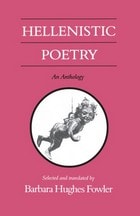
Hellenistic Poetry
An AnthologySelected and translated by Barbara Hughes Fowler
University of Wisconsin Press, 1990
An accomplished poet and classical scholar, Barbara Hughes Fowler brings Hellenistic poetry to life for the contemporary reader. Her selections engage us with the full range of Hellenistic poetic genres, styles, themes, and moods. The anthology includes Fowler’s new translation of the entire Argonautica of Apollonius of Rhodes, and eight of Theocritus’ Idylls, including the beautiful, sensuous description of late summer in Idyll VII and the shrewdly comical description of two young matrons venturing into the noisy streets of Alexandria in Idyll XV. There are translations of four hymns of Callimachus, as well as poems by Aratus, Bion, Herodas, Moschus, Pseudo-Moschus, and a substantial selection from the Greek Anthology.
An ideal companion to her recently published book, The Hellenistic Aesthetic, Barbara Fowler’s Hellenistic Poetry is both a major contribution to classical studies and an invitation to all interested readers to discover the beauty and richness of Hellenistic poetry.
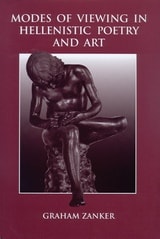
Modes of Viewing in Hellenistic Poetry and Art
And ArtGraham Zanker
University of Wisconsin Press, 2003
Taking a fresh look at the poetry and visual art of the Hellenistic age, from the death of Alexander the Great in 323 B.C. to the Romans’ defeat of Cleopatra in 30 B.C., Graham Zanker makes enlightening discoveries about the assumptions and conventions of Hellenistic poets and artists and their audiences.
Zanker’s exciting new interpretations closely compare poetry and art for the light each sheds on the other. He finds, for example, an exuberant expansion of subject matter in the Hellenistic periods in both literature and art, as styles and iconographic traditions reserved for grander concepts in earlier eras were applied to themes, motifs, and subjects that were emphatically less grand.
Poems from the Greek Anthology
Expanded EditionTranslated, with a Foreword, by Kenneth Rexroth
University of Michigan Press, 1999
Friend to the Beats, organizer of the Six Gallery poetry reading in 1955, and iconoclastic poet extraordinare, Kenneth Rexroth here turns his imagination to a selection of verses from the Greek Anthology. In his lively style he successfully captures the spirit of the originals by such poets as Sappho, Anyte, Glykon, Antipatros, Leonidas, Askelpiades, and Ammianos. Students of the classics as well as poets and translators will welcome this collection for the insight and dexterity of its unconventional editor.
Kenneth Rexroth (1905-1982), poet, critic, and translator, is also noted for his translations from the Chinese and Japanese. Widely prolific, he helped usher in the Beat movement in the 1950s and is widely considered to have invented the idea of San Francisco as a center of literary innovation. David Mulroy is Associate Professor in the Department of Foreign Languages and Linguistics, University of Wisconsin, Milwaukee. He is the translator of Early Greek Lyric Poetry and Horace's Odes and Epodes.
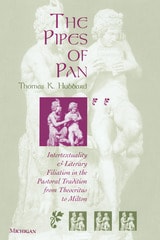
The Pipes of Pan
Intertextuality and Literary Filiation in the Pastoral Tradition from Theocritus to MiltonThomas K. Hubbard
University of Michigan Press, 1999
Pastoral poetry highlights the didactic relationship of older and younger shepherds, whether as rivals or as patron and successor. As such it is an ideal form for young poets' self-representation vis-à-vis their elders, whose work they simultaneously appropriated and transformed, even as the elder poets were represented in the new texts. This influence is reenacted in every generation: Theocritus vs. his Alexandrian forebears, Vergil vs. Theocritus, Calpurnius vs. Vergil, Nemesianus vs. Vergil and Calpurnius, Petrarch vs. Vergil, Boccaccio vs. Petrarch, Spenser vs. Vergil, along with Chaucer and Milton vs. Spenser.
The Pipes of Pan combines multiple strands of contemporary intertextual theory with reception aesthetics and Harold Bloom's theory of intersubjective conflict between generations of poets. It also provides one of the first systematic studies of intertextual and intersubjective dynamics within a whole genre.
This work will be of interest to classicists, students of literary theory, comparative literature, medieval and Renaissance literature, Italian humanism, and English literature of the sixteenth and seventeenth centuries. All texts are translated.
Thomas Hubbard is Associate Professor of Classics, University of Texas at Austin.
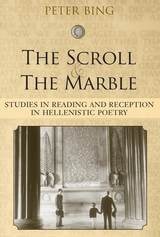
The Scroll and the Marble
Studies in Reading and Reception in Hellenistic PoetryPeter Bing
University of Michigan Press, 2010
---Benjamin Acosta-Hughes, Ohio State University
While people of previous ages relied on public performance as their chief means of experiencing poetry, the Hellenistic age developed what one may term a culture of reading. This was the first era in which poets consciously shaped their works with an eye toward publication and reception not just on the civic stage but in several media---in performance, on inscribed monuments, in scrolls. The essays in Peter Bing's collection explore how poetry accommodated various audiences and how these audiences in turn experienced the text in diverse ways. Over the years, Bing's essays have focused on certain Hellenistic authors and genres---particularly on Callimachus and Posidippus and on epigram. His themes, too, have been broadly consistent. Thus, although the essays in The Scroll and the Marble span some twenty years, they offer a coherent vision of Hellenistic poetics as a whole.
Peter Bing is Professor of Classics at Emory University and editor, most recently, of the Companion to Hellenistic Epigram: Down to Philip (coedited with Jon Steffen Bruss).
Jacket illustration: Film still from Mr. Smith Goes to Washington, directed by Frank Capra, Columbia Pictures 1939. Courtesy of Sony Pictures.