Results by title

3 books match the query 'Greenhouse gas mitigation'
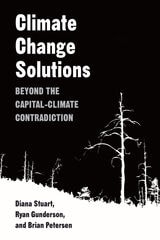
cover of Climate Change Solutions: Beyond the Capital-Climate Contradiction

Climate Change Solutions

Beyond the Capital-Climate Contradiction

Diana Stuart, Ryan Gunderson, and Brian Petersen

University of Michigan Press, 2020
Climate Change Solutions represents an application of critical theory to examine proposed solutions to climate change. Drawing from Marx’s negative conception of ideology, the authors illustrate how ideology continues to conceal the capital-climate contradiction or the fundamental incompatibility between growth-dependent capitalism and effectively and justly mitigating climate change. Dominant solutions to climate change that offer minor changes to the current system fail to address this contradiction. However, alternatives like degrowth involve a shift in priorities and power relations and can offer new systemic arrangements that confront and move beyond the capital-climate contradiction. While there are clear barriers to a systemic transition that prioritizes social and ecological well-being, such a transition is possible and desirable.
[more]
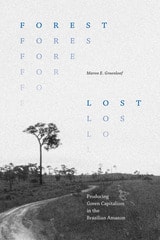
cover of Forest Lost: Producing Green Capitalism in the Brazilian Amazon

Forest Lost

Producing Green Capitalism in the Brazilian Amazon

Maron E. Greenleaf

Duke University Press, 2024
Forest Lost is an ethnography of forest carbon offsets and the wider effort to make the living rainforest valuable in the Brazilian Amazon. Unlike other forest commodities, forest carbon offsets do not involve resource extraction; instead, they require keeping carbon in place through forest protection. Maron E. Greenleaf explores forest carbon offsets to understand green capitalism—the use of capitalist logics and practices to mitigate environmental damage. She traces cultural, environmental, governmental, material, and multispecies relations involved in making forest carbon valuable as well as how forest carbon’s commodification in the Amazon turned it into a source of redistributable public environmental wealth. At the same time, Greenleaf shows how making forest carbon monetarily valuable created an unexpected set of uneven, contingent, and contested social and political relations. While forest carbon in the Amazon demonstrates that green capitalism can be socially inclusive, it also shows that green capitalism can reinforce the marginalization it purportedly seeks to combat. By outlining these complex relations and tensions, Greenleaf elucidates broader efforts to create a capitalism suited to the Anthropocene and those efforts’ alluring promises and vexing failures.
[more]
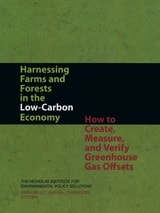
cover of Harnessing Farms and Forests in the Low-Carbon Economy: How to Create, Measure, and Verify Greenhouse Gas Offsets

Harnessing Farms and Forests in the Low-Carbon Economy

How to Create, Measure, and Verify Greenhouse Gas Offsets

Nicholas Institute for Environmental Policy Solutions and Zach Willey and Bill Chameides, editors, eds.

Duke University Press, 2007

As the United States moves to a low-carbon economy in order to combat global warming, credits for reducing carbon dioxide emissions will increasingly become a commodity that is bought and sold on the open market. Farmers and other landowners can benefit from this new economy by conducting land management practices that help sequester carbon dioxide, creating credits they can sell to industry to “offset” industrial emissions of greenhouse gases.

This guide is the first comprehensive technical publication providing direction to landowners for sequestering carbon and information for traders and others who will need to verify the sequestration. It will provide invaluable direction to farmers, foresters, land managers, consultants, brokers, investors, regulators, and others interested in creating consistent, credible greenhouse gas offsets as a tradable commodity in the United States.

The guide contains a non-technical section detailing methodologies for scoping of the costs and benefits of a proposed project, quantifying offsets of various sorts under a range of situations and conditions, and verifying and registering the offsets. The technical section provides specific information for quantifying, verifying, and regulating offsets from agricultural and forestry practices.

Visit the Nicholas Institute for Environmental Policy Solutions website for audio from the press conference announcing the book.
Read the press release announcing the book.

[more]