Results by title
4 books match the query 'Griffiths, Paul J.'
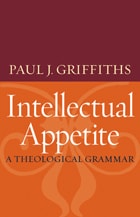
Intellectual Appetite
A Theological GrammarPaul J. Griffiths
Catholic University of America Press, 2009
The appetite for knowledge--wanting to know things--is very strong in humans. Some will sacrifice all other goods (sex, power, food, life itself) for it. But this is not a simple appetite, and this book treats some of its complications, deformations, beauties, and intensities.
[more]
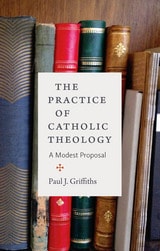
The Practice of Catholic Theology
Paul J. Griffiths
Catholic University of America Press, 2016
In The Practice of Catholic Theology: A Modest Proposal, Paul J. Griffiths has written a how-to book for Catholic theologians that will both instruct beginners and challenge long-time practitioners to sharpen their understanding of their craft. He defines Catholic theology as the practice of thinking, speaking, and writing about the God of Christian confession; so understood, it's something that anyone can learn to do. Personal sanctity is not required, but as with any other practice, practitioners of this beautiful and elevated thought-performance need to know some things and to develop some skills in order to be able to perform it.
[more]
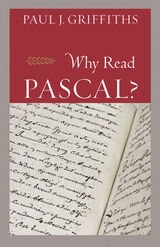
Why Read Pascal?
Paul J. Griffiths
Catholic University of America Press, 2021
Blaise Pascal (1623-1662) is known in the English-speaking world principally for the wager (an argument that it is rational to do what will affect belief in God and irrational not to), and, more generally, for the Pensées, a collection of philosophical and theological fragments of unusual emotional and intellectual intensity collected and published after his death. He thought and wrote, however, about much more than this: mathematics; physics; grace, freedom, and predestination; the nature of the church; the Christian life; what it is to write and read; the order of things; the nature and purpose of human life; and more. He was among the polymaths of the seventeenth century, and among the principal apologists of his time for the Catholic faith, against both its Protestant opponents and its secular critics.
Why Read Pascal? engages all the major topics of Pascal's theological and philosophical writing. It provides discussion of Pascal's literary style, his linked understandings of knowledge and of the various orders of things, his anthropology (with special attention to his presentation of affliction, death, and boredom), his politics, and his understanding of the relation between Christianity and Judaism. Pascal emerges as a literary stylist of a high order, a witty and polemical writer (never have the Jesuits been more thoroughly eviscerated), and, perhaps above all else, as someone concerned to show to Christianity's cultured despisers that the fabric of their own lives implies the truth of Christianity if only they can be brought to look at what their lives are like.
Why Read Pascal? is the first book in English in a generation to engage all the principal themes in Pascal's theology and philosophy. The book takes Pascal seriously as an interlocutor and as a contributor of continuing relevance to Catholic thought; but it also offers criticisms of some among the positions he takes, showing, in doing so, how lively his writing remains for us now.
[more]
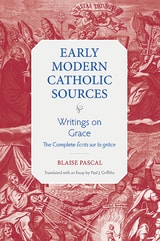
Writings on Grace
The Complete <i>Ecrits sur la grace</i>Blaise Pascal
Catholic University of America Press, 2025
A few years before he died in 1662, Blaise Pascal wrote fifteen interconnected essays on grace, which have collectively come to be known as the Écrits sur la grâce. These were not published before his death, and were not polished and revised by him with an eye to publication, which means that they show his mind at work experimentally, trying out lines of argument and engagements with magisterial and patristic texts without resolving them into anything like a final system. The Écrits are replete with experimental formulations and bursts of literary and intellectual energy; taken together, they provide an intense and extreme presentation of Pascal's version of Augustinianism with respect to grace, election, and predestination, the meaning of the Council of Trent, and much else. These essays provide one of the keys to the entirety of Pascal's thought, and they provide a view of grace's workings -- perhaps better, a grammar of grace -- which still warrants serious attention by Catholic theologians.
Less than one-fifth of the Écrits has yet been published in English. This book provides a complete translation, made from the French text provided in Michel Le Guern's edition (1998, 2000) of Pascal's Oeuvres complètes, and annotated to provide full information about Pascal's sources and how he used them. The translation is followed by a substantial interpretive essay in which Pascal's positions and approaches are restated and argued with.
[more]