Results by title
7 books match the query 'Gulf Coast'
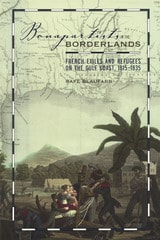
Bonapartists in the Borderlands
French Exiles and Refugees on the Gulf Coast, 1815-1835Rafe Blaufarb
University of Alabama Press, 2005
Bonapartists in the Borderlands debunks the standard account of the Vine and Olive Colony, which stresses the failure of aristocratic, luxury-loving French to tame the wilderness. Rafe Blaufarb recounts how Napoleonic exiles and French refugees from Europe and the Caribbean joined forces with Latin American insurgents, Gulf pirates, and international adventurers to seek their fortune in the Gulf borderlands. The US Congress welcomed the French and granted them a capacious tract of rich Black Belt land near Demopolis, Alabama, on the condition that they would establish a Mediterranean-style Vine and Olive colony.
Blaufard shows that it was not a lack of grit that caused the enterprise to fail. Rather, the Napoleonic officers involved in the colony sold their land shares to speculators to finance an even more perilous adventure—invading the Texas borderlands contested by Spain and the US. Their departure left the Vine and Olive colony in the hands of French refugees from the Haitian slave revolt. They soon abandoned vine cultivation and fused with the neighboring communities of Anglo-American slaveholding cotton planters and speculators.
Rafe Blaufarb examines the underlying motivations and aims that inspired this endeavor and details the nitty-gritty politics, economics, and backroom bargaining that resulted in the settlement. He employs a wide variety of local, national, and international resources: from documents held by the Alabama State Archives, Marengo County court records, and French-language newspapers published in America to material from the War Ministry Archives at Vincennes, the Diplomatic Archives at the Quai d’Orasy, and the French National Archives.
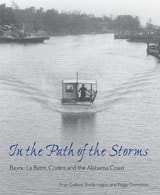
In the Path of the Storms
Bayou La Batre, Coden, and the Alabama CoastFrye Gaillard
University of Alabama Press, 2008
A Powerful Portrait of Resilience, Heritage, and Change on Alabama's Gulf Coast.
The Gulf Coast villages of Bayou La Batre and Coden are two of Alabama’s most distinctive, with roots going back to the French settlements of the 18th century. For generations, the proud inhabitants of these communities have extracted their modest livings from the sea, sustained by a lesson handed down over time— that providing for the needs of one’s family is the only true measure of success. But the world has changed drastically for them. A global economy of higher gas prices and cheap imported seafood has threatened the lifeblood of the area. And in recent years a rash of hurricanes, culminating with Hurricane Katrina, has battered the hopes and dreams of these Bayou towns.
But they have known hard times and massive changes before. In the 1970s, refugees from Vietnam, Cambodia, and Laos flooded into the area and within a few years made up a third of the local population. Three Buddhist temples soon took their places among the Catholic, Baptist, and Pentecostal churches that predominated, and for a time the different ethnic groups coexisted in a kind of uneasy peace. But now they are learning to pull together in an uncertain struggle to rebuild their communities.
In the Path of the Storms is a powerful portrait in words and photographs of a unique and unforgettable place. It is a story of tradition, and forces of change, and the epic struggle of these Gulf Coast communities to survive and thrive.
Native Peoples of the Gulf Coast of Mexico
Edited by Alan R. Sandstrom and E. Hugo García Valencia
University of Arizona Press, 2005
Native Peoples of the Gulf Coast of Mexico is the first book to argue that the people of this region constitute a culture area distinct from other parts of Mexico. A pioneering effort by a team of international scholars who summarize hundreds of years of history, this encyclopedic work chronicles the prehistory, ethnohistory, and contemporary issues surrounding the many and varied peoples of the Gulf Coast, bringing together research on cultural groups about which little or only scattered information has been published.
The volume includes discussions of the prehispanic period of the Gulf Coast, the ethnohistory of many of the neglected indigenous groups of Veracruz and the Huasteca, the settlement of the American Mediterranean, and the unique geographical and ecological context of the Chontal Maya of Tabasco. It provides descriptions of the Popoluca, Gulf Coast Nahua, Totonac, Tepehua, Sierra Ñähñu (Otomí), and Huastec Maya. Each chapter contains a discussion of each group’s language, subsistence and settlement patterns, social organization, belief systems, and history of acculturation, and also examines contemporary challenges to the future of each native people.
As these contributions reveal, Gulf Coast peoples share not only major cultural features but also historical experiences, such as domination by Hispanic elites beginning in the sixteenth century and subjection to forces of change in Mexico. Yet as contemporary people have been affected by factors such as economic development, increased emigration, and the spread of Protestantism, traditional cultures have become rallying points for ethnic identity.
Native Peoples of the Gulf Coast of Mexico highlights the significance of the Gulf Coast for anyone interested in the great encuentro between the Old and New Worlds and general processes of culture change. By revealing the degree to which these cultures have converged, it represents a major step toward achieving a broader understanding of the peoples of this region and will be an important reference work on these indigenous populations for years to come.
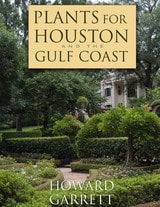
Plants for Houston and the Gulf Coast
By Howard Garrett
University of Texas Press, 2008
Whether you're a first-time homeowner, dedicated gardener, or landscape professional, if you're gardening on the Gulf Coast, you need Howard Garrett's Plants for Houston and the Gulf Coast. Garrett is one of Texas's top organic gardening experts, and gardeners rely on him for accurate, sensible advice about what to plant and how to maintain healthy yards and landscapes without synthetic fertilizers and toxic pesticides. In Plants for Houston and the Gulf Coast, Garrett presents nearly 400 plants, both native and adapted, that grow well in Southeast Texas.
Like all of Howard Garrett's books, Plants for Houston and the Gulf Coast is loaded with indispensable gardening information:
- Nearly 400 trees, shrubs, groundcovers and vines, annuals and perennials, and grasses
- 400 full-color, close-up photos of the plants
- Expert information about each plant's appearance, growing requirements, landscape uses, potential problems, and other interesting facts
- Precise, easy-to-follow instructions about how to design a garden, prepare the soil, install trees and other plants, grow grass and control weeds, and maintain the landscape and control pests
- A detailed gardening calendar for Southeast Texas that lists specific plants to plant and maintenance tasks to perform each month
No other book currently available provides such extensive and reliable information for Texas Gulf Coast gardeners.

The Karankawa Indians of Texas
An Ecological Study of Cultural Tradition and ChangeBy Robert A. Ricklis
University of Texas Press, 1996
Popular lore has long depicted the Karankawa Indians as primitive scavengers (perhaps even cannibals) who eked out a meager subsistence from fishing, hunting and gathering on the Texas coastal plains. That caricature, according to Robert Ricklis, hides the reality of a people who were well-adapted to their environment, skillful in using its resources, and successful in maintaining their culture until the arrival of Anglo-American settlers.
The Karankawa Indians of Texas is the first modern, well-researched history of the Karankawa from prehistoric times until their extinction in the nineteenth century. Blending archaeological and ethnohistorical data into a lively narrative history, Ricklis reveals the basic lifeway of the Karankawa, a seasonal pattern that took them from large coastal fishing camps in winter to small, dispersed hunting and gathering parties in summer. In a most important finding, he shows how, after initial hostilities, the Karankawa incorporated the Spanish missions into their subsistence pattern during the colonial period and coexisted peacefully with Euroamericans until the arrival of Anglo settlers in the 1820s and 1830s. These findings will be of wide interest to everyone studying the interactions of Native American and European peoples.
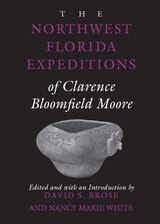
The Northwest Florida Expeditions of Clarence Bloomfield Moore
Clarence Bloomfield Moore
University of Alabama Press, 1999
A Dan Josselyn Memorial Publication
This comprehensive compilation of Moore's archaeological reports on northwest Florida and southern Alabama and Georgia presents the earliest documented investigations of this region.
When Clarence Bloomfield Moore cruised the rivers of Florida in search of prehistoric artifacts a century ago, he laid the groundwork for archaeological investigations to follow. This volume reflects Moore's fieldwork along the northwest Florida coast, the most archaeologically rich area of the state, as well as Southern Alabama and Georgia.
Here readers will share Moore's first look at the area in 1901-1903 and additional observations made in 1918 during what was to be his last field season. Moore's works reveal ceramics, tools, skeletal remains, and exotic artifacts excavated from the earthen mounds and shell middens built by native peoples over the last two millennia.
In the introduction to this edition, David Brose and Nancy Marie White place Moore's investigations within the context of the science, natural history, and antiquarianism of his day. They document what happened to the sites he explored, tell how his findings fit into the body of his research, and explain how those findings should be interpreted in the context of Southeastern culture history and modern archaeological theory.
Moore was the most knowledgeable Southeastern archaeologist of his time; his writings are a benchmark for anyone studying those areas today.
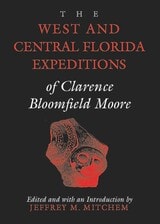
The West and Central Florida Expeditions of Clarence Bloomfield Moore
Clarence Bloomfield Moore, edited and with an introduction by Jeffrey M. Mitchem
University of Alabama Press, 1999
This compilation of Moore's publications on western and central Florida provides all of his archaeological data on the region's mounds and prehistoric canals in a single volume.
The name Clarence B. Moore is familiar to every archaeologist interested in the southeastern United States. This amateur archaeologist's
numerous scientific expeditions to the region resulted in dozens of well-illustrated publications, the value of which increases daily as many of the sites he investigated continue to be destroyed by modern development.
Moore invested considerable time and effort exploring Florida's archaeological sites, devoting more pages of published reports and articles to Florida than to any other state. Because of the wealth of material on Florida, Moore's Florida expedition publications have been
collected in three separate volumes, all published within the Classics in Southeastern Archaeology series. The thirteen papers reproduced in this
volume present the results of Moore's research in West and Central Florida.
Moore's first and last expeditions were to Florida and spanned almost fifty years of archaeological investigations. Following the eastern river drainages to central and western Florida, in 1900 Moore concentrated his efforts along the Florida Gulf Coast, spurred by the exciting
discoveries of Frank Hamilton Cushing at Key Marco in 1896. Although this region is rich in mound sites, many sites located by Moore in the early
years of this century had already been destroyed by construction and lime processing. In addition to mound groupings—some containing masses of skeletal remains—Moore found a number of sites connected by a network of prehistoric canals. Several of the sites located by Moore contained European trade goods and have been used to trace the early wanderings of the conquistadores in the New World.
Moore's early work on the Florida Gulf Coast succeeded in preserving much of the archaeological record in this area. He is to be credited with remarkable insights concerning mound and earthwork construction, artifact trade networks, and chronology development.