Results by title
12 books match the query 'Guns'
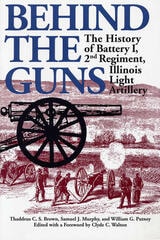
Behind the Guns
The History of Battery I, 2nd Regiment, Illinois Light ArtilleryThaddeus C. S. Brown, Samuel J. Murphy, and William G. Putney. Edited with a Foreword by Clyde C. Walton
Southern Illinois University Press, 2000
Much has been written of the infantry and the cavalry during the Civil War, but little attention has been paid the artillery. Through the battles of Chickamauga and Missionary Ridge in 1863 and the Atlanta Campaign of 1864 and with General Sherman’s forces on the famous March to the Sea, the acts of a courageous fighting group are vividly recounted in Behind the Guns: The History of Battery I, 2nd Regiment, Illinois Light Artillery. Originally published in 1965 in a limited edition, this regimental history of a light artillery unit was written by three of its soldiers, including the bugler.
Battery I was formed in 1861 by Charles W. Keith of Joliet and Henry B. Plant of Peoria. More than a hundred men were mustered into service in December near Springfield and left for Cairo in February 1862. The battery trained at Camp Paine across the Ohio River in Kentucky until March, when the men were dispatched to the South. During the war, the Battery was attached to three different armies: the Army of the Mississippi, the Army of the Ohio, and the Army of the Cumberland.
Clyde C. Walton’s foreword and the narrative discuss the variety of weapons used by the unit, including James, Parrott, and Rodman guns and the bronze, muzzle-loading Napoleons that fired twelve-pound projectiles. The book also includes an account of the prisoner-of-war experience of Battery I lieutenant Charles McDonald, biographical sketches of the battery soldiers, and eighteen maps and five line drawings.

Flowers, Guns, and Money
Joel Roberts Poinsett and the Paradoxes of American PatriotismLindsay Schakenbach Regele
University of Chicago Press, 2023
Joel Roberts Poinsett’s (1779–1851) brand of self-interested patriotism illuminates the paradoxes of the antebellum United States. He was a South Carolina investor and enslaver, a confidant of Andrew Jackson, and a secret agent in South America who fought surreptitiously in Chile’s War for Independence. He was an ambitious Congressman and Secretary of War who oversaw the ignominy of the Trail of Tears and orchestrated America’s longest and costliest war against Native Americans, yet also helped found the Smithsonian. In addition, he was a naturalist, after whom the poinsettia—which he appropriated while he was serving as the first US ambassador to Mexico—is now named.
As Lindsay Schakenbach Regele shows in Flowers, Guns, and Money, Poinsett personified a type of patriotism that emerged following the American Revolution, one in which statesmen served the nation by serving themselves, securing economic prosperity and military security while often prioritizing their own ambitions and financial interests. Whether waging war, opposing states’ rights yet supporting slavery, or pushing for agricultural and infrastructural improvements in his native South Carolina, Poinsett consistently acted in his own self-interest. By examining the man and his actions, Schakenbach Regele reveals an America defined by opportunity and violence, freedom and slavery, and nationalism and self-interest.
Flowers, Guns, and Money
Joel Roberts Poinsett and the Paradoxes of American PatriotismLindsay Schakenbach Regele
University of Chicago Press, 2023
A fascinating historical account of a largely forgotten statesman, who pioneered a form of patriotism that left an indelible mark on the early United States.
Joel Roberts Poinsett’s (1779–1851) brand of self-interested patriotism illuminates the paradoxes of the antebellum United States. He was a South Carolina investor and enslaver, a confidant of Andrew Jackson, and a secret agent in South America who fought surreptitiously in Chile’s War for Independence. He was an ambitious Congressman and Secretary of War who oversaw the ignominy of the Trail of Tears and orchestrated America’s longest and costliest war against Native Americans, yet also helped found the Smithsonian. In addition, he was a naturalist, after whom the poinsettia—which he appropriated while he was serving as the first US ambassador to Mexico—is now named.
As Lindsay Schakenbach Regele shows in Flowers, Guns, and Money, Poinsett personified a type of patriotism that emerged following the American Revolution, one in which statesmen served the nation by serving themselves, securing economic prosperity and military security while often prioritizing their own ambitions and financial interests. Whether waging war, opposing states’ rights yet supporting slavery, or pushing for agricultural and infrastructural improvements in his native South Carolina, Poinsett consistently acted in his own self-interest. By examining the man and his actions, Schakenbach Regele reveals an America defined by opportunity and violence, freedom and slavery, and nationalism and self-interest.

Guns in Law
Austin Sarat
University of Massachusetts Press, 2019
Weapons have been a source of political and legal debate for centuries. Aristotle considered the possession of arms a fundamental source of political power and wrote that tyrants “mistrust the people and deprive them of their arms.” Today ownership of weapons—whether handguns or military-grade assault weapons—poses more acute legal problems than ever before. In this volume, the editors' introduction traces the history of gun control in the United States, arguing that until the 1980s courts upheld reasonable gun control measures. The contributors confront urgent questions, among them the usefulness of history as a guide in ongoing struggles over gun regulation, the changing meaning of the Second Amendment, the perspective of law enforcement on guns and gun control law, and individual and relational perspectives on gun rights.
The contributors include the editors and Carl T. Bogus, Jennifer Carlson, Saul Cornell, Darrell A.H. Miller, Laura Beth Nielsen, and Katherine Shaw.

Guns of February
Ordinary Japanese Soldiers' Views of the Malayan Campaign and the Fall of Singapore, 1941-42Henry Frei
National University of Singapore Press, 1990
Guns, Democracy, and the Insurrectionist Idea
Joshua Horwitz and Casey Anderson
University of Michigan Press, 2009
---Saul Cornell, Ohio State University

Guns, Drugs, and Development in Colombia
By Jennifer S. Holmes, Sheila Amin Gutiérrez de Piñeres, and Kevin M. Curtin
University of Texas Press, 2009
For decades, Colombia has contended with a variety of highly publicized conflicts, including the rise of paramilitary groups in response to rebel insurgencies of the 1960s, the expansion of an illegal drug industry that has permeated politics and society since the 1970s, and a faltering economy in the 1990s. An unprecedented analysis of these struggles, Guns, Drugs, and Development in Colombia brings together leading scholars from a variety of fields, blending previously unseen quantitative data with historical analysis for an impressively comprehensive assessment. Culminating in an inspiring plan for peace, based on Four Cornerstones of Pacification, this landmark work is sure to spur new calls for change in this corner of Latin America and beyond.

Lions in the Balance
Man-Eaters, Manes, and Men with GunsCraig Packer
University of Chicago Press, 2015
Monsters take many forms: from man-eating lions to the people who hunt them, from armed robbers to that midnight knock at the door of a cheap hotel room in Dar es Salaam. And celebrated biologist Craig Packer has faced them all. Head on.
With Lions in the Balance, Packer takes us back into the complex, tooth-and-claw world of the African lion, offering revealing insights into both the lives of one of the most iconic and dangerous animals on earth and the very real risks of protecting them. A sequel to his prize-winning Into Africa—which gave many readers their first experience of fieldwork in Africa, of cooperative lions on dusty savannas, and political kidnappings on the shores of Lake Tanganyika—this new diary-based chronicle of cutting-edge research and heartbreaking corruption will both alarm and entertain. Packer’s story offers a look into the future of the lion, one in which the politics of conservation will require survival strategies far more creative and powerful than those practiced anywhere in the world today.
Packer is sure to infuriate millionaires, politicians, aid agencies, and conservationists alike as he minces no words about the problems he encounters. But with a narrative stretching from far flung parts of Africa to the corridors of power in Washington, DC, and marked by Packer’s signature humor and incredible candor, Lions in the Balance is a tale of courage against impossible odds, a masterly blend of science, adventure, and storytelling, and an urgent call to action that will captivate a new generation of readers.
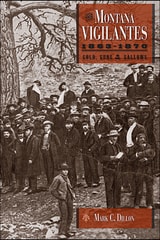
Montana Vigilantes 1863–1870
Gold,Guns and GallowsMark C. Dillon
Utah State University Press, 2016
Using newspaper articles, diaries, letters, biographies, invoices, and books that speak to the compelling history of Montana’s vigilantism in the 1860s, Dillon examines the conduct of the vigilantes in the context of the due process norms of the time. He implicates the influence of lawyers and judges who, like their non-lawyer counterparts, shaped history during the rush to earn fortunes in gold.
Dillon’s perspective as a state Supreme Court justice and legal historian uniquely illuminates the intersection of territorial politics, constitutional issues, corrupt law enforcement, and the basic need of citizenry for social order. This readable and well-directed analysis of the social and legal context that contributed to the rise of Montana vigilante groups will be of interest to scholars and general readers interested in Western history, law, and criminal justice for years to come.

Reducing Firearm Injury and Death
A Public Health Sourcebook on GunsTrudy A. Karlson
Rutgers University Press, 1997
There are few issues more explosive than guns. "Guns don't kill people, people kill people," is an often-heard response to calls for firearm control. But are there ways to make guns safer without placing further restrictions on gun owners? Can guns be engineered to reduce the number and severity of injuries?
This book is about guns and new solutions for addressing problems they create. Trudy Karlson and Stephen Hargarten, two experts in public health and injury control, show readers how guns are products, designed to injure and kill, and how changes in the design, technology, and marketing of firearms can lead to reductions in the number of injuries and fatalities.
Just as innovations in the design and technology of motor vehicles succeeded in creating safer cars, Karlson and Hargarten describe how responsible changes to gun products can reduce the number of serious injuries and fatalities. The injury control perspective illustrates how the characteristics of guns and ammunition are associated with their ability to cause injury and death. It also provides options for how guns can be re-engineered to ensure a greater degree of safety and protection. Reducing Firearm Injury and Death teaches basic facts about guns and gun injuries, and by reframing the problem of firearms as a public health issue, offers hope for saving lives.

Rhetoric and Guns
Lydia Wilkes
Utah State University Press, 2021
Guns hold a complex place in American culture. Over 30,000 Americans die each year from gun violence, and guns are intimately connected to issues of public health, as is evident whenever a mass shooting occurs. But guns also play an important role in many Americans’ lives that is not reducible to violence and death—as tools, sporting equipment, and identity markers. They are also central to debates about constitutional rights, as seen in ongoing discussions about the Second Amendment, and they are a continuous source of legislative concern, as apparent in annual ratings of gun-supporting legislators.
Even as guns are wrapped up with other crucial areas of concern, they are also fundamentally a rhetorical concern. Guns and gun violence occupy a unique rhetorical space in the United States, one characterized by silent majorities, like most gun owners; vocal minorities, like the firearm industry and gun lobby; and a stalemate that fails to stem the flood of the dead. How Americans talk, deliberate, and fight about guns is vital to how guns are marketed, used, and regulated. A better understanding of the rhetorics of guns and gun violence can help Americans make better arguments about them in the world. However, where guns are concerned, rhetorical studies is not terribly different from American culture more generally. Guns are ever-present and exercise powerful effects, but they are commonly talked about in oblique, unsystematic ways.
Rhetoric and Guns advances more direct, systematic engagement in the field and beyond by analyzing rhetoric about guns, guns in rhetoric, and guns as rhetoric, particularly as they relate to specific instances of guns in culture. The authors attempt to understand rhetoric’s relationship to guns by analyzing rhetoric about guns and how they function in and as rhetoric related to specific instances—in media coverage, political speech, marketing, and advertising. Original chapters from scholars in rhetorical studies, communication, education, and related fields elucidate how rhetoric is used to maintain and challenge the deadly status quo of gun violence in the United States and extend rhetoricians’ sustained interest in the fields’ relationships to violence, brutality, and atrocity.
Contributors: Ira J. Allen, Brian Ballentine, Matthew Boedy, Peter Buck, Lisa Corrigan, Rosa Eberly, Kendall Gerdes, Ian E. J. Hill, Nathalie Kuriowa-Lewis, Patricia Roberts-Miller, Craig Rood, Bradley Serber, Catherine R. Squires, Scott Gage
Silencing the Guns in Haiti
The Promise of Deliberative DemocracyIrwin P. Stotzky
University of Chicago Press, 1997
"A provocative study of the prospects for the rule of law in Haiti."—Marilyn Bowden, Miami Today
"[Stotzky] deepens insights into the contradictory obstacles to democratic governance in Haiti."—Library Journal
"Controversial and stimulating."—Choice
"Lucid and informative. . . . Stotzky gives readers a good foundation for understanding the pressures facing the impoverished but determined Caribbean island."—Islands