Results by title
3 books match the query 'Habit'
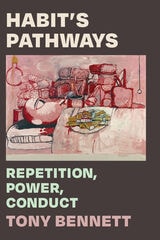
Habit's Pathways
Repetition, Power, ConductTony Bennett
Duke University Press, 2023
Habit has long preoccupied a wide range of theologians, philosophers, sociologists, psychologists, and neuroscientists. In Habit’s Pathways Tony Bennett explores the political consequences of the varied ways in which habit’s repetitions have been acted on to guide or direct conduct. Bennett considers habit’s uses and effects across the monastic regimens of medieval Europe, in plantation slavery and the factory system, through colonial forms of rule, and within a range of medicalized pathologies. He brings these episodes in habit’s political histories to bear on contemporary debates ranging from its role in relation to the politics of white supremacy to the digital harvesting of habits in practices of algorithmic governance. Throughout, Bennett tracks how habit’s repetitions have been articulated differently across divisions of class, race, and gender, demonstrating that although habit serves as an apparatus for achieving success, self-fulfillment, and freedom for the powerful, it has simultaneously served as a means of control over women, racialized peoples, and subordinate classes.
[more]
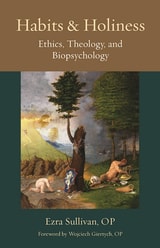
Habits and Holiness
Ethics, Theology, and BiopsychologyEzra, OP Sullivan
Catholic University of America Press, 2021
The topic of habitus is one of Thomas Aquinas’s greatest contributions to moral theology, but it has been generally neglected in theological scholarship until now. Habits and Holiness is the first work in English to explore Aquinas’s rich theology of habit in all of its grandeur and depth. Habits and Holiness shows that most facets of human life and behavior are greatly influenced by habits, which Thomas appraises as an analogous concept that is much broader than previous scholarship has recognized.
Habits and Holiness accomplishes three tasks. First, it gives a complete and coherent account of Aquinas’s account of habitus. Most accounts of Aquinas’s view of habitus focus almost exclusively on “Treatise on Habits” in the Summa Theologiae I-II, qq. 49-54, and speak of habitus in reference to the virtues. However, Aquinas speaks of habitus in many other places, especially his commentaries on Aristotle’s works and his commentaries on Sacred Scripture. Aquinas employs the concept of habitus to explain a wide variety of human inclinations, such as instincts, personal and societal custom, acquired skills and virtues, original sin, grace, infused virtues, and Gifts of the Holy Spirit. Second, this book indicates how biological psychology illuminates and enriches Aquinas’s account of habit, and vice versa. Finally, Habits and Holiness provides readers with a framework for interpreting and utilizing the vast amount of practical habit literature that exists: it offers a practical analysis of habit development found in Aquinas’s works and those of empirical studies.
The topic of habits is a golden thread that helps readers find their way through Aquinas’s extensive writings on morals. By describing the many kinds of habits we possess, and their widespread but often hidden effects in our lives, this book offers a new and unique reevaluation of many issues central to the moral life. It addresses childhood development, pagan virtue, akrasia, circumstances that limit free choice, how heroic virtue operates, and more.
By seeing habits in general as a prism for understanding human action and its influences, Habits and Holiness provides a unique and appealing synthesis of Thomistic virtue theory, the contemporary science of habits, and best practices for eliminating bad habits and living good habits.
[more]
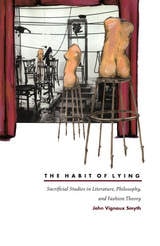
The Habit of Lying
Sacrificial Studies in Literature, Philosophy, and Fashion TheoryJohn Vignaux Smyth
Duke University Press, 2002
Lying appears to be ubiquitous, what Franz Kafka called "a universal principle”; yet, despite a number of recent books on the subject, it has been given comparatively little genuinely systematic attention by philosophers, social scientists, or even literary theorists. In The Habit of Lying John Vignaux Smyth examines three forms of falsification—lying, concealment, and fiction—and makes a strong critique of traditional approaches to each of them, and, above all, to the relations among them.
With recourse to Rene Girard, Paul de Man, Theodor Adorno, Leo Strauss, and other theoreticians not usually considered together, Smyth arrives at some surprising conclusions about the connections between lying, mimesis, sacrifice, sadomasochism, and the sacred, among other central subjects. Arguing that the relation between lying and truthtelling has been characterized in the West by sharply sacrificial features, he begins with a critique of the philosophies of lying espoused by Kant and Sissela Bok, then concludes that the problem of truth and lies leads to the further problem of the relation between law and arbitrariness as well as to the relation between rationality and unanimity. Constructively criticizing the work of such philosophers as Bertrand Russell, Ludwig Wittgenstein, Richard Rorty, and Nelson Goodman, Smyth shows how these problems occur comparably in fiction theory and how Paul de Man’s definition of fiction as arbitrariness finds confirmation in analytic philosophy. Through the novels of Defoe, Stendhal, and Beckett—with topics ranging from Defoe’s treatment of lies, fiction, and obscenity to Beckett’s treatment of the anus and the sacred—Smyth demonstrates how these texts generalize the issues of mendacity, concealment, and sacrificial arbitrariness in Girard’s sense to almost every aspect of experience, fiction theory, and cultural life. The final section of the book, taking its cue from Shakespeare, elaborates a sacrificial view of the history of fashion and dress concealment.
With recourse to Rene Girard, Paul de Man, Theodor Adorno, Leo Strauss, and other theoreticians not usually considered together, Smyth arrives at some surprising conclusions about the connections between lying, mimesis, sacrifice, sadomasochism, and the sacred, among other central subjects. Arguing that the relation between lying and truthtelling has been characterized in the West by sharply sacrificial features, he begins with a critique of the philosophies of lying espoused by Kant and Sissela Bok, then concludes that the problem of truth and lies leads to the further problem of the relation between law and arbitrariness as well as to the relation between rationality and unanimity. Constructively criticizing the work of such philosophers as Bertrand Russell, Ludwig Wittgenstein, Richard Rorty, and Nelson Goodman, Smyth shows how these problems occur comparably in fiction theory and how Paul de Man’s definition of fiction as arbitrariness finds confirmation in analytic philosophy. Through the novels of Defoe, Stendhal, and Beckett—with topics ranging from Defoe’s treatment of lies, fiction, and obscenity to Beckett’s treatment of the anus and the sacred—Smyth demonstrates how these texts generalize the issues of mendacity, concealment, and sacrificial arbitrariness in Girard’s sense to almost every aspect of experience, fiction theory, and cultural life. The final section of the book, taking its cue from Shakespeare, elaborates a sacrificial view of the history of fashion and dress concealment.
[more]