Results by title
11 books match the query 'Hamlet'
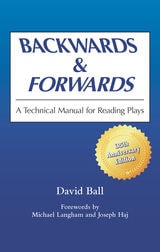
Backwards & Forwards
A Technical Manual for Reading PlaysDavid Ball. Forewords by Michael Langham and Joseph Haj
Southern Illinois University Press, 1983
The best-selling script analysis book for thirty-five years
Considered an essential text since its publication thirty-five years ago, this guide for students and practitioners of both theater and literature complements, rather than contradicts or repeats, traditional methods of literary analysis of scripts.
Ball developed his method during his work as literary director at the Guthrie Theater, building his guide on the crafts playwrights of every period and style use to make their plays stageworthy. The text is full of tools for students and practitioners to use as they investigate plot, character, theme, exposition, imagery, conflict, theatricality, and the other crucial parts of the superstructure of a play. Also included are guides for discovering what the playwright considers a play’ s most important elements, thus permitting interpretation based on the foundation of the play rather than its details.
Using Shakespeare’s Hamlet as illustration, Ball assures a familiar base for clarifying script-reading techniques as well as exemplifying the kinds of misinterpretation readers can fall prey to by ignoring the craft of the playwright. Of immense utility to those who want to put plays on the stage (actors, directors, designers, production specialists) Backwards & Forwards is also a fine playwriting manual because the structures it describes are the primary tools of the playwright.
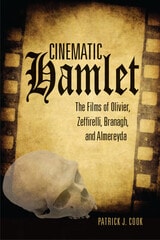
Cinematic Hamlet
The Films of Olivier, Zeffirelli, Branagh, and AlmereydaPatrick J. Cook
Ohio University Press, 2011
Hamlet has inspired four outstanding film adaptations that continue to delight a wide and varied audience and to offer provocative new interpretations of Shakespeare’s most popular play. Cinematic Hamlet contains the first scene-by-scene analysis of the methods used by Laurence Olivier, Franco Zeffirelli, Kenneth Branagh, and Michael Almereyda to translate Hamlet into highly distinctive and remarkably effective films.
Applying recent developments in neuroscience and psychology, Patrick J. Cook argues that film is a medium deploying an abundance of devices whose task it is to direct attention away from the film’s viewing processes and toward the object represented. Through careful analysis of each film’s devices, he explores the ways in which four brilliant directors rework the play into a radically different medium, engaging the viewer through powerful instinctive drives and creating audiovisual vehicles that support and complement Shakespeare’s words and story.
Cinematic Hamlet will prove to be indispensable for anyone wishing to understand how these films rework Shakespeare into the powerful medium of film.

Figurative Design in Hamlet
The Significance of the Dumb ShowLee Sheridan Cox
The Ohio State University Press, 1900
Forms of Attention
Botticelli and HamletFrank Kermode
University of Chicago Press, 2011
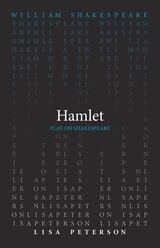
Hamlet
William Shakespeare
Arizona Center for Medieval and Renaissance Studies, 2021
Lovers of Shakespeare’s language take heart: Lisa Peterson’s translation of Hamlet into contemporary American English was guided by the principle of “First, do no harm.” Leaving the most famous parts of Hamlet untouched, Peterson untied the language knots that can make the rest of the play difficult to understand in a single theatrical viewing. Peterson’s translation makes Hamlet accessible to new audiences, drawing out its timeless themes while helping to contextualize "To be, or not to be: that is the question," and “Something is rotten in the state of Denmark,” so that contemporary audiences can feel their full weight.
This translation of Hamlet was written as part of the Oregon Shakespeare Festival’s Play On! project, which commissioned new translations of thirty-nine Shakespeare plays. These translations present work from "The Bard" in language accessible to modern audiences while never losing the beauty of Shakespeare’s verse. Enlisting the talents of a diverse group of contemporary playwrights, screenwriters, and dramaturges from diverse backgrounds, this project reenvisions Shakespeare for the twenty-first century. These volumes make these works available for the first time in print—a new First Folio for a new era.
Hamlet
shakespeare
St. Augustine's Press, 2024
This edition is the first that treats Hamlet as the work of a philosophical poet concerned with knowing the nature of the world, particularly the human world. Where conventional editions lift the play out of its specific setting and analyze it in the light of the social, cultural, and political circumstances of Elizabethan England, Jan Blits takes the play’s dramatic setting of early Renaissance Denmark as indispensable to understanding its rich meaning. In providing notations and commentary on Hamlet, Blits sets aside the historicist principle or prejudice, pervasive throughout literary studies today. Blits, by contrast, strives to understand the play entirely on its own terms. He inflicts no literary or philosophic theory—no parochial professional preconceptions—upon the play. Instead, he aims to be fully receptive to what Shakespeare wrote and try to draw out of the play the substance that he deliberately put into it. His treatment of Horatio is particularly stunning in this regard.
Though they differ from each other, there are two generally trustworthy texts of Hamlet—namely, the Second Quarto (1604–5) and the Folio (1623). Blits does not consult the First Quarto (1603), which contains a much different dialogue, some different character names, and omits some famous passages. Blits points out important variations and refrains from pronouncing which are clearly right or wrong. He omits references to secondary works (including his own) as distractions from the play itself. The Bibliography lists many primary and secondary readings that readers will find helpful. He follows the line-numbering of the New Cambridge Shakespeare Edition, edited by Philips Edwards.
Teachers and students of Shakespeare will find a valuable resource in Blits' new edition of Hamlet, which brings readers as close to the mind and heart of the real Shakespeare as possible and remains untouched by the fingerprints of literary theory and other mechanisms unknown and inconsequential to Shakespeare. This is also an indispensable tool in helping teachers in one of the greatest challenges of the classical classroom––namely, how to teach Shakespeare?

Hamlet Vocation Coleridge And Wordsworth
Martin Greenberg
University of Iowa Press, 1986
Hamletics
Shakespeare, Kafka, BeckettMassimo Cacciari
Seagull Books, 2023
During the dramatic course of the twentieth century, amid the clash of the titans which marked that era, humanity could still think in terms of partisan struggles in which large masses took sides against one another. The new millennium, by contrast, appears to have opened under the guise of generalized insecurity, which pertains not only to the historical and social situation, or to one’s personal psychological predicament, but to our very being. The Earth’s current faltering and the twilight of every convention that might govern it—where roles, images, and languages become confused by a lack of direction and distance—were already powerfully prophesied in Shakespeare’s Hamlet, and later in the works of Kafka and Beckett. In Hamletics, Massimo Cacciari, one of Italy’s foremost philosophers and leftist political figures, establishes a dialogue between these fateful authors, exploring the relationship between European nihilism and the aporias of action in the present.
Modern Hamlets & Soliloquies
An Expanded EditionMary Z. Maher
University of Iowa Press, 2003
In Modern Hamlets and Their Soliloquies (Iowa, 1992), Mary Maher examined how modern actors have chosen to perform Hamlet’s soliloquies, and why they made the choices they made, within the context of their specific productions of the play.
Adding to original interviews with, among others, Derek Jacobi, David Warner, Kevin Kline, and Ben Kingsley, Modern Hamlets and Their Soliloquies: An Expanded Edition offers two new and insightful interviews, one with Kenneth Branagh, focusing on his 1997 film production of the play, and one with Simon Russell Beale, discussing his 2000-2001 run as Hamlet at the Royal National Theatre.

San Francisco, 1846-1856
From Hamlet to CityRoger W. Lotchin
University of Illinois Press, 1997
Now back in print with a new introduction by the author, this is the classic study of America's most admired instant city, from its days as a sleepy Mexican village, through the Gold Rush and into its establishment as a major international port. Roger Lotchin examines the urbanizing influences in San Francisco and compares these to other urban centers, doing so against a colorful backdrop of opium dens and other sinful institutions.
The Vanishing
Shakespeare, the Subject, and Early Modern CultureChristopher Pye
Duke University Press, 2000
Pye explores the emergence of the early modern subject in terms of a range of subjectivizing mechanisms tied to the birth of a modern conception of history, one that is structured around a spatial and temporal horizon—a vanishing point. He also discusses the distinctly economic character of early modern subjectivity and how this, too, is implicated in our own modern modes of historical understanding. After explaining how the aims of New Historicist and Foucauldian approaches to the Renaissance are inseparably linked to such a historical conception, Pye demonstrates how the early modern subject can be understood in terms of a Lacanian and Zizekian account of the emerging social sphere. By focusing on the Renaissance as a period of remarkable artistic and cultural production, he is able to illustrate his points with discussions of a number of uniquely fascinating topics—for instance, how demonism was intimately related to a significant shift in law and symbolic order and how there existed at the time a “demonic” preoccupation with certain erotic dimensions of the emergent social subject.
Highly sophisticated and elegantly crafted, The Vanishing will be of interest to students of Shakespeare and early modern culture, Renaissance visual art, and cultural and psychoanalytic theory.