Results by title
6 books match the query 'Hardt, Michael'
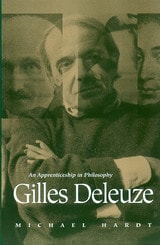
Gilles Deleuze
An Apprenticeship in PhilosophyMichael Hardt
University of Minnesota Press, 1993
The key to understanding Deleuze's complete body of work.
"A coherent and systematic reading of a philosopher who has consistently courted the incoherent and systematic. What we must avoid are encounters with those who cultivate sad passions (the men of ressentiment in the Nietzschean formulation); and we must increase our power to compose new relationships with compatible bodies with whom we share a common notion. Hardt's exceptional book is one such joyful encounter." -Times Literary Supplement"An excellent book. The project of Gilles Deleuze is to situate Deleuze squarely in the camp of those who seek to deepen and transform our philsophical understanding and political situation. Hardt seems to me to be directly on target." -Substance"Both for its object and its method of study, here is a work that will mark the future of the field of Deleuzian studies." -Eric Alliez, Critique"Hardt's reading of Deleuze is complex and precise. He follows the intricacies of the argument and of the shifting positions with considerable skill, thus providing us with a study not only of the Deleuzian way of doing philosophy, but of Deleuzian reading-of the selectivity of its targets, of its agonistic approach to philosophy, through indirect attack on one main opponent. Reading Hardt reading Deleuze reading, we can understand, for instance, why Deleuze's exposition usually takes the form not of a dialectic but of a correlation, of a system of differences." -Radical Philosophy"How can we forget the dialectic? How an we affirm a constitutive ontology? Through its efforts to respond to these questions, Gilles Deleuze's philosophical apprenticeship presents the Bildungsroman of any contemporary philosophy that wants to break away from the destiny of modernity. Michael Hardt unravels the guiding thread of this philosophy of the future." -Antonio Negri"Hardt's interpretations are exceptionally well-grounded in the history of philosophical discourse, a discourse he exercises with discipline and rare insight. As the only major work on Deleuze in English, this book will undoubtedly set the standard for any future study of one of France's most important thinkers-and it is a very high standard, indeed." -Peggy Kamuf
Labor Of Dionysus
A Critique of the State-FormMichael Hardt
University of Minnesota Press, 1994
“Labor is the living, form-giving fire,” Marx wrote. “It is the transitoriness of things, their temporality, as their transformation by living time.” How is it, then, that labor, with all its life-affirming potential, has become the means of capitalist discipline, exploitation, and domination in modern society? The authors expose and pursue this paradox through a systematic analysis of the role of labor in the processes of capitalist production and in the establishment of capitalist legal and social institutions. Critiquing liberal and socialist notions of labor and institutional reform from a radical democratic perspective, Hardt and Negri challenge the state-form itself.
In the twentieth century, labor has become central to the material and formal constitution of the State, as a complex nexus of value and right. And yet, in living labor and social cooperation, which cut across the divisions of workdays and wage relations, the authors identify a total critique of capitalist practice as well, presenting not only the negation of the present social order but also the affirmation of an alternative system of value, norms, and desires. The forms in which this potential is expressed, from the social movements of the 1960s to those of the 1990s, are the “prerequisites of communism” already existing in contemporary society.
Language and Death
The Place of NegativityGiorgio Agamben
University of Minnesota Press, 2006

October!
The Soviet CentenaryMichael Hardt and Sandro Mezzadra, special issue editors
Duke University Press, 2017
Contributors. Giso Amendola, Martín Bergel, Kathy Ferguson, Michael Hardt, Wang Hui, Artemy Magun, John MacKay, Sandro Mezzadra, Antonio Negri, Enzo Traverso
Radical Thought in Italy
A Potential PoliticsPaolo Virno
University of Minnesota Press, 2006
The Cultural Logic of Late Capitalism
The Postmodernism EssayFredric Jameson. Introduction by Michael Hardt.
Duke University Press, 2026