Results by title
12 books match the query 'Hardy, Thomas'
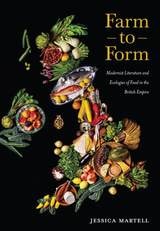
Farm to Form
Modernist Literature and Ecologies of Food in the British EmpireJessica Martell
University of Nevada Press, 2020
Deeply informed by Martell’s extensive knowledge of modern British, Irish, American, and World Literatures, this progressive work positions modernism as central to the study of narratives of resistance against social and environmental degradation. Analyzed works include those of Thomas Hardy, E. M. Forster, Virginia Woolf, Joseph Conrad, George Russell, and James Joyce.
In light of climate change, fossil fuel supremacy, nutritional dearth, and other pressing food issues, modernist texts bring to life an era of crisis and anxiety similar to our own. In doing so, Martell summons the past as a way to employ the modernist term of “defamiliarizing” the present so that entrenched perceptions can be challenged. Our current food regime is both new and constantly evolving with the first industrial food trades. Studying earlier cultural responses to them invites us to return to persistent problems with new insights and renewed passion.

First Love
The Affections of Modern FictionMaria DiBattista
University of Chicago Press, 1991
DiBattista argues that modernity reinvented First Love as a myth of creative initiative, as its characteristic response to a pervasive sense of historical belatedness. Anxious that its own creations can never be more than diminished forms of mightier originals, modernity idolizes First Love as the beginning that can never be repeated. First Love hence epitomizes the dream of a new self-incarnation. From Turgenev's First Love to the formative works of Virginia Woolf, Gertrude Stein, E. M. Forster, and Vladimir Nabokov, First Love confirms the birth of an artistic vocation. For modern men and women intent on becoming the original authors of their own lives, First Love becomes paradigmatic of those life-altering moments that transform the undifferentiated sequence of days into a fateful narrative.
DiBattista focuses on the enunciation of First Love in the fiction of Thomas Hardy, D. H. Lawrence, James Joyce, and Samuel Beckett. In reading their works, DiBattista dramatically revises the accepted view of irony as the dominant tone of modernism. First Love constitutes, she shows, a new apprehension of the world characterized not by the frigid distances of irony but by a belief in the creative individual who may begin the world anew, as if for the first time.
Imagining Minds
The Neuro-Aesthetics of Austen, Eliot, and HardyKay Young
The Ohio State University Press, 2010
Narrating Trauma
Victorian Novels and Modern Stress DisordersGretchen Braun
The Ohio State University Press, 2022
Pregnancy in the Victorian Novel
Livia Arndal Woods
The Ohio State University Press, 2023
In Pregnancy in the Victorian Novel—the first book-length study of the topic—Livia Arndal Woods traces the connections between literary treatments of pregnancy and the medicalization of pregnancy and childbirth occurring over the long nineteenth century. Woods uses the problem of pregnancy in the Victorian novel (in which pregnancy is treated modestly as a rule and only rarely as an embodied experience) to advocate for “somatic reading,” a practice attuned to impressions of the body on the page and in our own messy lived experiences.
Examining works by Emily Brontë, Charlotte Mary Yonge, Anthony Trollope, George Eliot, Thomas Hardy and others, Woods considers instances of pregnancy that are tied to representations of immodesty, poverty, and medical diagnosis. These representations, Woods argues, should be understood in the arc of Anglo-American modernity and its aftershocks, connecting backward to early modern witch trials and forward to the criminalization of women for pregnancy outcomes in twenty-first-century America. Ultimately, she makes the case that by clearing space for the personal and anecdotal in scholarship, somatic reading helps us analyze with uncertainty rather than against it and allows for richer and more relevant textual interpretation.
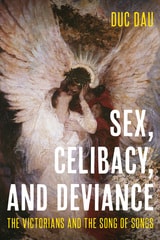
Sex, Celibacy, and Deviance
The Victorians and the Song of SongsDuc Dau
The Ohio State University Press, 2024
Sex, Celibacy, and Deviance is the first major study to explore the Song of Songs (or Song of Solomon) in Victorian literature and art. As the Bible’s only erotic poem, the Song of Songs is the canonical Judeo-Christian book about love, furnishing the Victorians with an authoritative and literary language for love, marriage, sex, mourning, and religious celibacy.
Duc Dau adopts a queer and feminist lens to consider how Victorians employed and interpreted the Song of Songs in their work. How did writers and artists fashion and, most importantly, challenge the norms of gender, romantic love, and marriage? Spanning the early Victorian era through the first two decades of the twentieth century, Sex, Celibacy, and Deviance considers the works of Charlotte Brontë, Thomas Hardy, Christina Rossetti, John Gray, Michael Field, Edward Burne-Jones, and Simeon Solomon alongside two lesser-known figures: Irish-born Scottish artist Phoebe Anna Traquair and the Catholic religious leader Augusta Theodosia Drane. By addressing the relevance of the Song of Songs in light of shifting and conflicting religious and social contexts, Dau provides a fresh perspective on Victorian literature, religion, and culture.
The Age of Eclecticism
Literature and Culture in Britain, 1815–1885Christine Bolus-Reichert
The Ohio State University Press, 2009
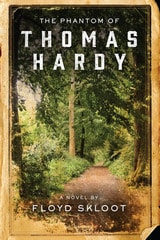
The Phantom of Thomas Hardy
Floyd Skloot
University of Wisconsin Press, 2016
In this imaginative novel, worlds continue to collide as Floyd, an American writer recovering from a devastating neuro-viral attack, and his wife, Beverly, immerse themselves in Hardy’s world. While pondering the enigma of a fictional character living in a factual building, Floyd is approached by Hardy himself—despite his death in 1928.
This phantom—possibly conjured out of Floyd’s damaged brain—tasks the Americans with finding out what Hardy missed in love. Embarking on their quest, they visit Hardy’s birthplace, home, and grave, exploring the Dorset landscape and the famous novels with their themes of tormented love. Peering into the Victorian past, they slowly dismantle the clutter of screens that Hardy placed around his private life, even as their own love story unfolds, filled with healing and hope.

Thomas Hardy'S Tragic Poetry
The Lyrics And The DynastsKatherine K. Maynard
University of Iowa Press, 1991
Contrary to some scholars, tragic poetry did not die with the rise of melodrama in nineteenth-century theater or the glowing secularism spread by the proliferation of liberal-scientific philosophies. Rather, artists found alternative means to portray tragic situations.Thomas Hardy's Tragic Poetry convincingly argues that Hardy's lyric poetry and The Dynasts occupy a pivotal place in the development of modern tragic poetry and drama, crystallizing the tragic feeling that surfaces intermittently in Romantic and Victorian poems and plays.
Many scholars have noted the tragic forms and themes of Thomas Hardy's novels, but the tragic quality of his lyric poems has received less critical attention. Katherine Maynard remedies that situation by tracing the emergence of the Hardyean figure—tragically isolated against the backdrop of a stark landscape, neutral universe, or indifferent social milieu—through both a review of critical opinion about tragedy's place within modern literature and a survey of the frustrated attempts by major nineteenth-century poets to write tragic drama. Hardy's epic-drama The Dynasts is seen as a fulcrum work, bearing many of the flaws of its dramatic forebears but also illustrating his use of contemporary science and philosophy in the service of dramatic irony. Maynard examines a significant sample of lyrics to identify the contribution of Hardy's poetry to our understanding of tragic literature. She places the thematic and formal innovations of Hardy's tragic poetry squarely within the main lines of development from Wordsworth's Solitary to Beckett's lone figures waiting in a desert for a Godot who never arrives.
Ultimately, Thomas Hardy's Tragic Poetry calls for a rereading of Hardy's poetry as "tragic," arguing that he was able, paradoxically, to incorporate these literary and philosophical conventions of his time which some critics insist signaled the death of tragic literature. This study will prove fascinating for Hardyists, students of nineteenth-century literature, and all those interested in the ongoing development of poetry.
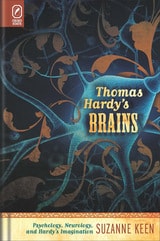
Thomas Hardy's Brains
Psychology, Neurology, and Hardy's ImaginationSuzanne Keen
The Ohio State University Press, 2014
This study reveals how Hardy made sense of diverse sources of an affective human psychology, a discipline that expanded significantly during Hardy’s working life. From the 1870s to the turn of the twentieth century, the tools and techniques for studying the structures and function of the nervous system developed rapidly. Simultaneously, Hardy moved steadily toward realizing a more physiologically accurate rendering of brains and nerves.
Towards the Ethics of Form in Fiction
Narratives of Cultural RemissionLeona Toker
The Ohio State University Press, 2010
Toker is especially interested in cultural remissions such as the carnivalesque—that is, the inverting of standard cultural hierarchies or the blurring of boundaries between normally separated social groups, actors and audiences, self and other. She argues that cultural remissions have the potential not simply to provide a break from the determinacies of our quotidian existence but also to return us to that existence with some alteration of our perceptions, beliefs, and values. Toker contends that the ethical consequences of reading fiction result from features of its aesthetics, particularly what she calls, following the semiotician Louis Hjemslev, “the form of the content”—the patterns arising from the artistic deployment of narrative details. In addition to addressing the carnivalesque discourse of Bakhtin as well as the theory of oppositionality developed by de Certeau and Chambers, she puts theory into practice through detailed analyses of canonical texts by Fielding, Sterne, Austen, Hawthorne, Dickens, Conrad, Joyce, and other writers.
Victorian Lessons in Empathy and Difference
Rebecca N. Mitchell
The Ohio State University Press, 2011