Results by title
6 books match the query 'Harvest'

Feminist Organizations
Harvest of the New Women's Movementedited by Myra Marx Ferree and Patricia Yancey Martin
Temple University Press, 1995
This collection of twenty-six original essays looks at contemporary feminist organizations, how they've survived, the effects of their work, the problems they face, the strategies they develop, and where the women's movement is headed. The contributors, leading feminist scholars from nine social science disciplines, examine a wide variety of local feminist organizations, past and preset, illuminating the struggles of feminist organizers and activists.
In the series Women in the Political Economy, edited by Ronnie J. Steinberg.

Harvest of Blossoms
Poems from a Life Cut ShortSelma Meerbaum-Eisinger
Northwestern University Press, 2008

Harvest of Hazards
Family Farming, Accidents, and Expertise in the Corn Belt, 1940-1975Derek S. Oden
University of Iowa Press, 2017
In this study of the farm safety movement in the Corn Belt, historian Derek Oden examines why agriculture was so dangerous and why improvements were so difficult to achieve. Because farmers were self-employed business owners whose employees were mainly family members; because they lived far from aid such as hospitals and fire stations; and because they had to manage such a diverse array of new technologies, they could not easily adopt the workplace safety and public health reforms designed for factories and urban settings. In response, beginning in the 1940s, farmers and a new breed of farm safety specialists relied upon an increasingly elaborate educational campaign to lessen injuries and illnesses on the farm.
Several government, business, and nonprofit organizations—from the US Department of Agriculture to the National Safety Council and 4-H and the Future Farmers of America—worked together to publicize both the dangers of farming and the information farmers needed to stay safe while driving tractors, applying anhydrous ammonia, or repairing machinery. By the 1960s, however, the partnership began to break down, and by the 1970s the safety movement became increasingly contested as professional and policy divisions emerged. This groundbreaking study incorporates agriculture into the histories of occupational safety and public health.
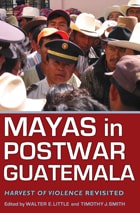
Mayas in Postwar Guatemala
Harvest of Violence RevisitedEdited by Walter E. Little and Timothy J. Smith
University of Alabama Press, 2009
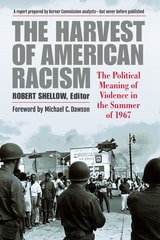
The Harvest of American Racism
The Political Meaning of Violence in the Summer of 1967Robert Shellow
University of Michigan Press, 2018
In the summer of 1967, in response to violent demonstrations that rocked 164 U.S. cities, the National Advisory Commission on Civil Disorders, a.k.a. the Kerner Commission, was formed. The Commission sought reasons for the disturbances, including the role that law enforcement played. Chief among its research projects was a study of 23 American cities, headed by social psychologist Robert Shellow. An early draft of the scientists’ analysis, titled “The Harvest of American Racism: The Political Meaning of Violence in the Summer of 1967,” provoked the Commission’s staff in November 1967 by uncovering political causes for the unrest; the team of researchers was fired, and the controversial report remained buried at the LBJ Presidential Library until now.
The first publication of the Harvest report half a century later reveals that many of the issues it describes are still with us, including how cities might more effectively and humanely react to groups and communities in protest. In addition to the complete text of the suppressed Harvest report, the book includes an introduction by Robert Shellow that provides useful historical context; personal recollections from four of the report’s surviving social scientists, Robert Shellow, David Boesel, Gary T. Marx, and David O. Sears; and an appendix outlining the differences between the unpublished Harvest analysis and the well-known Kerner Commission Report that followed it.
“The [Harvest of American Racism] report was rejected by Johnson administration functionaries as being far too radical—politically ‘unviable’… Social science can play an extremely positive role in fighting racial and other injustice and inequality, but only if it is matched with a powerful political will to implement the findings. That will has never come from within an American presidential administration—that will has only been forged in black and other radical communities’ movements for justice. The political power for change, as incremental as it has been, has come from within those communities. Washington responds, it does not lead."
—from the Foreword by Michael C. Dawson
Tomorrow We're All Going to the Harvest
Temporary Foreign Worker Programs and Neoliberal Political EconomyBy Leigh Binford
University of Texas Press, 2013
From its inception in 1966, the Canadian Seasonal Agricultural Worker Program (SAWP) has grown to employ approximately 20,000 workers annually, the majority from Mexico. The program has been hailed as a model that alleviates human rights concerns because, under contract, SAWP workers travel legally, receive health benefits, contribute to pensions, are represented by Canadian consular officials, and rate the program favorably. Tomorrow We’re All Going to the Harvest takes us behind the ideology and examines the daily lives of SAWP workers from Tlaxcala, Mexico (one of the leading sending states), observing the great personal and family price paid in order to experience a temporary rise in a standard of living. The book also observes the disparities of a gutted Mexican countryside versus the flourishing agriculture in Canada, where farm labor demand remains high.
Drawn from extensive surveys and nearly two hundred interviews, ethnographic work in Ontario (destination of over 77 percent of migrants in the author’s sample), and quantitative data, this is much more than a case study; it situates the Tlaxcala-Canada exchange within the broader issues of migration, economics, and cultural currents. Bringing to light the historical genesis of “complementary” labor markets and the contradictory positioning of Mexican government representatives, Leigh Binford also explores the language barriers and nonexistent worker networks in Canada, as well as the physical realities of the work itself, making this book a complete portrait of a provocative segment of migrant labor.