Results by title
62 books match the query 'Hawaii' and 9 start with a
A Chosen People, a Promised Land
Mormonism and Race in Hawai’iHokulani K. Aikau
University of Minnesota Press, 2012
Christianity figured prominently in the imperial and colonial exploitation and dispossession of indigenous peoples worldwide, yet many indigenous people embrace Christian faith as part of their cultural and ethnic identities. A Chosen People, a Promised Land gets to the heart of this contradiction by exploring how Native Hawaiian members of the Church of Jesus Christ of Latter-Day Saints (more commonly known as Mormons) understand and negotiate their place in this quintessentially American religion.
Mormon missionaries arrived in Hawai‘i in 1850, a mere twenty years after Joseph Smith founded the church. Hokulani K. Aikau traces how Native Hawaiians became integrated into the religious doctrine of the church as a “chosen people”—even at a time when exclusionary racial policies regarding black members of the church were being codified. Aikau shows how Hawaiians and other Polynesian saints came to be considered chosen and how they were able to use their venerated status toward their own spiritual, cultural, and pragmatic ends.
Using the words of Native Hawaiian Latter-Day Saints to illuminate the intersections of race, colonization, and religion, A Chosen People, a Promised Land examines Polynesian Mormon articulations of faith and identity within a larger political context of self-determination.
Aina Hanau / Birth Land
Brandy Nalani McDougall
University of Arizona Press, 2023
‘Āina Hānau / Birth Land is a powerful collection of new poems by Kanaka ʻŌiwi (Native Hawaiian) poet Brandy Nālani McDougall. ‘Āina hānau—or the land of one’s birth—signifies identity through intimate and familial connections to place and creates a profound bond between the people in a community. McDougall’s poems flow seamlessly between ‘Ōlelo Hawai‘i and English, forming rhythms and patterns that impress on the reader a deep understanding of the land. Tracing flows from the mountains to the ocean, from the sky to the earth, and from ancestor to mother to child, these poems are rooted in the rich ancestral and contemporary literature of Hawaiʻi —moʻolelo, moʻokūʻauhau, and mele —honoring Hawaiian ʻāina, culture, language, histories, aesthetics, and futures.
The poems in Āina Hānau / Birth Land cycle through sacred and personal narratives while exposing and fighting ongoing American imperialism, settler colonialism, militarism, and social and environmental injustice to protect the ʻāina and its people. The ongoing environmental crisis in Hawaiʻi, inextricably linked to colonialism and tourism, is captured with stark intensity as McDougall writes, Violence is what we settle for / because we’ve been led to believe / green paper can feed us / more than green land. The experiences of birth, motherhood, miscarriage, and the power of Native Hawaiian traditions and self-advocacy in an often dismissive medical system is powerfully narrated by the speaker of the titular poem, written for McDougall’s daughters.
‘Āina Hānau reflects on what it means to be from and belong to an ʻāina hānau, as well as what it means to be an ‘āina hānau, as all mothers serve as the first birth lands for their children.
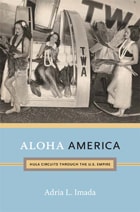
Aloha America
Hula Circuits through the U.S. EmpireAdria L. Imada
Duke University Press, 2012
At vaudeville theaters, international expositions, commercial nightclubs, and military bases, Hawaiian women acted as ambassadors of aloha, enabling Americans to imagine Hawai'i as feminine and benign, and the relation between colonizer and colonized as mutually desired. By the 1930s, Hawaiian culture, particularly its music and hula, had enormous promotional value. In the 1940s, thousands of U.S. soldiers and military personnel in Hawai'i were entertained by hula performances, many of which were filmed by military photographers. Yet, as Adria L. Imada shows, Hawaiians also used hula as a means of cultural survival and countercolonial political praxis. In Aloha America, Imada focuses on the years between the 1890s and the 1960s, examining little-known performances and films before turning to the present-day reappropriation of hula by the Hawaiian self-determination movement.
Aloha Betrayed
Native Hawaiian Resistance to American ColonialismNoenoe K. Silva
Duke University Press, 2004
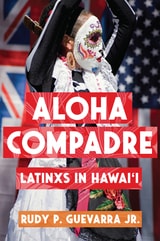
Aloha Compadre
Latinxs in Hawai'iRudy P. Guevarra
Rutgers University Press, 2023
Aloha Compadre: Latinxs in Hawaiʻi is the first book to examine the collective history and contemporary experiences of the Latinx population of Hawaiʻi. This study reveals that contrary to popular discourse, Latinx migration to Hawaiʻi is not a recent event. In the national memory of the United States, for example, the Latinx population of Hawaiʻi is often portrayed as recent arrivals and not as long-term historical communities with a presence that precedes the formation of statehood itself. Historically speaking, Latinxs have been voyaging to the Hawaiian Islands for over one hundred and ninety years. From the early 1830s to the present, they continue to help shape Hawaiʻi’s history, yet their contributions are often overlooked. Latinxs have been a part of the cultural landscape of Hawaiʻi prior to annexation, territorial status, and statehood in 1959. Aloha Compadre also explores the expanding boundaries of Latinx migration beyond the western hemisphere and into Oceania.
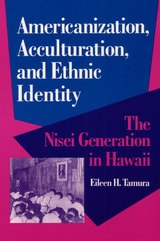
Americanization, Acculturation, and Ethnic Identity
The Nisei Generation in HawaiiEileen H. Tamura
University of Illinois Press, 1994
Wartime hysteria over "foreign" ways fueled a movement for Americanization that swept the United States during and after World War I. Eileen H. Tamura examines the forms that hysteria took in Hawai'i, where the Nisei (children of Japanese immigrants) were targets of widespread discrimination.
Tamura analyzes Hawaii's organized effort to force the Nisei to adopt "American" ways, discussing it within the larger phenomenon of Nisei acculturation. While racism was prevalent in "paradise," the Nisei and their parents also performed as active agents in their own lives, with the older generation attempting to maintain Japanese cultural ways and the younger wishing to become "true Americans." Caucasian "Americanizers," often associated with powerful agricultural interests, wanted labor to remain cheap and manageable; they lobbied for racist laws and territorial policies, portending the treatment of ethnic Japanese on the U.S. mainland during World War II.
Tamura offers a wealth of original source material, using personal accounts as well as statistical data to create an essential resource for students of American ethnic history and U.S. race and class relations.
Anahulu
The Anthropology of History in the Kingdom of Hawaii, Volume 1: Historical EthnographyPatrick Vinton Kirch and Marshall Sahlins
University of Chicago Press, 1992
Volume I shows the surprising effects of the encounter with the imperial forces of commerce and Christianity—the distinctive ways the Hawaiian people culturally organized the experience, from the structure of the kingdom to the daily life of ordinary people. Volume II examines the material record of changes in local social organization, economy and production, population, and domestic settlement arrangements.
Anahulu
The Anthropology of History in the Kingdom of Hawaii, Volume 2: The Archaeology of HistoryPatrick Vinton Kirch and Marshall Sahlins
University of Chicago Press, 1992
Volume 2, by Patrick V. Kirch, examines the material record of changes in local social organization, economy and production, population, and domestic settlement arrangements.
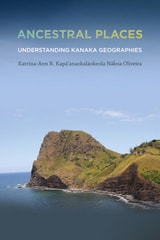
Ancestral Places
Understanding Kanaka GeographiesKatrina-Ann R. Kapa'anaokalaokeola Nakoa Oliveira
Oregon State University Press, 2014
Katrina-Ann R. Kapa‘anaokalaokeola Nakoa Oliveira elucidates a Kanaka geography and provides contemporary scholars with insights regarding traditional culture—including the ways in which Kanaka utilize cartographic performances to map our ancestral places and retain our mo‘olelo, such as reciting creation accounts, utilizing nuances embedded in language, and dancing hula.
A Kanaka by birth, a kumu ‘olelo Hawai‘i (language teacher) by profession, and a geographer by training, Oliveira’s interests intersect at the boundary where words and place-making meet her ancestral land. Thus, Ancestral Places imbues the theoretical with sensual practice. The book’s language moves fluidly between Hawaiian and English, terms are nimbly defined, and the work of the field is embodied: geographic layers are enacted within the text, new understandings created—not just among lexica, but amidst illustrations, charts, terms, and poetry.
In Ancestral Places, Oliveira reasserts both the validity of ancestral knowledge systems and their impact in modernity. Her discussion of Kanaka geographies encompasses the entire archipelago, offering a new framework in Kanaka epistemology.