Results by title
12 books match the query 'Hearing'
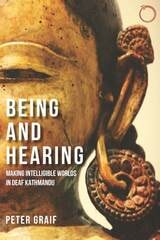
Being and Hearing
Making Intelligible Worlds in Deaf KathmanduPeter Graif
HAU, 2018
From pranks and protests, to diverse acts of love and resistance, to renewed distinctions between material and immaterial, deaf communities in Nepal have crafted ways to foreground the habits of perception that shape both their own experiences and how they are experienced by the hearing people around them. By exploring these often overlooked strategies, Being and Hearing makes a unique contribution to ethnography and comparative philosophy.
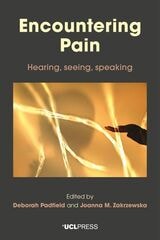
Encountering Pain
Hearing, Seeing, SpeakingEdited by Deborah Padfield and Joanna M. Zakrzewska
University College London, 2020
What is pain—and how do we communicate it? Persistent pain changes the brain and nervous system so that it can no longer warn of danger. However, despite being a major cause of disability globally, pain remains difficult to communicate. As language struggles to bridge the gap between those who suffer from pain and those who are trying to help, this book shares leading research into the potential value of visual images and non-verbal forms of communication as means of improving interactions between clinicians and their patients. Accompanied by vivid photographs co-created with those who live with pain, the volume integrates the voices of leading scientists, academics, and contemporary artists to provide a manual for understanding the meanings of pain for healthcare professionals, pain patients, students, academics, and artists.
Ethical Considerations in Educating Children Who Are Deaf or Hard of Hearing
Kathee Mangan Christensen
Gallaudet University Press, 2011
The education of deaf or hard of hearing children has become as complex as the varying needs of each individual child. Teachers face classrooms filled with students who are culturally Deaf, hard of hearing, or post-lingually deaf; they might use American Sign Language, cochlear implants, hearing aids/FM systems, speech, Signed English, sign-supported speech, contact signing, nonverbal communication, or some combination of methods. Educators who decide what tools are best for these children are making far-reaching ethical decisions in each case. This collection features ten chapters that work as constructive conversations to make the diverse needs of these deaf students the primary focus.
The initial essays establish fundamental points of ethical decision-making and emphasize that every situation should be examined not with regard for what is “right or wrong,” but for what is “useful.” Absolute objectivity is unattainable due to social influences, while “common knowledge” is ruled out in favor of “common awareness.” Other chapters deal with the reality of interpreting through the professional’s eyes, of how they are assessed, participate, and are valued in the total educational process, including mainstream environments. The various settings of education for deaf children are profiled, from residential schools to life in three cultures for deaf Latino students, to self-contained high school programs. Ethical Considerations in Educating Deaf Children Who Are Deaf or Hard of Hearing offers an invaluable set of guidelines for administrators and educators of children with hearing loss in virtually every environment in a postmodern world.

Four Days in Michigan
A NovelPhilip Zazove
Gallaudet University Press, 2012
As a young, deaf Jewish woman living in a small town in Michigan in 1942, Sandra Horowitz felt deeply frustrated by her limited prospects. Even though she had just graduated from junior college, she knew that she had two strikes against her in fulfilling her dream to become a veterinarian. Better to marry Jacob Winter, her parents urged her, a deaf Jewish man who made a good living. Then, Sandra met Rudy Townsend, a hearing soldier on leave before shipping out to the war in Europe.
In just four days, both Sandra and Rudy’s worlds were turned upside down. Sandra’s parents feared him for being hearing and a Gentile, while Rudy’s parents expressed openly their bias against her ethnic background and her deafness. Even so, Sandra and Rudy soon realized that they had fallen in love, deeply and passionately. As they shared the brief time they had together, they learned about each other’s dreams for the future — Sandra’s desire to be a vet and Rudy’s determination to serve in Congress. Then, Rudy had to leave for the war.
Philip Zazove’s novel Four Days in Michigan captures perfectly the power of irrepressible love between two individuals from opposite backgrounds. The struggles they encounter in an era when such differences were never more sharply drawn also reveal great detail about deaf and hearing life. Despite all, their triumph comes ultimately because of their long-lasting individual respect and love.
From Gesture to Language in Hearing and Deaf Children
Virginia Volterra
Gallaudet University Press, 1994
Renowned scholars contributing to this volume include Ursula Bellugi, Judy Snitzer Reilly, Susan Goldwin-Meadow, Andrew Lock, M. Chiara Levorato, and many others.
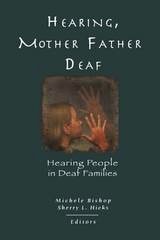
HEARING, MOTHER-FATHER DEAF
Hearing People in Deaf FamiliesMichele Bishop
Gallaudet University Press, 2009
The newest entry in the Sociolinguistics in Deaf Communities series explores the richness and complexity of the lives of hearing people in deaf families. Along with their own contributions, volume editors Michele Bishop and Sherry L. Hicks present the work of an extraordinary cadre of deaf, hearing, and Coda (children of deaf adults) researchers: Susan Adams, Jean Andrews, Oya Ataman, Anne E. Baker, Beppie van den Bogaerde , Helsa B. Borinstein, Karen Emmorey, Tamar H. Gollan, Mara Lúcia Masutti, Susan Mather, Ronice Müller de Quadros, Jemina Napier, Paul Preston, Jennie E. Pyers, Robin Thompson, and Andrea Wilhelm. Their findings represent research in a number of countries, including Australia, Brazil, England, Germany, the Netherlands, and the United States.
Hearing, Mother^Father Deaf: Hearing People in Deaf Families includes a comprehensive description of the societal influences at work in the lives of deaf people and their hearing children, which serves as a backdrop for the essays. The topics range from bimodal bilingualism in adults to cultural and linguistic behaviors of hearing children from deaf families; sign and spoken language contact phenomena; and to issues of self-expression, identity, and experience. A blend of data-based research and personal writings, the articles in this sociolinguistic study provide a thorough understanding of the varied experiences of hearing people and their deaf families throughout the world.
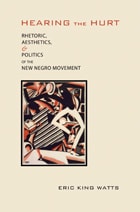
Hearing the Hurt
Rhetoric, Aesthetics, and Politics of the New Negro MovementEric King Watts
University of Alabama Press, 2012
Here for the Hearing
Analyzing the Music in Musical TheaterMichael Buchler and Gregory J. Decker, Editors
University of Michigan Press, 2023
Winner of the Society for Music Theory's Outstanding Multi-Author Collection Award
This book offers a series of essays that show the integrated role that musical structure (including harmony, melody, rhythm, meter, form, and musical association) plays in making sense of what transpires onstage in musicals. Written by a group of music analysts who care deeply about musical theater, this collection provides new understanding of how musicals are put together, how composers and lyricists structure words and music to complement one another, and how music helps us understand the human relationships and historical and social contexts. Using a wide range of musical examples, representing the history of musical theater from the 1920s to the present day, the book explores how music interacts with dramatic elements within individual shows and other pieces within and outside of the genre. These essays invite readers to consider issues that are fundamental both to our understanding of musical theater and to the multiple ways we engage with music.
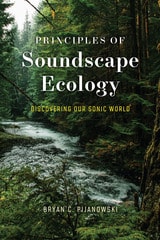
Principles of Soundscape Ecology
Discovering Our Sonic WorldBryan C. Pijanowski
University of Chicago Press, 2024
What do the sounds of a chorus of tropical birds and frogs, a clap of thunder, and a cacophony of urban traffic have in common? They are all components of a soundscape, acoustic environments that have been identified by scientists as a combination of the biophony, geophony, and anthrophony, respectively, of all of Earth’s sound sources. As sound is a ubiquitous occurrence in nature, it is actively sensed by most animals and is an important way for them to understand how their environment is changing. For humans, environmental sound is a major factor in creating a psychological sense of place, and many forms of sonic expression by people embed knowledge and culture. In this book, soundscape ecology pioneer Bryan C. Pijanowski presents the definitive text for both students and practitioners who are seeking to engage with this thrilling new field. Principles of Soundscape Ecology clearly outlines soundscape ecology’s critical foundations, key concepts, methods, and applications. Fundamentals include concise and valuable descriptions of the physics of sound as well as a thorough elucidation of all sounds that occur on Earth. Pijanowski also presents a rich overview of the ecological, sociocultural, and technical theories that support this new science, illustrating the breadth of this amazingly transdisciplinary field. In methods, he describes the principles of data mining, signal processing, and mixed methods approaches used to study soundscapes in ecological, social, or socio-ecological contexts. The final section focuses on terrestrial, aquatic, urban, and music applications, demonstrating soundscape ecology’s utility in nearly all spaces.
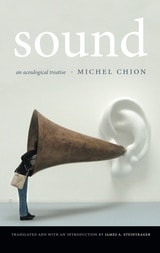
Sound
An Acoulogical TreatiseMichel Chion
Duke University Press, 2016
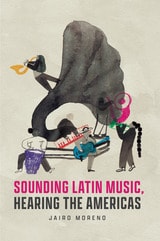
Sounding Latin Music, Hearing the Americas
Jairo Moreno
University of Chicago Press, 2023
Many in the United States believe Latin American musicians make “Latin music”—which carries with it a whole host of assumptions, definitions, and contradictions. In their own countries, these expatriate musicians might generate immense national pride or trigger suspicions of “national betrayals.” The making, sounding, and hearing of “Latin music” brings into being the complex array of concepts that constitute “Latin Americanism”—its fissures and paradoxes, but also its universal aspirations. Taking as its center musicians from or with declared roots in Latin America, Jairo Moreno presents us with an innovative analysis of how and why music emerges as a necessary but insufficient shorthand for defining and understanding Latin American, Latinx, and American experiences of modernity.
This close look at the growth of music-making by Latin American and Spanish-speaking musicians in the United States at the turn of the twenty-first century reveals diverging understandings of music’s social and political possibilities for participation and belonging. Through the stories of musicians—Rubén Blades, Shakira, Arturo O’Farrill and the Afro-Latin Jazz Orchestra, and Miguel Zenón—Sounding Latin Music, Hearing the Americas traces how artists use music to produce worlds and senses of the world at the ever-transforming conjunction of Latin America and the United States.
When Our Words Return
Writing, Hearing, and Remembering Oral Traditions from Alasak and the Yukonedited by Phyllis Morrow & William Schneider
Utah State University Press, 1995
The title to this interdisciplinary collection draws on the Yupik Eskimo belief that seals, fish, and other game are precious gifts that, when treated with respect and care, will return to be hunted again. Just so, if oral traditions are told faithfully and respectfully, they will return to benefit future generations. The contributors to this volume are concerned with the interpretation and representation of oral narrative and how it is shaped by its audience and the time, place, and cultural context of the narration. Thus, oral traditions are understood as a series of dialogues between tradition bearers and their listeners, including those who record, write, and interpret.