Results by title
27 books match the query 'Hell'
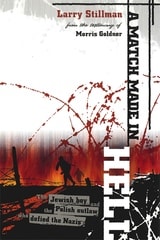
A Match Made in Hell
The Jewish Boy and the Polish Outlaw Who Defied the NazisLarry Stillman, from the testimony of Morris Goldner
University of Wisconsin Press, 2003
When Moniek (Morris) Goldner and his family were uprooted from their Polish farming village during a German action, the child-sized sixteen-year-old fled into the forests. He eventually met up with his father, who had also escaped, and together they managed to survive until a former friend betrayed the pair. Wounded and left for dead beneath his father’s murdered body, Goldner was rescued by the enigmatic outlaw Jan Kopec, who was also in hiding, looking for ways to profit from his criminal expertise.
For eighteen months Kopec hid the boy with him, moving from one area to another, often staying in hideouts he had fashioned years earlier. At first Kopec trained Goldner simply to serve as his accomplice in robberies and black market activities. But before long he pushed the training to a whole new level, making it possible for him to sell Goldner’s services to a shadowy resistance group which was becoming interested in the daring young saboteur.
And through it all, these two disparate personalities—the quiet, small-framed boy and the stocky, callous mercenary—forged an remarkable friendship and co-dependency born of need and desperation in a hellish time and place.
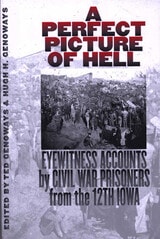
A Perfect Picture Of Hell
Eyewitness Accounts By Civil War Prisoners From 12Th IoTed Genoways
University of Iowa Press, 2000
From the shooting of an unarmed prisoner at Montgomery, Alabama, to a successful escape from Belle Isle, from the swelling floodwaters overtaking Cahaba Prison to the inferno that finally engulfed Andersonville, A Perfect Picture of Hell is a collection of harrowing narratives by soldiers from the 12th Iowa Infantry who survived imprisonment in the South during the Civil War.
Editors Ted Genoways and Hugh Genoways have collected the soldiers' startling accounts from diaries, letters, speeches, newspaper articles, and remembrances. Arranged chronologically, the eyewitness descriptions of the battles of Shiloh, Corinth, Jackson, and Tupelo, together with accompanying accounts of nearly every famous Confederate prison, create a shared vision
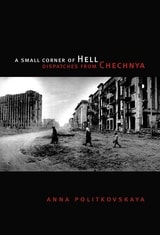
A Small Corner of Hell
Dispatches from ChechnyaAnna Politkovskaya
University of Chicago Press, 2003
Chechnya, a 6,000-square-mile corner of the northern Caucasus, has struggled under Russian domination for centuries. The region declared its independence in 1991, leading to a brutal war, Russian withdrawal, and subsequent "governance" by bandits and warlords. A series of apartment building attacks in Moscow in 1999, allegedly orchestrated by a rebel faction, reignited the war, which continues to rage today. Russia has gone to great lengths to keep journalists from reporting on the conflict; consequently, few people outside the region understand its scale and the atrocities—described by eyewitnesses as comparable to those discovered in Bosnia—committed there.
Anna Politkovskaya, a correspondent for the liberal Moscow newspaper Novaya gazeta, was the only journalist to have constant access to the region. Her international stature and reputation for honesty among the Chechens allowed her to continue to report to the world the brutal tactics of Russia's leaders used to quell the uprisings. A Small Corner of Hell: Dispatches from Chechnya is her second book on this bloody and prolonged war. More than a collection of articles and columns, A Small Corner of Hell offers a rare insider's view of life in Chechnya over the past years. Centered on stories of those caught-literally-in the crossfire of the conflict, her book recounts the horrors of living in the midst of the war, examines how the war has affected Russian society, and takes a hard look at how people on both sides are profiting from it, from the guards who accept bribes from Chechens out after curfew to the United Nations. Politkovskaya's unflinching honesty and her courage in speaking truth to power combine here to produce a powerful account of what is acknowledged as one of the most dangerous and least understood conflicts on the planet.
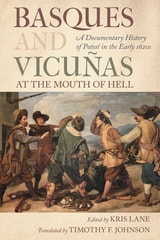
Basques and Vicuñas at the Mouth of Hell
A Documentary History of Potosí in the Early 1620sKris Lane
University of Nevada Press, 2024
As mines flooded and Indigenous workers died or fled, the city descended into a maelstrom of swordfights, gun battles, ambushes, sniper attacks, and summary executions. Though its roots were economic, the Basque-Vicuña conflict strained the sinews of Habsburg global governance even as it exposed festering local tensions, only some of which were unique to Potosí.
This rich collection of original sources, all of them archival documents housed in Bolivia, Spain, the United Kingdom, and the United States, consists of contemporary eyewitness accounts from several perspectives, allowing readers to play historian. All sources have been expertly translated and carefully annotated in a manner that will engage students and scholars alike. Basques and Vicuñas at the Mouth of Hell includes an extensive introduction, seven vital documents in translation, and appendices on everyday life in 1620s Potosí and on the historiography of this watershed episode of colonial violence.
Death, Judgement, Heaven, and Hell
Edward Condon
Catholic University of America Press, 2019
Eleven Days in Hell
The 1974 Carrasco Prison Siege at Huntsville, TexasWilliam T. Harper
University of North Texas Press, 2004
From the Ballroom to Hell
Grace and Folly in Nineteenth-Century DanceElizabeth Aldrich
Northwestern University Press, 1991
From the Ballroom to Hell collects over 100 little-known excerpts from dance, etiquette, beauty, and fashion manuals from the nineteenth century. Included are instructions for performing various dances, as well as musical scores, costume patterns, and the proper way to hold one's posture, fork, gloves, and fan. While of particular interest to dancers, dance historians, and choreographers, anyone fascinated by the ways and mores of the period will find From the Ballroom to Hell an endearing and informative glimpse of America's past.
Harlem Between Heaven And Hell
Monique M. Taylor
University of Minnesota Press, 2002
A hard-hitting look at race, class, and black gentrification in this emblematic community.
Harlem brings to mind a kaleidoscope of images-the jazz clubs and cultural ferment of the 1920s and 1930s, the urban decay of the 1960s and 1970s, and the revitalization of the past twenty years, with artists, writers, professionals, and even an ex-president moving to a community often seen as the capital of black America. Integral to the ongoing transformation of Harlem has been the return of the African-American middle class to what had become an overwhelmingly poor area. In this lively book, Monique M. Taylor explores the stresses created by this influx, the surprising ways class differences manifest themselves and are managed, and what we can learn from examining a community in which race and class are so closely intertwined.
Harlem between Heaven and Hell is told through a look at history, literature, redevelopment strategies, community activism, and extensive interviews with black professionals-married and single, with children and without, long-term residents and recent arrivals. In their voices we hear of the cultural legacy, political commitments, economic considerations, and desire for community that drew them to Harlem. They tell us of the complexities of gentrification and their own role in it: the trepidation and distrust that often greeted their arrival, the challenges of renovating Harlem’s historic brownstones in the face of entrenched neighborhood decay, learning and shaping the social mores of the area. Two key questions underlie these accounts: What does it mean when blacks move in alongside blacks of a different social class? How can a neighborhood successfully balance racial and class diversity in the face of rapid change? Taylor places this intraracial class conflict within the context of America’s changing race relations, showing how the feelings and issues that have arisen-to oppose, embrace, or participate in gentrification-reveal unsettled questions surrounding race, racism, class, and culture in a changing urban landscape. Through her incisive description of the everyday ways race and class are experienced, she has created a vivid exploration of black middle-class identity in the post-civil rights era.
Heaven, Hell, and Everything in Between
Murals of the Colonial AndesBy Ananda Cohen-Aponte
University of Texas Press, 2016
Examining the vivid, often apocalyptic church murals of Peru from the early colonial period through the nineteenth century, Heaven, Hell, and Everything in Between explores the sociopolitical situation represented by the artists who generated these murals for rural parishes. Arguing that the murals were embedded in complex networks of trade, commerce, and the exchange of ideas between the Andes and Europe, Ananda Cohen-Aponte also considers the ways in which artists and viewers worked through difficult questions of envisioning sacredness.
This study brings to light the fact that, unlike the murals of New Spain, the murals of the Andes possess few direct visual connections to a pre-Columbian painting tradition; the Incas’ preference for abstracted motifs created a problem for visually translating Catholic doctrine to indigenous congregations, as the Spaniards were unable to read Inca visual culture. Nevertheless, as Cohen Suarez demonstrates, colonial murals of the Andes can be seen as a reformulation of a long-standing artistic practice of adorning architectural spaces with images that command power and contemplation. Drawing on extensive secondary and archival sources, including account books from the churches, as well as on colonial Spanish texts, Cohen Suarez urges us to see the murals not merely as decoration or as tools of missionaries but as visual archives of the complex negotiations among empire, communities, and individuals.
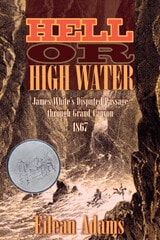
Hell Or High Water
James White's Disputed Passage through Grand Canyon, 1867Eilean Adams
Utah State University Press, 2001
Although John Wesley Powell and party are usually given credit for the first river descent through the Grand Canyon, the ghost of James White has haunted those claims. White was a Colorado prospector, who, almost two years before Powell's journey, washed up on a makeshift raft at Callville, Nevada. His claim to have entered the Colorado above the San Juan River with another man (soon drowned) as they fled from Indians was widely disseminated and believed for a time, but Powell and his successors on the river publically discounted it. Colorado River runners and historians have since debated whether White's passage through Grand Canyon even could have happened.
Hell or High Water is the first full account of White's story and how it became distorted and he disparaged over time. It is also a fascinating detective story, recounting how White's granddaughter, Eilean Adams, over decades and with the assistance of a couple of notable Colorado River historians who believed he could have done what he claimed, gradually uncovered the record of James White's adventure and put together a plausible narrative of how and why he ended up floating helplessly down a turbulent river, entrenched in massive cliffs, with nothing but a driftwood raft to carry him through.
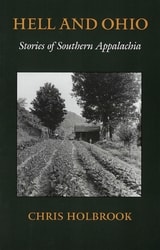
Hell and Ohio
Stories of Southern AppalachiaChris Holbrook
Ohio University Press, 1995
Originally published by Gnomon Press in 1995Hell and Ohio: Stories of Southern Appalachia brings together a powerful collection of stories that illuminate the complexities of contemporary Appalachian life. Drawing on the landscapes, communities, and traditions of eastern Kentucky and the greater Southern Appalachian region, Chris Holbrook crafts nuanced portraits of people negotiating family ties, economic hardship, migration, memory, and belonging. His characters confront loss, resilience, and change while remaining deeply rooted in the culture and terrain that shape their lives. Written with remarkable empathy and a keen ear for regional speech, these stories move beyond stereotypes to reveal the richness and contradictions of mountain communities. Holbrook's fiction explores the tensions between home and exile, tradition and modernity, and individual aspiration and communal identity, offering readers an intimate view of a region often misunderstood but rarely rendered with such authenticity. Praised by novelist Robert Morgan for capturing "the voices" and "living vivid details of contemporary life in the mountains," and described in Appalachian Journal as "beautifully crafted, nuanced, empathetic," Hell and Ohio stands as an important contribution to Appalachian literature and the modern American short story.
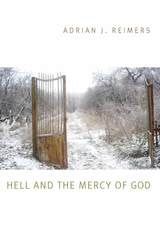
Hell and the Mercy of God
Adrian J. Reimers
Catholic University of America Press, 2017
Catholic philosopher Adrian Reimers takes on these challenges in Hell and the Mercy of God, drawing on relevant sources from Aristotle to Aquinas, from Dante to Tolkien, from Wagner to John Paul II, along with Billie Holliday, The Godfather, and the music of George Gershwin. He presents a philosophical theology, grounded in Scripture, of the nature of goodness and evil, exploring various types of pain, the seven capital sins, the resurrection of the body, the meaning of mammon, the core meaning of idolatry, the psychology of Satan and those who choose his path, and the moral responsibility of the human person.
These reflections illuminate the intelligibility of orthodox Catholic teachings on the goodness of God and the reality of hell. Hell is not an arbitrary imposition set up for human rule-breakers but a continuation of a freely chosen way of life manifest even in this world. Examples from history, art, and contemporary culture lead the author to conclude that anyone who does not believe in the reality of hell is not paying enough attention. And yet, mercy and hope remain triumphant, because, just as Christ offers entrance into paradise to the “good thief” Dismas on the cross, God continues to offer repentance and salvation to all who live.
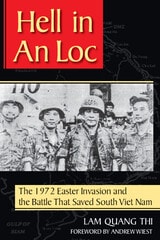
Hell in An Loc
The 1972 Easter Invasion and the Battle That Saved South Viet NamQuang Thi Lam
University of North Texas Press, 2009
Hell of a Vision
Regionalism and the Modern American WestRobert L. Dorman
University of Arizona Press, 2012
The American West has taken on a rich and evocative array of regional identities since the late nineteenth century. Wilderness wonderland, Hispanic borderland, homesteader’s frontier, cattle kingdom, urban dynamo, Native American homeland. Hell of a Vision explores the evolution of these diverse identities during the twentieth century, revealing how Western regionalism has been defined by generations of people seeking to understand the West’s vast landscapes and varied cultures.
Focusing on the American West from the 1890s up to the present, Dorman provides us with a wide-ranging view of the impact of regionalist ideas in pop culture and diverse fields such as geography, land-use planning, anthropology, journalism, and environmental policy-making.
Going well beyond the realm of literature, Dorman broadens the discussion by examining a unique mix of texts. He looks at major novelists such as Cather, Steinbeck, and Stegner, as well as leading Native American writers. But he also analyzes a variety of nonliterary sources in his book, such as government reports, planning documents, and environmental impact studies.
Hell of a Vision is a compelling journey through the modern history of the American West—a key region in the nation of regions known as the United States.

Hell of a Way to Make a Living
The Unvarnished Truth about What It's Like to Cover Major League BaseballPaul Hagen
Temple University Press, 2027
For 50 years, Paul Hagen lived the dream of being a beat writer covering the Dodgers, Rangers, and Phillies. But, as Hell of a Way to Make a Living demonstrates, the enviable job isn’t always as glamorous as it seems.
This insider’s account gives readers an all-access pass to the press box, clubhouse, and dugout to discover what the experience is really about. It’s both a clear-eyed dissection of the daily grind and a breezy, occasionally gossipy, account of being to paid to watch baseball games.
Hagen features entertaining and insightful anecdotes such as confirming to manager Terry Francona that the Phillies were going to fire him two weeks before it happened and building trust with players from the last man on the roster to future Hall of Famers like Mike Schmidt, Ferguson Jenkins, Billy Wagner, and Scott Rolen. He also addresses the changing media landscape, what’s on the record and off, the ethics of reporting on a team fairly, and how sports writing has changed over the decades.
Covering all the bases, Hell of a Way to Make a Living is an ode to the importance of conscientious beat writing and building trust with readers.

Marina Tsvetaeva
The Double Beat of Heaven and HellLily Feiler
Duke University Press, 1994
Born to a family of Russian intelligentsia in 1892 and coming of age in the crucible of revolution and war, Tsvetaeva has been seen as a victim of her politicized time, her life and her work marked by exile, neglect, and persecution. This book is the first to show us the poet as she discovered her life through art, shaped as much by inner demons as by the political forces and harsh realities of her day. With remarkable psychological and literary subtlety, Lily Feiler traces these demons through the tragic drama of Tsvetaeva’s life and poetry. Hers is a story full of contradictions, resisting social and literary conventions but enmeshed in the politics and poetry of her time. Feiler depicts the poet in her complex relation to her contemporaries—Pasternak, Rilke, Mayakovsky, Mandelstam, and Akhmatova. She shows us a woman embodying the values of nineteenth-century romanticism, yet radical in her poetry, supremely independent in her art, but desperate for appreciation and love, simultaneously mother and child in her complicated sexual relationships with men and women.
From prerevolutionary Russia to Red Moscow, from pre-World War II Berlin, Prague, and Paris to the Soviet Union under Stalin, Feiler follows the tortuous drama of Tsvetaeva’s life and work to its last tragic act, exposing at each turn the passions that molded some of this century’s most powerful poetry.

Microbes from Hell
Patrick Forterre
University of Chicago Press, 2016
In Microbes from Hell, one of the world’s leading experts on archaea and hyperthermophiles, or organisms that have evolved to flourish in extreme temperatures, offers a colorful, engaging account of this taxonomic upheaval. Blending tales of his own search for thermophiles with discussions of both the physiological challenges thermophiles face and the unique adaptations they have evolved to live in high-temperature environments, Forterre illuminates our developing understanding of the relationship between archaea and the rest of Earth’s organisms. From biotech applications to the latest discoveries in thermophile research, from microbiomes to the communities of organisms that dwell on deep-sea vents, Forterre’s exploration of life-forms that seem to thrive at the mouth of hell provides a glimpse into the early days of Earth, offering deep insight into what life may have looked like in the extreme environments of our planet’s dawn.

No Hope for Heaven, No Fear of Hell
The Stafford-Townsend Feud of Colorado County, Texas 1871-1911James Kearney
University of North Texas Press, 2016
Paradise
PoemsStephen Gibson
University of Arkansas Press, 2011
Ten Percent of Nothing
The Case of the Literary Agent from HellJim Fisher
Southern Illinois University Press, 2004
Former FBI agent Jim Fisher upends the genteel racket of fee-based literary agents and vanity publishers in this searing look at the rise and fall of one bogus entrepreneur who systematically swindled thousands of would-be writers out of millions of dollars with promises of having their work turned into salable books. In divulging the details of this colossal and shocking confidence game, Ten Percent of Nothing: The Case of the Literary Agent from Hell exposes a growing and serious crime against writers and a dark, ugly secret about the American publishing industry.
In 1989, Dorothy L. Deering, possessing a high school degree, a recent embezzlement conviction, and no experience as a professional writer, editor, or publisher, began operating a fee-based literary agency out of her garage in Nicholasville, Kentucky. Over the next ten years, she racked up a fortune in reading and marketing fees, learning the business of sham publishing as she went along. Later, as the owner of a vanity press, she bilked 1.5 million dollars out of her clients, masterfully manufacturing dreams of literary success until she was brought to justice by Fisher’s investigative journalism, an FBI probe, and the retaliation and testimonies of numerous victims.
Deering never sold a single manuscript to a major publisher. With the money in her pocket and her clients’ hopes and hard work wrapped up in fraudulent contracts, Deering produced a few copies of four cheaply printed, poorly edited paperbacks. These she used as bait to hoodwink more clients. She was abetted by her husband, Charles, a former car salesman; his son, Daniel, a drug user with a ninth-grade education; and her brother, Bill, a fugitive from the law at the time he headed her vanity press.
By successfully impersonating a literary agent for ten years, Deering operated one of the longest-running confidence games in American history. The financial loss for her clients was devastating, and the heartbreak was extreme. Drawing on victims’ experiences and documents recovered from the Deering venture, Fisher shows how Deering engineered and executed her scam, emphasizing the warning signs of sham agents, crook book doctors, and mendacious publishers.
Ten Percent of Nothing provides essential information for aspiring writers and publishing professionals. Fisher’s findings also prompt new inquiries into the potential licensing of literary agents and the prosecution of interstate scam artists. The volume’s gallery of illustrations includes reproductions of correspondence, newsletters, and advertisements used by the Deering operation.

The Devil’s Own Luck
From Hell to HappinessLadislav Grosman
Karolinum Press, 2026
Ladislav Grosman's powerful story of a twelve-year-old Jewish boy in wartime Slovakia smuggled into Hungary to escape deportation.
In The Devil's Own Luck, readers experience the horrors of war and the Holocaust through the lens of the young boy's obsessive reading of pulp fiction, imposing a layer of adventure on the bleak landscape of his experience. This simultaneously tragic, humorous, and poetic novel by Ladislav Grosman was published posthumously.
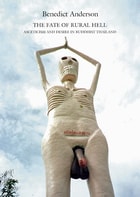
The Fate of Rural Hell
Asceticism and Desire in Buddhist ThailandBenedict Anderson
Seagull Books, 2012
The Marriage of Heaven and Hell
William Blake
Bodleian Library Publishing, 2011
This new facsimile edition of The Marriage of Heaven and Hell includes a plate-by-plate guide to the texts, interlinear figures, and larger designs in a commentary accompanying the transcript of each reproduced plate. Drawings from Blake’s manuscript notebook, which were used as a basis for the designs, as well as working proof impressions, are also included, demonstrating the evolution of the work. This edition also reproduces a single plate from each of the other eight surviving copies, revealing how over a period of more than thirty years Blake altered the way he finished each copy. An introduction explores the book's literary and historical background, Blake’s printing process, and the book's anonymous initial publication.
This expertly edited work is available for students and scholars in paperback and for collectors in a special hardcover edition. Both versions allow Blake’s vision to reassert its breathtaking power.
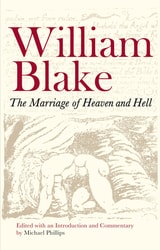
The Marriage of Heaven and Hell
William Blake
Bodleian Library Publishing, 2011
This new facsimile edition of The Marriage of Heaven and Hell includes a plate-by-plate guide to the texts, interlinear figures, and larger designs in a commentary accompanying the transcript of each reproduced plate. Drawings from Blake’s manuscript notebook, which were used as a basis for the designs, as well as working proof impressions, are also included, demonstrating the evolution of the work. This edition also reproduces a single plate from each of the other eight surviving copies, revealing how over a period of more than thirty years Blake altered the way he finished each copy. An introduction explores the book's literary and historical background, Blake’s printing process, and the book's anonymous initial publication.
This expertly edited work is available for students and scholars in paperback and for collectors in a special hardcover edition. Both versions allow Blake’s vision to reassert its breathtaking power.
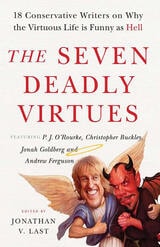
The Seven Deadly Virtues
18 Conservative Writers on Why the Virtuous Life is Funny as HellJonathan V. Last
Templeton Press, 2014
The book’s contributors include Sonny Bunch, Christopher Buckley, David “Iowahawk” Burge, Christopher Caldwell, Andrew Ferguson, Jonah Goldberg, Michael Graham, Mollie Hemingway, Rita Koganzon, Matt Labash, James Lileks, Rob Long, Larry Miller, P. J. O’Rourke, Joe Queenan, Christine Rosen, and Andrew Stiles. Jonathan V. Last, senior writer at the Weekly Standard, editor of the collection, is also a contributor. All eighteen essays in this book are appearing for the first time anywhere.
In the book’s opening essay, P. J. O’Rourke observes: “Virtue has by no means disappeared. It’s as much in public view as ever. But it’s been strung up by the heels. Virtue is upside down. Virtue is uncomfortable. Virtue looks ridiculous. All the change and the house keys are falling out of Virtue’s pants pockets.”
Here are the virtues everyone (including the book’s contributors) was taught in Sunday school but have totally forgotten about until this very moment. In this sanctimony-free zone:
• Joe Queenan observes: “In essence, thrift is a virtue that resembles being very good at Mahjong. You’ve heard about people who can do it, but you’ve never actually met any of them.”
• P. J. O’Rourke notes: “Fortitude is quaint. We praise the greatest generation for having it, but they had aluminum siding, church on Sunday, and jobs that required them to wear neckties or nylons (but never at the same time). We don’t want those either.”
• Christine Rosen writes: “A fellowship grounded in sociality means enjoying the company of those with whom you actually share physical space rather than those with whom you regularly and enthusiastically exchange cat videos.”
• Rob Long offers his version of modern day justice: if you sleep late on the weekend, you are forced to wait thirty minutes in line at Costco.
• Jonah Goldberg offers: “There was a time when this desire-to-do-good-in-all-things was considered the only kind of integrity: ‘Angels are better than mortals. They’re always certain about what is right because, by definition, they’re doing God’s will.’ Gabriel knew when it was okay to remove a mattress tag and Sandalphon always tipped the correct amount.”
• Sonny Bunch dissects forbearance, observing that the fictional Two Minutes Hate of George Orwell’s 1984 is now actually a reality directed at living, breathing people. Thanks, in part, to the Internet, “Its targets are designated by a spontaneously created mob—one that, due to its hive-mind nature—is virtually impossible to call off.”
By the time readers have completed The Seven Deadly Virtues, they won’t even realize that they’ve just been catechized into an entirely different—and better—moral universe.
The Way to Hell
Machiavelli for Catastrophic TimesNathan Crick
University of Alabama Press, 2024
An incisive and erudite survey of Machiavelli, the catastrophes of his times and ours, and his counsel for responding to an era of constant crises.
Catastrophe looms. Political, environmental, epidemic, and military crises arrive with increasing frequency. In The Way to Hell, Nathan Crick argues that our perilous times call for the strongest medicine in the Western canon: Machiavelli. Crick reminds contemporary readers about the Florentine master’s advice—that one must learn the road to Hell precisely to avoid taking it.
Like a knowledgeable friend, Crick offers contemporary readers a guide to Machiavelli’s world, work, and warnings. He takes in the sweep of Western history, comparing Machiavelli’s work with ancient sources such as Cicero and Thucydides. And as Machiavelli has never stopped provoking comment, Crick treats readers to a feast of responses to Machiavelli’s work—caustic, learned, and humorous—in the five centuries since he lived.
Including both Machiavelli’s best-known works, The Prince and Discourses on Livy, as well as his personal correspondence and comic plays, Crick asks anew the questions that bedeviled Machiavelli’s beloved Florentine republic: When is force necessary? When are lies justified? Is cruelty defensible? When does social protest slip into violent revolution? What is the correct response to catastrophe?
Like Machiavelli himself, The Way to Hell is witty, stimulating, and challenging. In a world seemingly on the road to Hell, Machiavelli offers an alternative route. His bracing vision exhorts readers to see the dangers in their path and to take action with vigor and determination. Far from a vision of cynicism, Machiavelli offers a beacon of hope for a world that seems on the brink.
Tourist in Hell
Eleanor Wilner
University of Chicago Press, 2010
Eleanor Wilner’s poems attempt to absorb the shock of the wars and atrocities of the twentieth and early twenty-first centuries. In their litany of loss, in their outrage and sorrow, they retain the joy in life, mercy for the mortal condition, and praise for the plenitude of nature and the gifts of human artistry.
As with her six earlier collections, these poems are drawn from the transpersonal realm of history and cultural memory, but they display an increasing horror at the bloody repetitions of history, its service of death, and the destructive savagery of power separated from intelligence and restraint. The poems describe “a sordid drama” in which the players wear “eyeless masks,” and the only thing time changes is the name of the enemy. Underneath it all, driving “the art that” in both senses “keeps nothing at bay,” swim the enormous formal energies of life, the transitive figure that moves on in the depths, something glimpsed in the first light, something stronger than hope.
“It is a relief to come across work in which a moral intelligence is matched by aesthetic refinement, in which the craft of the poems is equal to their concerns.”--Christian Wiman, Poetry