Results by title
9 books match the query 'Quest'
Becoming a Social Science Researcher
Quest and ContextBruce Parrott
University of Michigan Press, 2023
Becoming a Social Science Researcher is designed to help aspiring social scientists, including credentialed scholars, understand the formidable complexities of the research process. Instead of explaining specific research techniques, it concentrates on the philosophical, sociological, and psychological dimensions of social research. These dimensions have received little coverage in guides written for social science researchers, but they are arguably even more important than particular analytical techniques. Truly sophisticated social science scholarship requires that the researcher understand the intellectual and social contexts in which they collect and interpret information. While social science training in US graduate schools has become more systematic over the past two decades with numerous publications aimed at instruction, training and guidance still fall short in addressing the fundamental needs of this field.
Beginning the Quest
Law and Politics in the Early Work of Eric VoegelinBarry Cooper
University of Missouri Press, 2009
Everybody's History
Indiana's Lincoln Inquiry and the Quest to Reclaim a President's PastKeith A. Erekson
University of Massachusetts Press, 2012
Revered by the public, respected by scholars, and imitated by politicians, Abraham Lincoln remains influential more than two hundred years after his birth. His memory has inspired books, monuments, and museums and also sparked controversies, rivalries, and forgeries. That so many people have been interested in Lincoln for so long makes him an ideal subject for exploring why history matters to ordinary Americans as well as to academic specialists.
In Everybody's History, Keith A. Erekson focuses on the Southwestern Indiana Historical Society—an organization composed of lawyers, historians, collectors, genealogists, teachers, college presidents, and newspaper editors—who joined together during the 1920s and 1930s to recover a part of Lincoln's life his biographers had long ignored: the years from age seven to twenty-one when he lived on the Indiana frontier. Participants in the “Lincoln Inquiry,” as it was commonly known, researched old records, interviewed aging witnesses, hosted pageants, built a historical village, and presented their findings in public and in print. Along the way they defended their methods and findings against competitors in the fields of public history and civic commemoration, and rescued some of Indiana's own history by correcting a forgotten chapter of Lincoln's.
Everybody's History traces the development of popular interest in Lincoln to uncover the story of an extensive network of nonprofessional historians who contested old authorities and advanced new interpretations. In so doing, the book invites all who are interested in the past to see history as both vital to public life and meaningful to everybody.
In Quest of Great Lakes Ice Age Vertebrates
J. Alan Holman
Michigan State University Press, 2001
The first book of its kind, In Quest of Great Lakes Ice Age Vertebrates details the Ice Age fishes, amphibians, reptiles, birds and mammals in the provinces and states surrounding the Great Lakes. Holman's work begins with definitions of concepts and terms for the general audience and a general discussion of how the last ice age, the Pleistocene Epoch, affected our physical and biological world. Methods employed and tools used in the collection of vertebrate fossils, as well as ethics and protocol in the maintenance of a useful collection follow, coupled with details of each animal's structure, habits, habitats, and ecological importance. The heart of the book is a species-by-species account of the Pleistocene vertebrates of the region, followed by an examination of the compelling problems of the Pleistocene relative to faunal interpretations, including overall ecological makeup of the region's fauna, vertebrate range adjustment that occurred in the region, Pleistocene extinction effects on the animals of the region, the aftermath of the Ice Age, and a look at what the future may hold for the region.

In Quest of History
On Czech Statehood and IdentityJirí Pribán and Karel Hvíždala
Karolinum Press, 2019
In Quest of the Ordinary
Lines of Skepticism and RomanticismStanley Cavell
University of Chicago Press, 1988
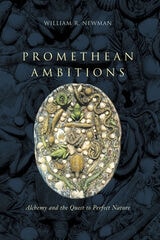
Promethean Ambitions
Alchemy and the Quest to Perfect NatureWilliam R. Newman
University of Chicago Press, 2004
In Promethean Ambitions, William R. Newman ambitiously uses alchemy to investigate the thinning boundary between the natural and the artificial. Focusing primarily on the period between 1200 and 1700, Newman examines the labors of pioneering alchemists and the impassioned—and often negative—responses to their efforts. By the thirteenth century, Newman argues, alchemy had become a benchmark for determining the abilities of both men and demons, representing the epitome of creative power in the natural world. Newman frames the art-nature debate by contrasting the supposed transmutational power of alchemy with the merely representational abilities of the pictorial and plastic arts—a dispute which found artists such as Leonardo da Vinci and Bernard Palissy attacking alchemy as an irreligious fraud. The later assertion by the Paracelsian school that one could make an artificial human being—the homunculus—led to further disparagement of alchemy, but as Newman shows, the immense power over nature promised by the field contributed directly to the technological apologetics of Francis Bacon and his followers. By the mid-seventeenth century, the famous "father of modern chemistry," Robert Boyle, was employing the arguments of medieval alchemists to support the identity of naturally occurring substances with those manufactured by "chymical" means.
In using history to highlight the art-nature debate, Newman here shows that alchemy was not an unformed and capricious precursor to chemistry; it was an art founded on coherent philosophical and empirical principles, with vocal supporters and even louder critics, that attracted individuals of first-rate intellect. The historical relationship that Newman charts between human creation and nature has innumerable implications today, and he ably links contemporary issues to alchemical debates on the natural versus the artificial.
The Quest
History and Meaning in ReligionMircea Eliade
University of Chicago Press, 1969
"Each of these essays contains insights which will be fruitful and challenging for professional students of religion, but at the same time they all retain the kind of cultural relevance and clarity of style which makes them accessible to anyone seriously concerned with man and his religious possibilities."—Joseph M. Kitagawa, Religious Education

The Search for Society
Quest for a Biosocial Science and MoralityFox, Robin
Rutgers University Press, 1989